
Law of Demand - Why Price Matters
Quality reviewed September 2026
- Grades
- Grades 9-12
- Time
- About two 50-minute class periods
- Includes
- 11 ready-to-teach files
- Format
- Word (.docx) · PowerPoint (.pptx)
- Slide deck
- Guided notes
- Guided notes teacher key
- Activity + answer key
- Quiz + answer key
- Exit ticket + answer key
- Teacher guide
- Teacher presentation notes
What students do
- Read the movie-ticket demand curve and demand schedule to predict quantity demanded at a new price
- Distinguish a movement along the demand curve from a shift in the whole curve
- Explain a personal purchase decision using either the substitution effect or the income effect
- Apply ceteris paribus to isolate why price alone changes quantity demanded
What it covers
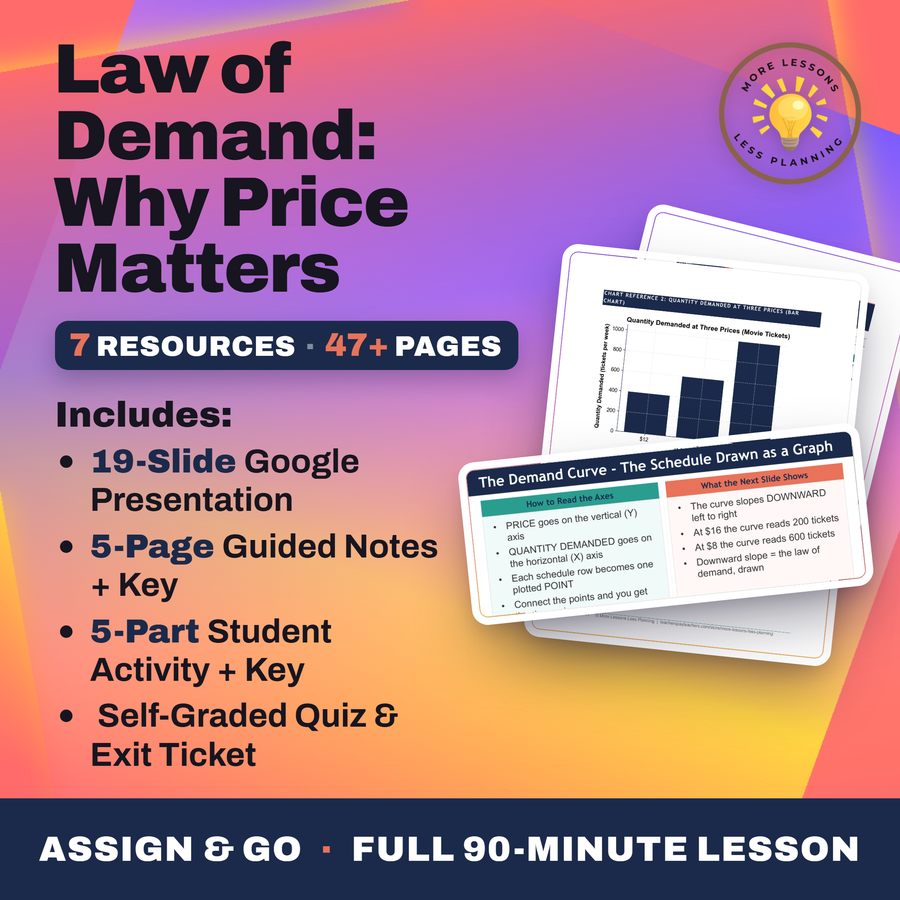
- The law of demand, as price rises, quantity demanded falls, all else equal
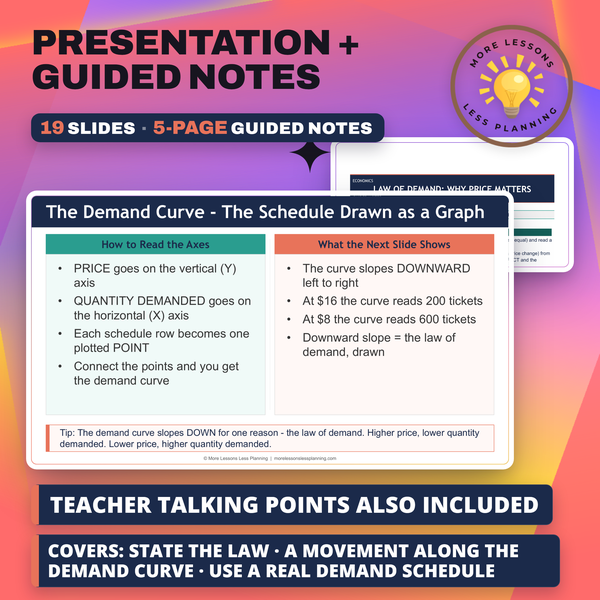
- How a demand schedule becomes a demand curve, using the movie-ticket example
- The two reasons the law holds, the substitution effect and the income effect
- Why ceteris paribus matters for isolating price as the one variable in motion
Learning targets
- State the LAW OF DEMAND (price up = quantity demanded down, all else equal) and read a downward-sloping demand curve and the demand schedule behind it
- Distinguish a MOVEMENT ALONG the demand curve (caused only by a price change) from the two reasons price drives quantity demanded - the SUBSTITUTION EFFECT and the INCOME EFFECT
- Use a real demand schedule and demand curve to predict how quantity demanded changes when price changes, and explain WHY price is the key variable held in focus by ceteris paribus
Peek inside
The Rule in One Sentence
When price goes UP, quantity demanded goes .
When price goes DOWN, quantity demanded goes .
Price and quantity demanded move in directions.
Opposite directions = an relationship.
You Already Live This
1. Maya opens with the rule every market obeys. All else equal, when a good gets more expensive buyers purchase less of it, and when it gets cheaper they purchase more - economists call this the .
Why this matters
A movie ticket that jumps in price is a decision every student has actually made: skip it, wait for streaming, or go anyway. This lesson's curve shows the resulting drop in ticket sales is not one reaction but two, the substitution effect and the income effect.
Students conflate the two constantly, treating "found something cheaper" and "can't afford both" as the same reaction. The exit ticket forces a real purchase into one bucket with no hedging, and once they can also separate a movement along the curve from a shift, a lot clears up.
From one teacher to another
I want students able to redraw the movie-ticket demand curve from memory, because once they can read price off the vertical axis and quantity off the horizontal, half of economics starts making sense. I split the substitution effect from the income effect on purpose since students conflate them constantly, and the exit ticket won't let them off the hook: they have to pick a real purchase and name which one explains their own behavior. This is a graph-reading lesson first and a vocabulary lesson second.
Every file in this toolkit
-
Activity (Student)
Maya Chen is pricing movie tickets at Starline Cinemas, so you read her demand curve and bar chart to fill in quantities at four price points, sort four scenarios into substitution or income effect, then write her a pricing memo predicting next month's ticket sales.
-
Activity (Answer Key)
Both demand charts get matched point for point at $16, $12, $8, and $4, then all four real-market scenarios get sorted correctly between substitution and income effects. The memo names a specific ticket price for next month's sales.
-
Exit Ticket (Student)
The three items predict what happens to quantity demanded when concert tickets jump from $50 to $90, name the effect behind switching to home coffee after a price hike, and identify what a drop in a good's own price does to the demand curve. A personal purchase gets tied to one named effect.
-
Exit Ticket (Answer Key)
A fall in quantity demanded follows the $50-to-$90 jump, the substitution effect explains the home-coffee switch, and a slide along that same curve is what an own-price drop produces. Full credit needs both the substitution and income effects explained correctly.
-
Guided Notes (Student)
Movie ticket prices from $16 down to $4 get plotted on a demand schedule as students watch quantity demanded climb from 200 to 1,000 tickets, then sort that climb into two forces, income and substitution. A final section has them separate a slide along one curve from a shift into a new one.
-
Guided Notes (Teacher Key)
Every plotted point on the movie-ticket schedule stands answered, $16 for 200 tickets down to $4 for 1,000, next to full wording for the income effect and its substitution-effect partner. A slide along one fixed curve versus a shift into a new one is explained for grading.
-
Quiz (Student)
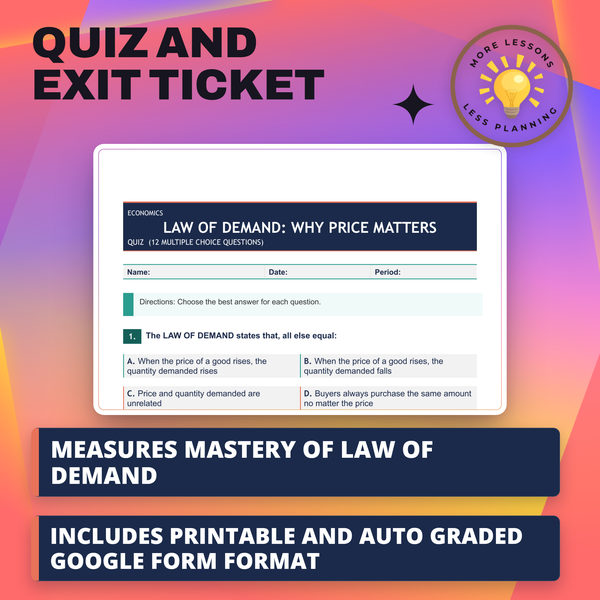
A movie-ticket schedule drops the price from $16 to $4 and asks what happens to quantity demanded, plus a beef-to-chicken scenario testing which named effect explains the switch.
-
Quiz (Answer Key)
That $16-to-$4 movie ticket price drop pushes quantity demanded up to 1,000 tickets, the beef-to-chicken switch gets pinned on the substitution effect, and a demand curve always slopes downward left to right.
-
Slides
The substitution and income effects each earn a separate slide after the movie-ticket curve, 200 tickets sold at $16 against 600 at $8, and a bar chart at $12, $8, and $4 repeats the same slope before ceteris paribus holds every other variable still.
-
Teacher Guide
Luxury handbags and concert tickets that seem to sell better at a higher price anchor one debate question, testing whether ceteris paribus actually broke down. An extension has students sketch their own demand schedule for a good they buy regularly.
-
Teacher Presentation Notes
A pizza place doubling its price becomes the substitution effect prompt on one card, right before the next card turns to real income shrinking as that same price climb explains the income effect instead.
Download
Where should I send the next one?
Everything here is free and it stays that way. Leave your email and I'll send you the new lessons as they go up. You can unsubscribe from any one of them.
Related resources
Law of Supply: The Producer Side
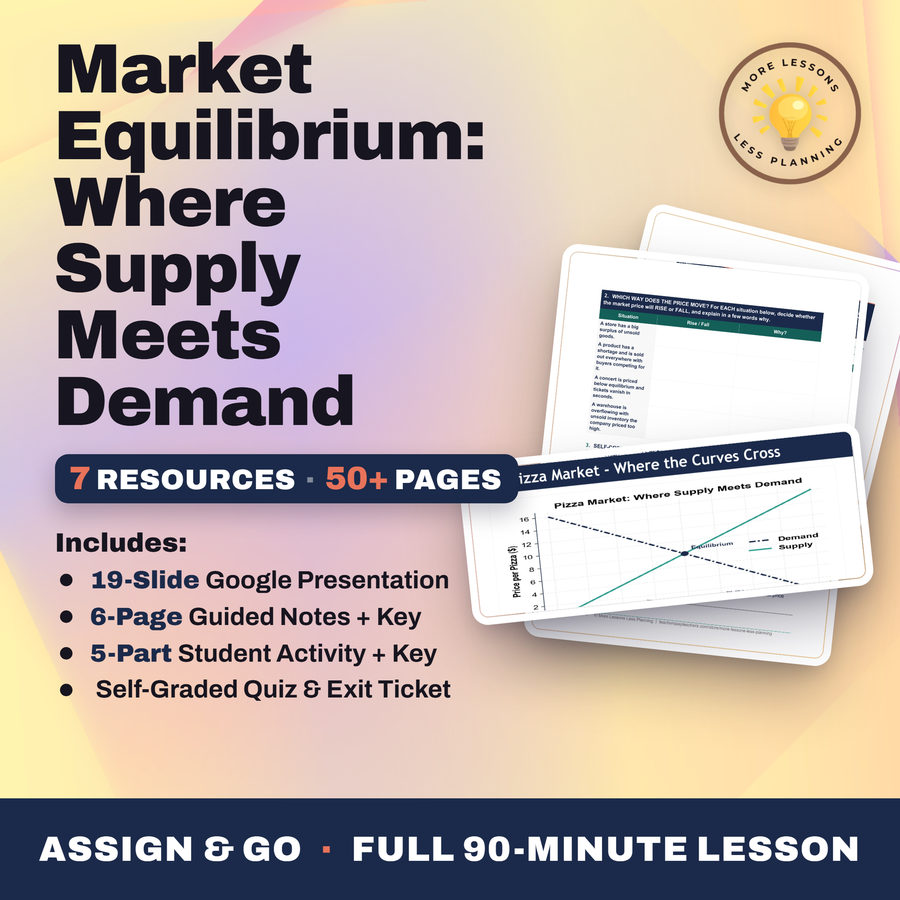
Market Equilibrium: Where Supply Meets Demand
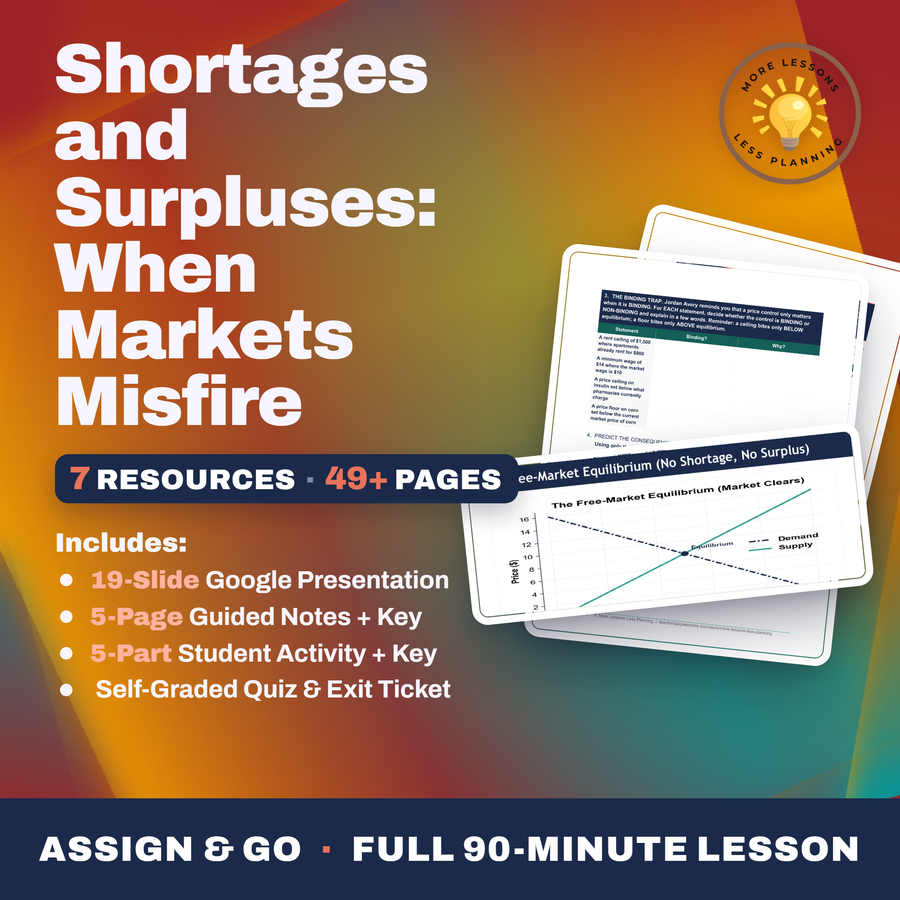
Shortages and Surpluses
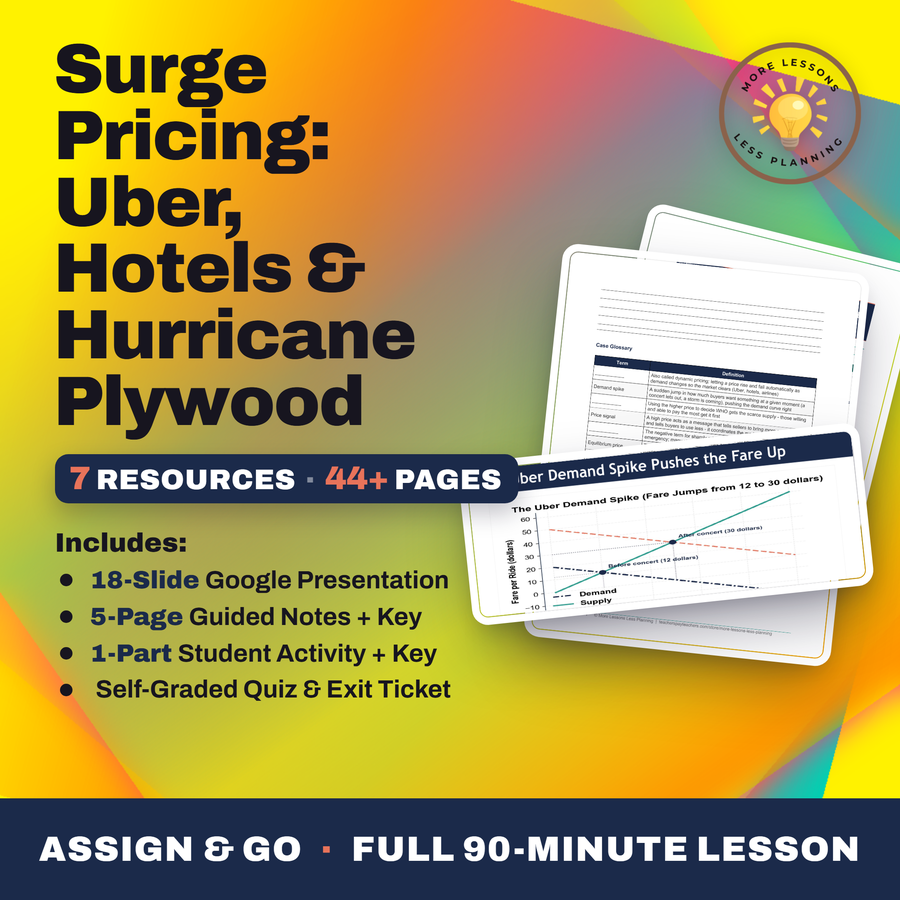
Surge Pricing: Uber, Hotels & Hurricane Plywood
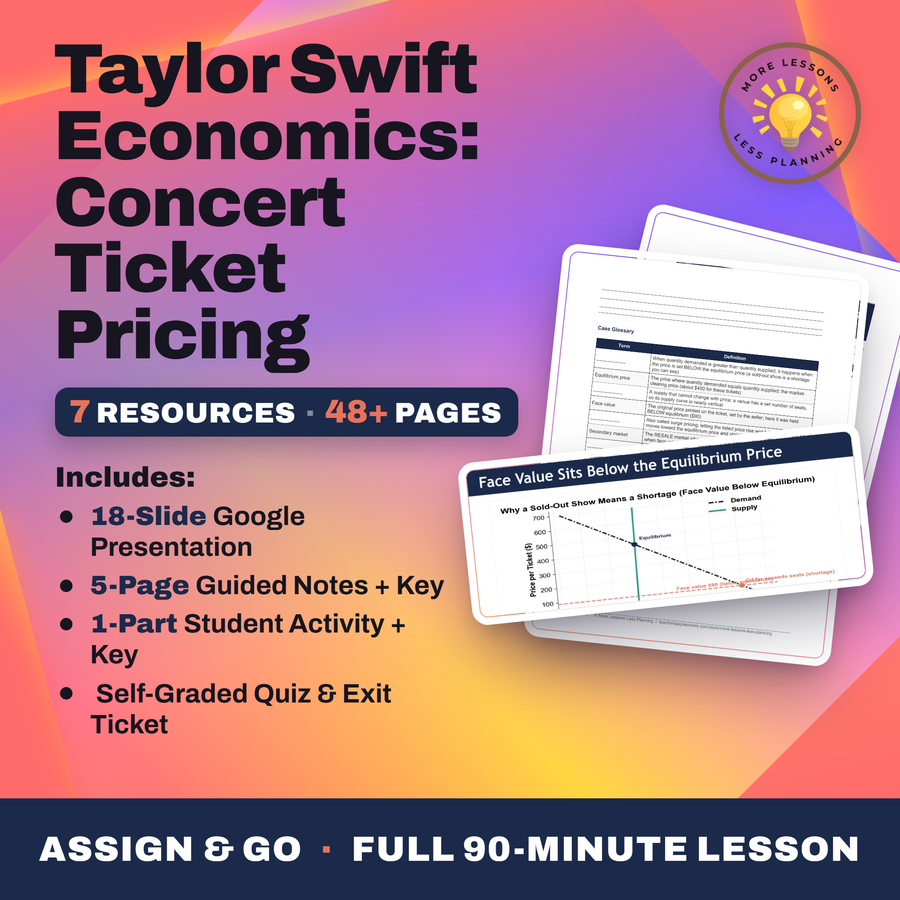
Taylor Swift Economics - Concert Ticket Pricing
Amazon Warehouses: Working Conditions Investigation
Every lesson on this site is free to download and use. If one of them saved you a prep period, you can chip in a few bucks toward my three kids' daycare fund. That's genuinely where tips go.