Market Equilibrium: Where Supply Meets Demand
Quality reviewed September 2026
- Grades
- Grades 9-12
- Time
- About two 50-minute class periods
- Includes
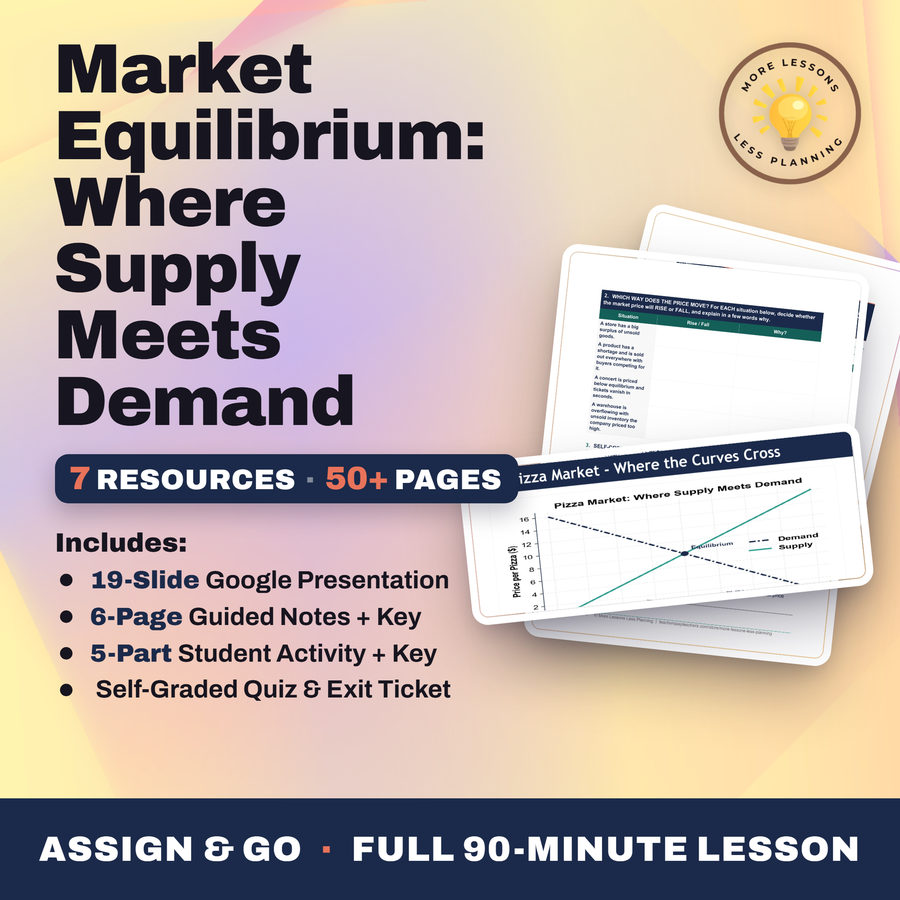
- 11 ready-to-teach files
- Format
- Word (.docx) · PowerPoint (.pptx)
- Slide deck
- Guided notes
- Guided notes teacher key
- Activity + answer key
- Quiz + answer key
- Exit ticket + answer key
- Teacher guide
- Teacher presentation notes
What students do
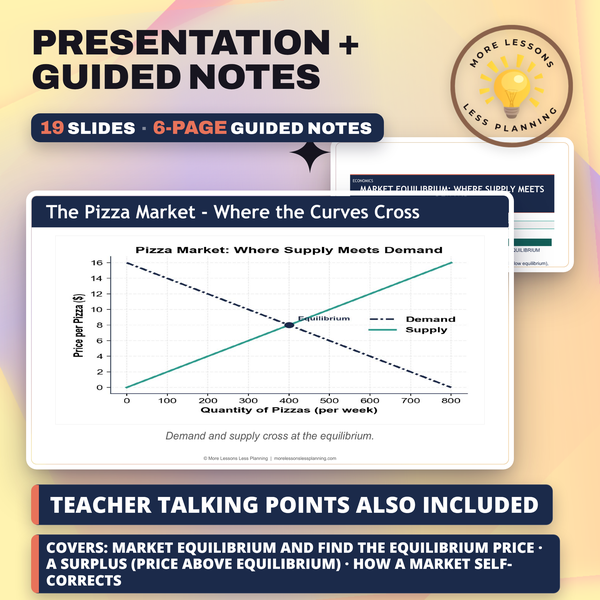
- Locate the equilibrium price and quantity where the demand and supply curves cross for Bella's Pizza Kitchen
- Diagnose a surplus versus a shortage from three price points on the same supply-and-demand chart
- Calculate the size of a surplus or shortage by subtracting quantity demanded from quantity supplied, or the reverse
- Explain how a market self-corrects, tracing why a surplus pushes the price down and a shortage pushes it up
What it covers
- How the demand curve built in one lesson and the supply curve built in another cross to set a single market price
- What a surplus looks like when the price sits above equilibrium, and what a shortage looks like when it sits below
- Why an unregulated price does not stay away from equilibrium for long
Learning targets
- Define MARKET EQUILIBRIUM and find the EQUILIBRIUM PRICE and EQUILIBRIUM QUANTITY where the demand and supply curves cross
- Identify a SURPLUS (price above equilibrium) and a SHORTAGE (price below equilibrium), and read each one off a supply-and-demand chart
- Explain HOW a market self-corrects - a surplus pushes the price DOWN and a shortage pushes the price UP, back toward equilibrium
Peek inside
The Idea in One Sentence
Demand = buyers; Supply = producers
Put both curves on ONE chart
They cross at exactly ONE point
That crossing point is EQUILIBRIUM
The Idea in One Sentence
DEMAND is the buyers; SUPPLY is the .
Put both curves on ONE chart and they cross at exactly point.
That single crossing point is called the market .
Why It Matters
At equilibrium, quantity demanded EQUALS quantity .
Why this matters
Two lessons of curve-drawing pay off here, when Bella's Pizza Kitchen's demand and supply curves finally land on one chart and cross. Reading three price points off that chart shows a surplus, a shortage, and equilibrium were never separate ideas, just three readings of the same picture.
What I want every student explaining by the end is why an off-equilibrium price does not just sit there: a surplus pushes price down because unsold pizza costs Bella money, a shortage pushes it up because unmet demand is money left on the table.
From one teacher to another
Demand and supply groundwork from the last two units finally pays off here, once both curves land on the same chart for the first time. Students spend most of the activity reading three price points off the same pizza market, so the surplus, the shortage, and the equilibrium all end up as readings of one picture instead of separate ideas. It's the self-correction piece, that a surplus pushes price down and a shortage pushes it up, that I most want them to explain out loud by the end.
Every file in this toolkit
-
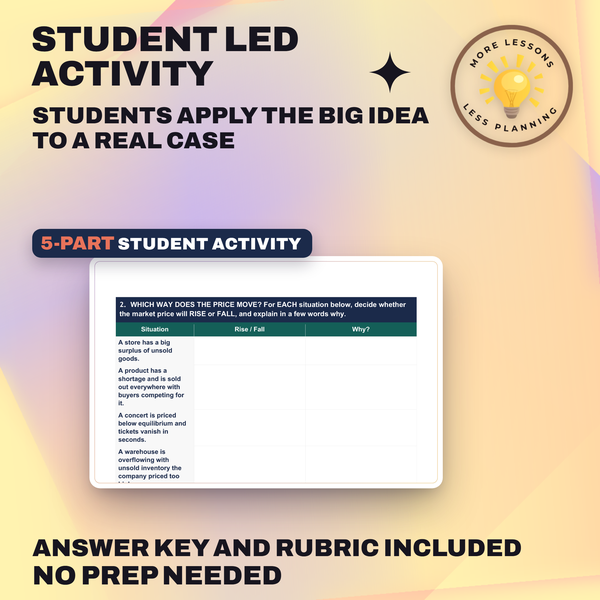
Activity (Student)
Jordan Avery has students find where Bella's Pizza Kitchen's curves cross, then read three price points to diagnose a surplus at $12 and a shortage at $4. They calculate the size of each gap before writing a pricing recommendation memo.
-
Activity (Answer Key)
Two mismatches get the full worked math in the key: 600 pizzas supplied against 200 wanted at the $12 price, and 600 wanted against only 200 baked at $4. Both correct back to the $8 equilibrium of 400 pizzas a week.
-
Exit Ticket (Student)
Multiple-choice items predict the result of pricing concert tickets below equilibrium, ask what a store does after pricing a jacket above equilibrium with racks left unsold, and define what quantity demanded equals at equilibrium. A real surplus or shortage gets applied to one price-direction fix.
-
Exit Ticket (Answer Key)
A shortage follows tickets priced below equilibrium, lowering the price toward equilibrium answers the unsold-jacket case, and quantity supplied equaling quantity demanded defines equilibrium itself. Full credit needs both a surplus and a shortage explained correctly.
-
Guided Notes (Student)
Three pizza prices, $12, $8, and $4, get diagnosed as a surplus, an equilibrium, or a shortage, and students size each gap exactly before working out why price settles at $8. A four-step chain explains the self-correction each time.
-
Guided Notes (Teacher Key)
600 supplied against 200 demanded at $12 for a surplus of 400, and 600 demanded against 200 supplied at $4 for a shortage of 400, both sit worked out on the pizza table. All nine vocabulary terms, from equilibrium price to self-correcting market, come with their answers ready.
-
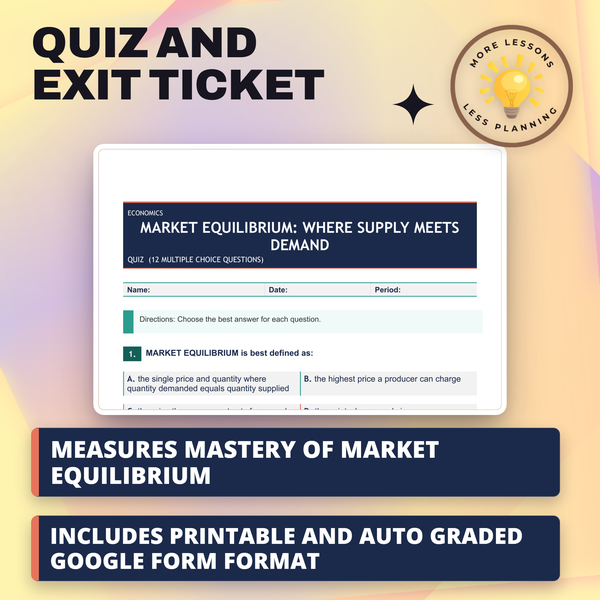
Quiz (Student)
Reading Bella's supply-and-demand graph, items ask students to find where the curves cross for price and quantity, then work out a surplus at $12 and a shortage at $4 a pizza.
-
Quiz (Answer Key)
Bella's graph settles at an equilibrium of $8 for 400 pizzas, the $12 and $4 prices create a surplus and a shortage measured against that same 400, and economists call the settling point the market-clearing price.
-
Slides
Bella's Pizza Kitchen sets equilibrium at $8 for 400 pizzas a week, then two follow-on charts push price to $12 for a 400-pizza surplus and down to $4 for the same size shortage.
-
Teacher Guide
One extension has each student set a price for a product they know, a sneaker or a concert ticket, then describe the surplus or shortage that price creates. A second challenge reuses the same $12, $8, and $4 pizza table, asking for one justified number.
-
Teacher Presentation Notes
A pizza kitchen stuck with 400 unsold pizzas at $12 gets scripted as the surplus card, right before a sold out by lunch line at $4 flips the same chart into the shortage half.
Download
Where should I send the next one?
Everything here is free and it stays that way. Leave your email and I'll send you the new lessons as they go up. You can unsubscribe from any one of them.
Related resources
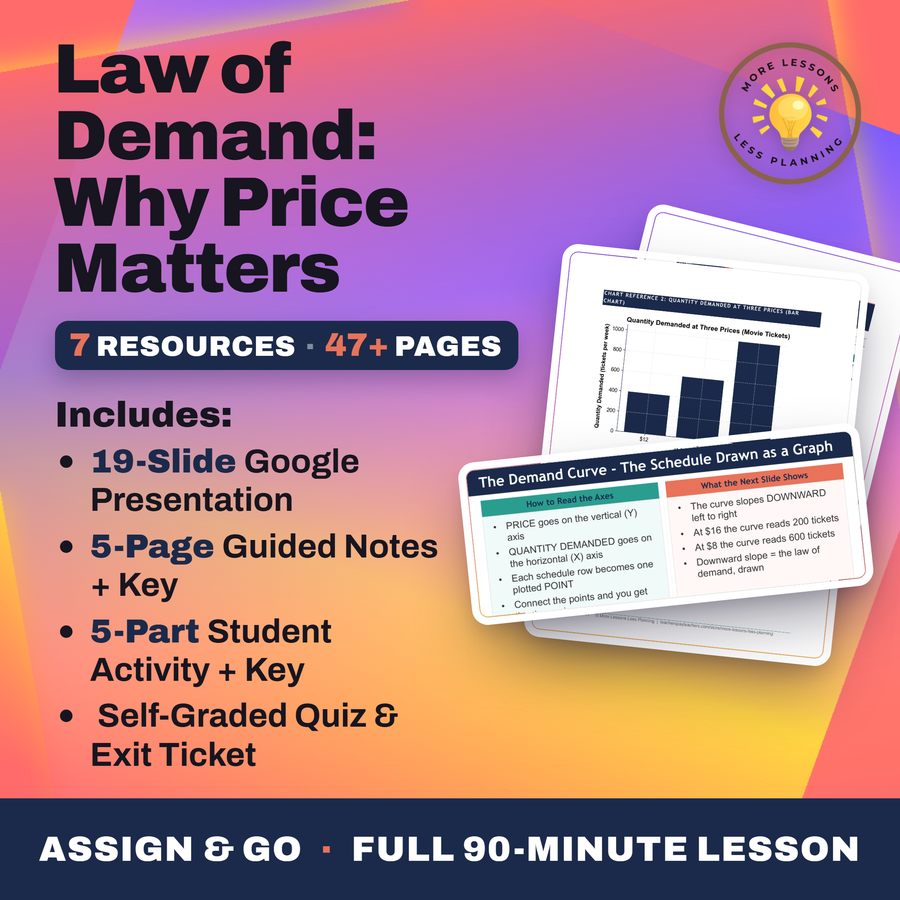
Law of Demand - Why Price Matters
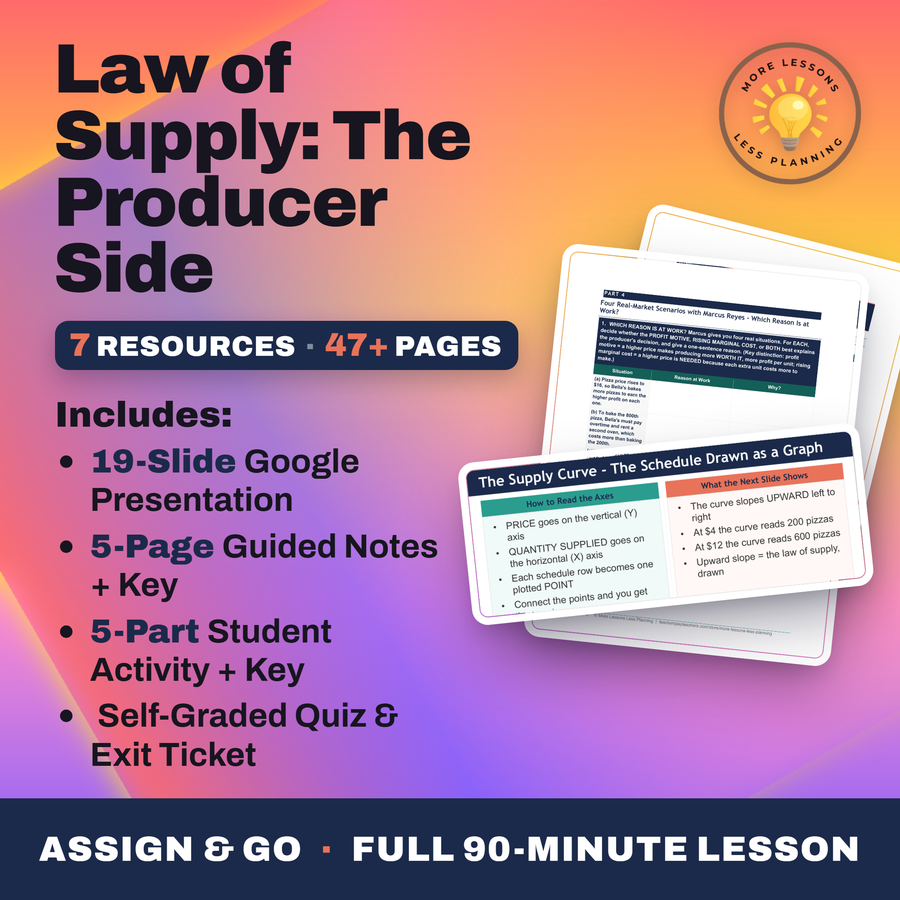
Law of Supply: The Producer Side
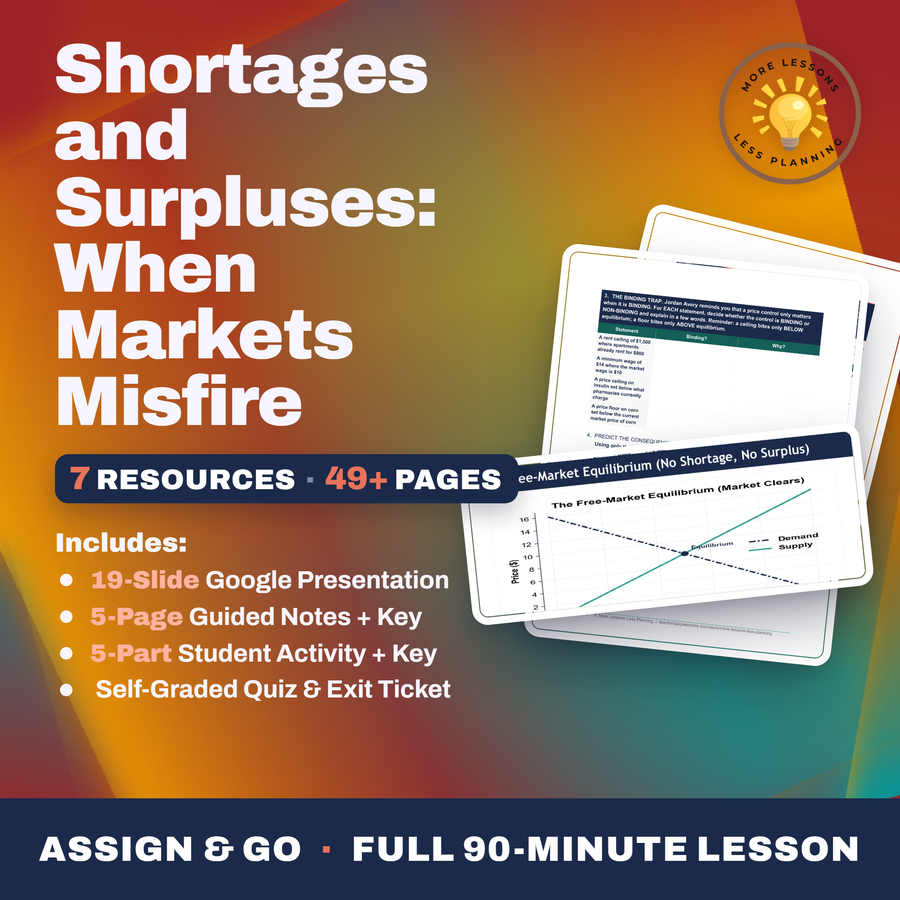
Shortages and Surpluses
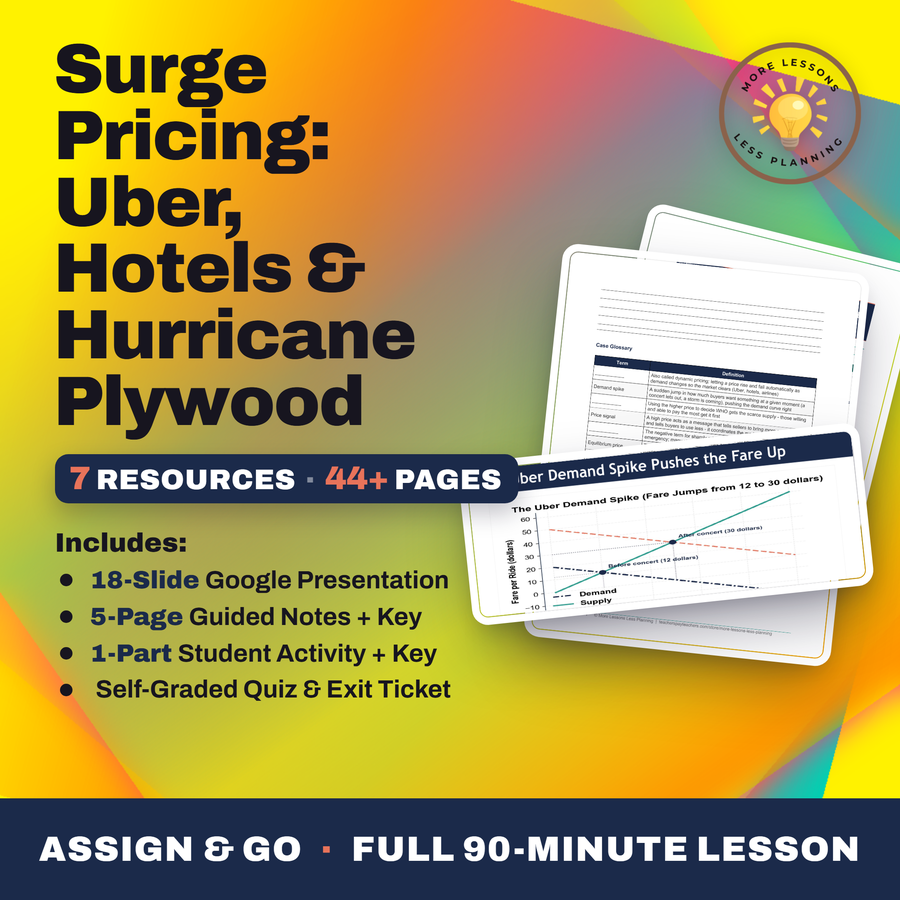
Surge Pricing: Uber, Hotels & Hurricane Plywood
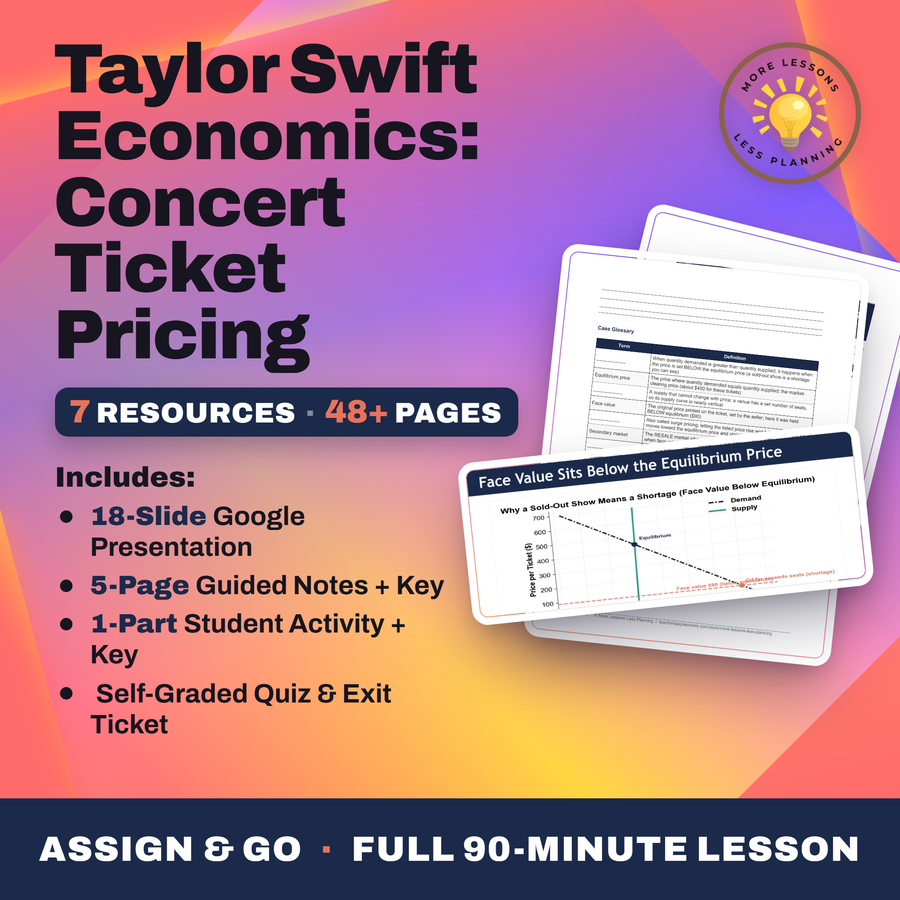
Taylor Swift Economics - Concert Ticket Pricing
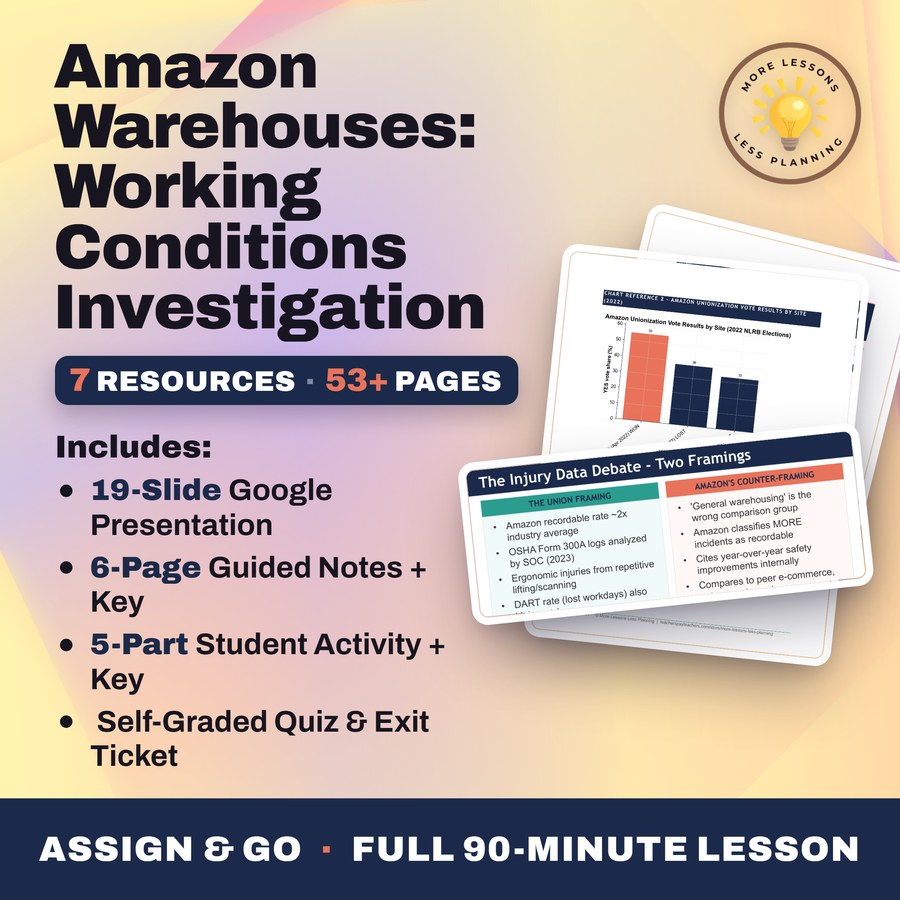
Amazon Warehouses: Working Conditions Investigation
Every lesson on this site is free to download and use. If one of them saved you a prep period, you can chip in a few bucks toward my three kids' daycare fund. That's genuinely where tips go.