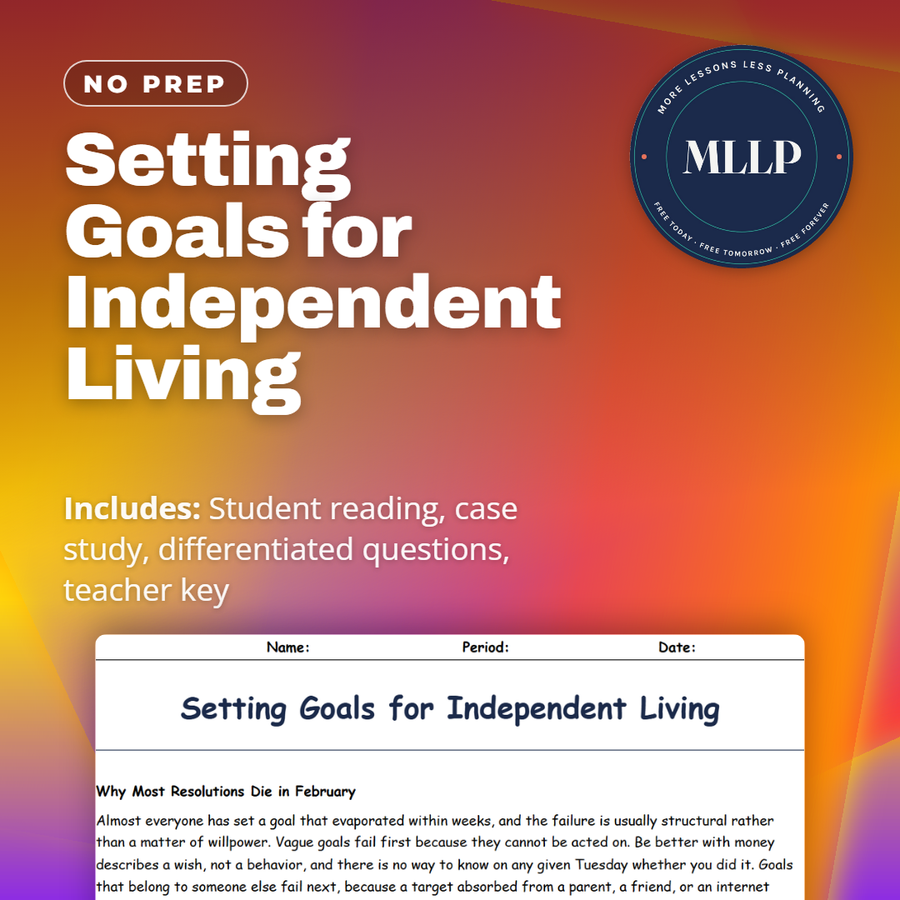
Setting Goals for Independent Living
Quality reviewed September 2026
Facts verified September 23, 2026
- Subject
- Career & Life Skills
- Grades
- Grades 9-12
- Length
- 9-page student worksheet
- Time
- About one 50-minute class period
- Great for
- Sub plans and independent work
- Includes
- Reading passage, comprehension questions + full answer key
- Format
- Print-and-go PDF
What students do
- Elena's sticky note goal, rewritten after a summer of feeling behind, drives both case study questions
- Sort five terms, from SMART goal to take home pay, into their correct definitions
- The independent living order, income before budget before emergency fund before credit, gets laid out step by step
- Answer three short answer questions on goal altitude, credit timing, and adjusting a plan without quitting
What it covers
- The SMART framework and why relevance is the element most often skipped
- Short, medium, and long term goals sorted across six independent living domains
- The order independent living actually happens in, from income to retirement saving
Start reading this worksheet
Why Most Resolutions Die in February
Almost everyone has set a goal that evaporated within weeks, and the failure is usually structural rather than a matter of willpower. Vague goals fail first because they cannot be acted on. Be better with money describes a wish, not a behavior, and there is no way to know on any given Tuesday whether you did it. Goals that belong to someone else fail next, because a target absorbed from a parent, a friend, or an internet video does not survive the first inconvenient morning. Goals with no deadline fail quietly, since anything that can be started tomorrow forever will be. Goals that require perfection fail on the first missed day, because a person who defines success as an unbroken streak treats one lapse as proof the whole project is over. The most common structural failure is the goal set at the wrong altitude. Save fifteen thousand dollars is not a goal a person can act on this week, and setting only that produces a year of feeling behind. The alternative is not to lower ambition. It is to build a chain, where the large target is broken into a yearly amount, a monthly amount, and a specific action taken on a specific day. Research on goal setting has consistently found that specific and challenging goals produce better performance than vague encouragement to do your best, provided the person is committed and receives feedback on progress.
Writing a Goal That Survives Contact
The most widely taught fix is the SMART framework, which requires a goal to be specific, measurable, achievable, relevant, and time bound. Specific means naming exactly what will happen, so save money becomes deposit two hundred dollars into a separate savings account. Measurable means a number exists that settles whether it happened. Achievable means the target is genuinely reachable given actual income, time, and obligations, since an impossible goal is abandoned rather than pursued. Relevant means it connects to something the person actually values, which is the step most often skipped and the one that determines survival. Time bound means a deadline exists. Applied to a first apartment, be ready to move out becomes save twenty one hundred sixty dollars for move in costs by depositing one hundred eighty dollars on the first of each month for twelve months. That version can be checked, adjusted, and either met or missed honestly. Two additions make it stronger. Implementation intentions, meaning a written plan in the form of when this happens, I will do that, substantially improve follow through by deciding in advance rather than in the moment. Naming obstacles before starting works the same way, since the person who has already decided what to do when a friend suggests an expensive weekend is not making that decision under social pressure with no plan.
Sorting Goals by Distance and Domain
Goals are usually organized by time horizon, and the sorting matters because different horizons require different tools. Short term goals take under a year and respond well to habit and routine, such as building a three hundred dollar starter emergency fund or completing a food handler certification. Medium term goals run one to five years, need milestones to stay alive, and include things like completing a credential, buying a reliable used car, or saving a full emergency fund. Long term goals run beyond five years, are the ones most vulnerable to drift, and include homeownership, retirement saving, and career advancement. The key relationship is that short term goals should be the visible steps of the longer ones. A short term goal that contradicts a long term goal is how people stay busy while going nowhere. Domains matter as much as horizons, and a plan covering only money is not an independent living plan. Financial goals cover emergency savings, debt, and credit. Career goals cover credentials, experience, and advancement. Housing goals cover the move out sequence. Health goals cover insurance, a primary care provider, and routine care that people skip until something hurts. Relationship goals cover the support network that everything else depends on. Personal development goals cover the skills adulthood requires, including several from this course. Reviewing all six periodically prevents the common outcome of optimizing one domain while another quietly deteriorates. Writing all six down on a single page is a useful exercise precisely because it exposes conflicts. A career goal requiring night classes and a health goal requiring consistent sleep are not impossible together, but seeing them side by side forces the trade off to be decided deliberately instead of resolved by whichever one happens to be more urgent that week.
Like what you read? The full reading, the case study, and every question set are in the free download below, along with the answer key.
Why this matters
Students in this class are close enough to independent living that a goal like Elena's is not hypothetical, and the reading gives them exact numbers to work from, a general SMART example that turns a vague move out goal into a plan to save twenty one hundred sixty dollars by depositing one hundred eighty dollars every month, and Elena's own version built from her real take home pay. The sequence in passage four matters as much as the framework, since it explains why building credit or saving for a deposit too early or too late strands people who did the work in the wrong order. Elena's added sentence about a short paycheck also teaches a student how to plan for a setback in advance, rather than treating one missed month as proof the whole plan failed.
From one teacher to another
Elena wrote one goal on a sticky note in January, move out this year, and by June four hundred dollars in savings still felt like failure because the goal never told her what success looked like. This worksheet uses her rebuilt plan to teach the SMART framework, implementation intentions, and the specific order independent living actually happens in, income, budget, emergency fund, credit, then move out savings. Students read about why vague and borrowed goals fail predictably, then use the case study to identify three exact weaknesses in Elena's first attempt. A short answer question asks why the reading treats adjusting a goal as something other than failure.
What you get
Download
Where should I send the next one?
Everything here is free and it stays that way. Leave your email and I'll send you the new lessons as they go up. You can unsubscribe from any one of them.
Related resources
Balancing Work, Family, and Personal Life

Careers in Culinary Arts and Hospitality

Careers in Early Childhood Education

Careers in Family and Consumer Sciences

Careers in Fashion and Interior Design

Careers in Human Services
Every lesson on this site is free to download and use. If one of them saved you a prep period, you can chip in a few bucks toward my three kids' daycare fund. That's genuinely where tips go.