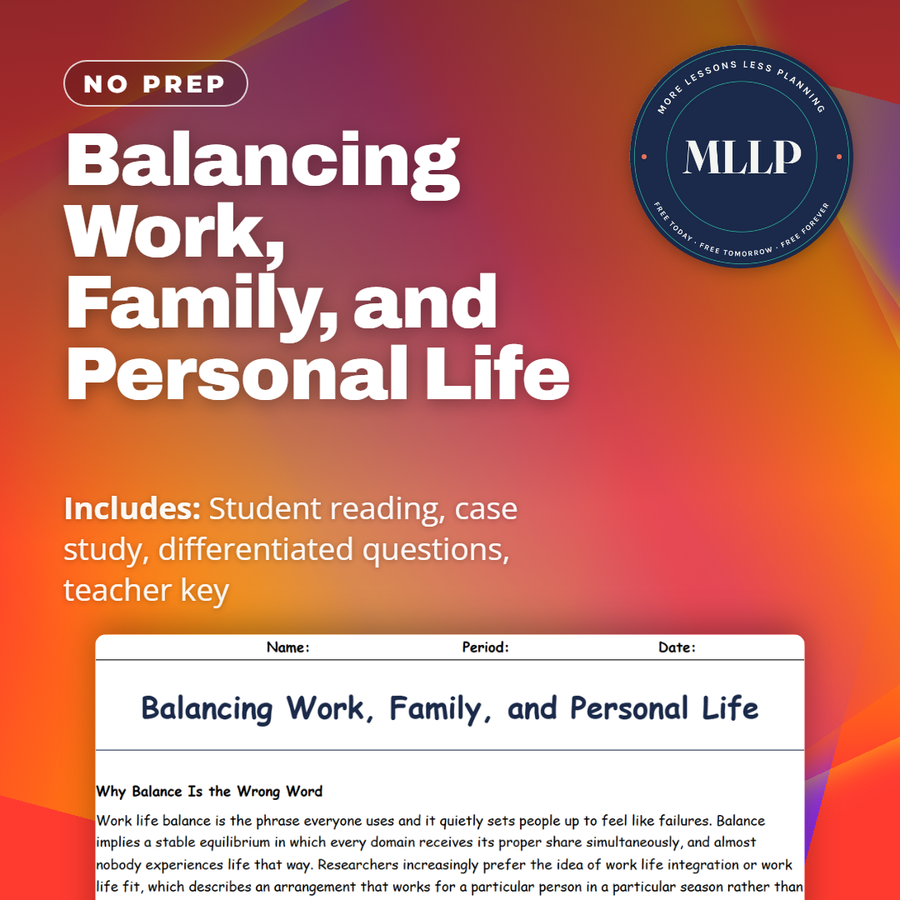
Balancing Work, Family, and Personal Life
Quality reviewed September 2026
Facts verified September 23, 2026
- Subject
- Career & Life Skills
- Grades
- Grades 9-12
- Length
- 9-page student worksheet
- Time
- About one 50-minute class period
- Great for
- Sub plans and independent work
- Includes
- Reading passage, comprehension questions + full answer key
- Format
- Print-and-go PDF
What students do
- Match five terms, from role conflict to time blocking, to their exact definitions
- The FMLA's twelve weeks of unpaid, job protected leave gets weighed against real benefit questions worth asking an employer
- Nadia's nineteen item Sunday list supplies the evidence for explaining why her partner can be sincere and still wrong
- Fill in three blanks naming the second shift, the sandwich generation, and time blocking
What it covers
- Work life fit versus work life balance, including role conflict and boundary blurring
- The second shift, cognitive labor, and the sandwich generation as unpaid, invisible work
- FMLA leave requirements and the benefits questions worth asking before accepting a job
Start reading this worksheet
Why Balance Is the Wrong Word
Work life balance is the phrase everyone uses and it quietly sets people up to feel like failures. Balance implies a stable equilibrium in which every domain receives its proper share simultaneously, and almost nobody experiences life that way. Researchers increasingly prefer the idea of work life integration or work life fit, which describes an arrangement that works for a particular person in a particular season rather than an even split maintained forever. A nursing student with no children has a different fit than a parent of a newborn, who has a different fit than someone caring for an aging parent while working full time. All three arrangements can be healthy and none of them looks balanced. What makes the distinction practical is that it changes the question. Instead of asking whether the hours are evenly divided, which is rarely useful, you ask whether the current arrangement is sustainable, whether it is chosen rather than merely inherited, and whether it can be renegotiated when the season changes. That reframing matters because the alternative produces guilt in every direction at once, the sense that you are shortchanging work while also shortchanging home. Role conflict is the technical name for that experience, and it occurs when the demands of one role make it harder to meet the demands of another. Naming it accurately is the first step toward addressing it, because a scheduling problem and a values problem require completely different solutions.
When Work Follows You Home
The boundary between work and everything else used to be enforced by geography and equipment. You left the building, and the work stayed in it. Smartphones and remote work dissolved that boundary for millions of people, producing what researchers call boundary blurring, and the effects run in both directions. Work bleeds into evenings, meals, and vacations through notifications that arrive whether or not anyone expects a reply. Household demands bleed into the workday for people working from home. Studies of remote work generally find it produces real gains in commute time, autonomy, and flexibility while also making it harder to stop working, with remote employees frequently reporting longer total hours than in office peers. The countermeasure is deliberate boundary setting, and the effective versions are concrete rather than aspirational. Turning off notifications after a set hour, keeping work on a separate device or account, designating a physical space used only for work, and creating a shutdown routine that marks the end of the day all work better than a general intention to disconnect. Several countries have adopted right to disconnect laws limiting after hours contact, and some employers have set internal norms with the same goal. The research consistently finds that clarity matters more than strictness. A team that knows a message sent at ten at night does not require an answer until morning functions better than one where everyone silently guesses. The same logic applies at home. A household that agrees dinner is a phone free hour has made one decision once, while a household that renegotiates it nightly is spending energy on the same argument repeatedly and rarely winning it.
The Second Shift and Who Actually Does It
Any honest treatment of this subject has to address unpaid household labor, because it is where the largest imbalance in most homes sits. Sociologists have long described a second shift, meaning the housework and child care that begins when paid work ends, and time use research in the United States continues to find that women perform more of it on average than men do, including in households where both partners work full time. The gap has narrowed over decades but has not closed. A related and less visible burden is cognitive labor, sometimes called the mental load, which is the ongoing work of noticing, planning, remembering, and delegating. It is the person who knows the permission slip is due, that the milk is low, and that the pediatrician appointment needs rescheduling. Cognitive labor is invisible precisely because it produces no observable activity, which makes it easy for a partner to underestimate while genuinely believing tasks are shared. Caregiving for aging parents adds another layer, and the people carrying both child and elder responsibilities at once are often called the sandwich generation. The practical response is not to assign blame but to make the invisible visible. Households that inventory every recurring task, including the noticing and planning, and then divide ownership of whole domains rather than individual chores, consistently report more equitable arrangements than households that rely on one person to assign work to another.
Like what you read? The full reading, the case study, and every question set are in the free download below, along with the answer key.
Why this matters
Most students in this class will be negotiating a work life fit of their own within a few years, whether that means a first full time job, a first apartment, or caring for a parent. The reading names the invisible parts of that negotiation, cognitive labor and role conflict, in language students can actually use with a roommate or a partner instead of vague frustration. Knowing to ask an employer how many people actually used a benefit, rather than whether the handbook lists it, is a concrete skill this reading hands students before they need it in an interview.
From one teacher to another
Nadia's Sunday night list runs to nineteen items, and every one of them is invisible work her partner never sees. This worksheet walks through why researchers now prefer work life fit over work life balance, then moves into boundary blurring, the second shift, and what the Family and Medical Leave Act actually guarantees. Students read all five passages, work through the key info table, and use the case study to explain why a partner can be sincere and still be wrong about how evenly the work is split. One of the short answer questions pushes students to explain why naming role conflict correctly changes which fix actually works.
What you get
Download
Where should I send the next one?
Everything here is free and it stays that way. Leave your email and I'll send you the new lessons as they go up. You can unsubscribe from any one of them.
Related resources

Careers in Culinary Arts and Hospitality

Careers in Early Childhood Education

Careers in Family and Consumer Sciences

Careers in Fashion and Interior Design
Careers in Human Services
FCCLA and Student Leadership
Every lesson on this site is free to download and use. If one of them saved you a prep period, you can chip in a few bucks toward my three kids' daycare fund. That's genuinely where tips go.