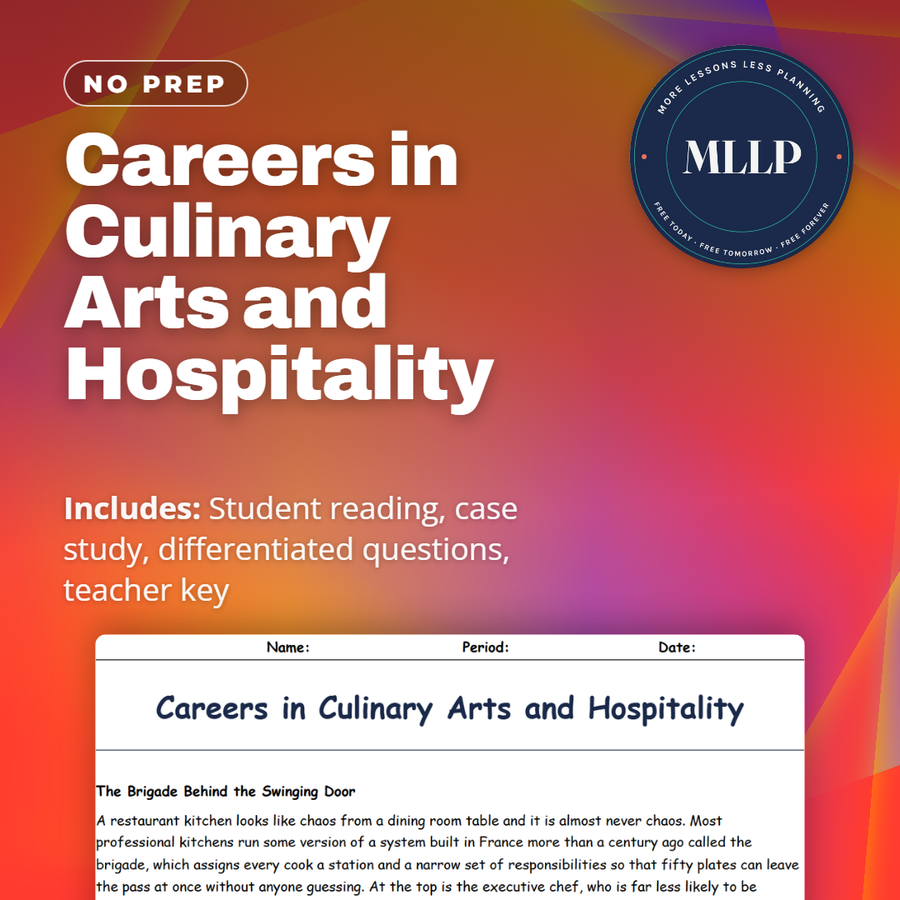
Careers in Culinary Arts and Hospitality
Quality reviewed September 2026
Facts verified September 23, 2026
- Subject
- Career & Life Skills
- Grades
- Grades 9-12
- Length
- 9-page student worksheet
- Time
- About one 50-minute class period
- Great for
- Sub plans and independent work
- Includes
- Reading passage, comprehension questions + full answer key
- Format
- Print-and-go PDF
What students do
- Priya's two offers, a busy downtown line and a steady school kitchen shift, anchor both case study questions
- Identify which of three multiple choice answers matches what the reading says about kitchen structure, safety, and cost
- The math behind a six dollar plate that sells for twenty gets worked out through food cost percentage
- Explain in three short answers why the brigade system, labor cuts, and flexible careers work the way they do
What it covers
- The kitchen brigade system and where entry level cooks actually start
- Food safety rules including the temperature danger zone and cross contamination
- Food cost percentage, menu engineering, and why restaurants fail on math, not flavor
Start reading this worksheet
The Brigade Behind the Swinging Door
A restaurant kitchen looks like chaos from a dining room table and it is almost never chaos. Most professional kitchens run some version of a system built in France more than a century ago called the brigade, which assigns every cook a station and a narrow set of responsibilities so that fifty plates can leave the pass at once without anyone guessing. At the top is the executive chef, who is far less likely to be cooking than students expect. That job is ordering, costing, scheduling, hiring, and menu writing, which is to say it is management with a culinary vocabulary. Below that sits the sous chef, the second in command who actually runs service and covers whichever station is drowning. Then come the line cooks, each responsible for a station: saute, grill, fry, pantry for cold food, and pastry, which usually operates on its own schedule because baking runs on chemistry and timing rather than orders. Dishwashers and prep cooks are the entry points, and in this industry entry points are real rather than symbolic, because promotion is based on demonstrated speed and consistency more than on paper credentials. A cook who can hold a station clean through a Saturday night rush is visible to everyone in the room. The structure exists for one reason. Under pressure, people default to whatever they have practiced, so the kitchen removes decisions in advance by deciding who owns what before service ever starts.
Hospitality Is a Much Bigger Building
Culinary work is the part of hospitality students can picture, and it is a minority of the industry's jobs. Hospitality covers lodging, food service, events, tourism, and institutional dining, and most of those roles never touch a saute pan. Hotels employ front desk staff, housekeeping managers, revenue managers who set room prices, and directors of sales who fill the building during slow weeks. Catering and event management run on logistics: a wedding coordinator is managing vendors, timelines, contracts, and a client's expectations under conditions where nothing can be rescheduled. Institutional food service, meaning schools, hospitals, universities, prisons, and corporate cafeterias, is the quietest and most stable corner of the field. Those kitchens serve enormous volume on fixed budgets under nutrition regulations, and they typically offer something restaurants rarely do, which is a predictable schedule with benefits. School nutrition directors in particular are FCS adjacent by definition, because the job blends menu planning, food safety, budgeting, and federal meal pattern compliance. Food trucks and small independent operations sit at the other extreme, where one person may cook, buy, market, and file the taxes. Students should hear both ends of that spectrum honestly. The industry contains work that will consume every weekend of your twenties and work that ends at three in the afternoon with summers off, and both are legitimate hospitality careers. Students should also know that the skills move between these corners more easily than the job titles suggest. A cook who has run a station through a Saturday rush can transfer that speed and organization to a school kitchen, a catering line, or a hospital tray assembly, because the underlying discipline of timing, temperature, and consistency does not change with the building.
Safety Rules Are the Real Entry Exam
Every hospitality career is built on food safety, and it is the one area where the industry does not negotiate. Foodborne illness sickens millions of Americans a year, and a single outbreak traced to a restaurant can close it permanently, which is why regulators, insurers, and owners all treat this material as non optional. The core concepts are simple to state and hard to execute at volume. The temperature danger zone runs from forty one to one hundred thirty five degrees Fahrenheit, and food should not sit inside it for more than four hours cumulatively. Cross contamination is prevented by separating raw proteins from ready to eat food in storage, on cutting boards, and in the order things are prepped. Cooling is where most operations actually fail, because a large stockpot cools far too slowly on its own and has to be broken into shallow pans or chilled in an ice bath. Handwashing is the single highest value action in the building. Most states require at least one certified food protection manager on site during operating hours, and ServSafe is the most widely recognized program for that certification. Many high school programs let students earn the food handler card before graduation, which is a genuine hiring advantage. Health inspections score against these rules and the results are public in most jurisdictions. Managers learn quickly that inspection day should be indistinguishable from any other day.
Like what you read? The full reading, the case study, and every question set are in the free download below, along with the answer key.
Why this matters
A number of students in this class will work a service job before they finish high school, and the food safety habits in this reading, handwashing, the temperature danger zone, and keeping raw and ready to eat food separate, apply the first shift they work, not only in a restaurant career. The reading is also honest about hours in a way career materials rarely are, laying out night and weekend schedules next to the daytime hours of school and institutional kitchens so students can weigh a job by its calendar before they take it.
From one teacher to another
Priya has two job offers on the table, a downtown restaurant line cook position and an assistant cook role with the school district, and this worksheet uses her decision to teach the whole industry. Students read about the brigade system, then work through food safety rules like the temperature danger zone, then move into food cost percentage and why a six dollar plate sells for twenty. The case study asks students to weigh what Priya gains and gives up under each schedule, since the reading argues the real difference between her two offers is the calendar rather than the pay. A short answer question asks why cutting labor hours can cost a restaurant more than it saves.
What you get
Download
Where should I send the next one?
Everything here is free and it stays that way. Leave your email and I'll send you the new lessons as they go up. You can unsubscribe from any one of them.
Related resources
Balancing Work, Family, and Personal Life

Careers in Early Childhood Education
Careers in Family and Consumer Sciences

Careers in Fashion and Interior Design
Careers in Human Services
FCCLA and Student Leadership
Every lesson on this site is free to download and use. If one of them saved you a prep period, you can chip in a few bucks toward my three kids' daycare fund. That's genuinely where tips go.