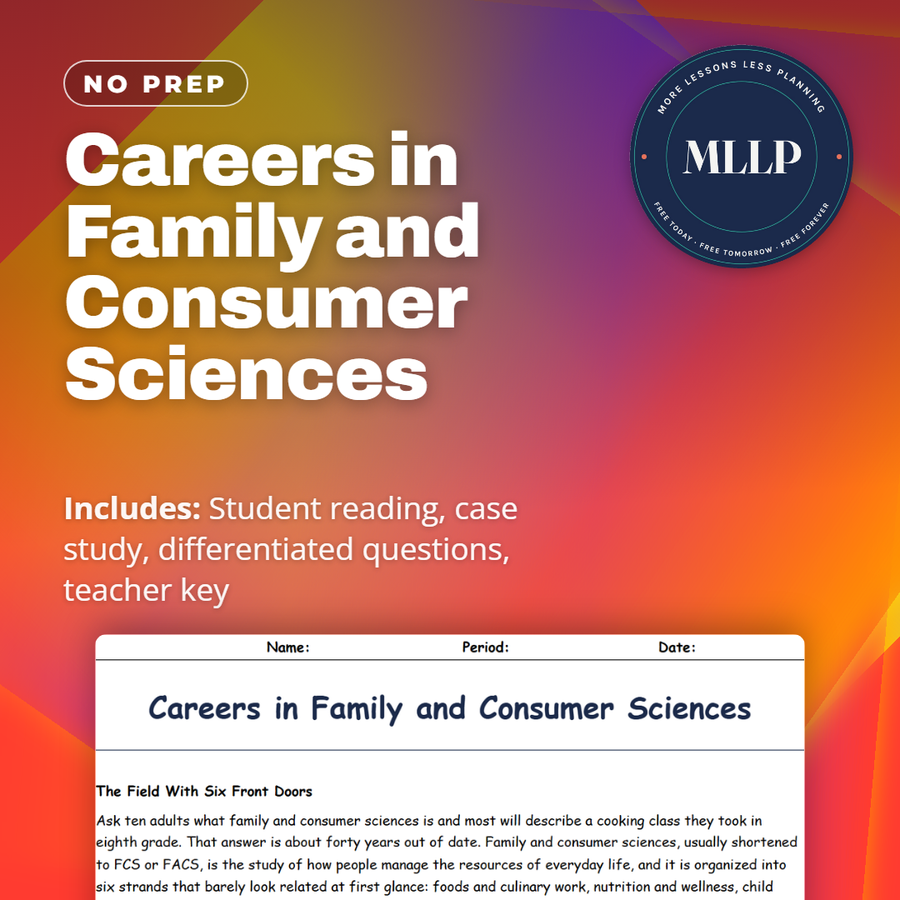
Careers in Family and Consumer Sciences
Quality reviewed September 2026
Facts verified September 23, 2026
- Subject
- Career & Life Skills
- Grades
- Grades 9-12
- Length
- 9-page student worksheet
- Time
- About one 50-minute class period
- Great for
- Sub plans and independent work
- Includes
- Reading passage, comprehension questions + full answer key
- Format
- Print-and-go PDF
What students do
- Devon's table full of interests, foods, child development, and consumer economics, drives both case study questions
- Pay differences between a licensed dietitian and an unlicensed aide get traced back to the credential itself
- Answer three short answer questions on credentials, pay drivers, and skill transfer
- Sort five terms, from Cooperative Extension to transferable skill, into their correct definitions
What it covers
- The six FCS strands and how one question, using limited resources well, ties them together
- Where FCS graduates actually work, from extension offices to industry test kitchens
- Credentials like the CDA and CFCS and how they shape both pay and legal responsibility
Start reading this worksheet
The Field With Six Front Doors
Ask ten adults what family and consumer sciences is and most will describe a cooking class they took in eighth grade. That answer is about forty years out of date. Family and consumer sciences, usually shortened to FCS or FACS, is the study of how people manage the resources of everyday life, and it is organized into six strands that barely look related at first glance: foods and culinary work, nutrition and wellness, child development and education, textiles and apparel, housing and interior design, and consumer economics. What holds those six together is a single question. How do individuals and families use limited money, time, and energy to live well? A person answering that question in a kitchen becomes a chef. Someone answering it about toddlers becomes a preschool director. Someone answering it about fabric ends up in a design studio, and someone answering it about grocery budgets ends up in a county office teaching a class on stretching food dollars. The field is unusually wide, which is a real advantage for a student who is not certain yet. A high school FCS course sequence touches all six strands, so you get to test drive several careers before committing tuition to any of them. That breadth is also why FCS graduates land in job titles that never contain the words family and consumer sciences. They are called nutrition educators, child care directors, merchandisers, food safety inspectors, family support specialists, and teachers. The degree is one thing. The doors it opens are six, and most students only ever hear about one of them.
Classrooms, Clinics, and County Offices
The most visible FCS career is the one running the class you are sitting in. FCS teachers work in middle and high schools and often run several different courses in a single day, moving from a foods lab to a child development section to a personal finance unit before lunch. Outside of schools, the largest employer of FCS professionals in the country is the Cooperative Extension system, a partnership between land grant universities and county governments that puts a nutrition or family resource agent in local offices nationwide. Extension agents teach food preservation workshops, run parenting programs, and answer the phone when a resident wants to know whether a home canned jar is safe to eat. Health care hires FCS graduates into clinical nutrition, diabetes education, and community health roles. Federal and state programs, including nutrition assistance clinics and school nutrition departments, hire people who can plan menus, meet regulations, and teach families how to use what they receive. Industry is the pathway students hear about least and it may be the largest. Food companies employ product developers and test kitchen staff. Retailers employ buyers and merchandisers who came up through textiles and apparel programs. Appliance manufacturers hire consumer scientists to test how real households actually use their products. Nonprofits hire family support specialists to work with families in crisis. The common thread is that all of these employers need someone who understands both the technical material and the human being who has to use it.
Credentials and the Letters After a Name
In FCS careers, the credential often matters more than the job title, and it is worth learning the vocabulary early because credentials determine both who may legally do the work and what it pays. Teaching requires a state issued license, and in most states an FCS teacher also carries a career and technical education endorsement earned through a college program plus a certification exam. The American Association of Family and Consumer Sciences, known as AAFCS, awards the Certified in Family and Consumer Sciences credential, which signals broad competence across the strands and is common among extension agents and industry professionals. Nutrition has the strictest path. A registered dietitian nutritionist must complete an accredited academic program, finish a supervised practice requirement of roughly a thousand hours, and pass a national exam administered by the Commission on Dietetic Registration, and since January 1, 2024, the rules have required a graduate degree to sit for that exam. Early childhood has a shorter on ramp. The Child Development Associate credential can be earned while working in a center and is recognized in every state. Food service work runs on food safety certification, most commonly ServSafe, which many states require of at least one manager on every shift. Interior design uses the NCIDQ examination in states that regulate the title. None of these are optional extras. In regulated roles the credential is the difference between assisting and being responsible.
Like what you read? The full reading, the case study, and every question set are in the free download below, along with the answer key.
Why this matters
FCS as a field is often reduced to the cooking class a parent remembers from decades ago, and this reading corrects that in the same session it builds vocabulary the students will use for the rest of the unit. Every strand connects to work students already know exists, a chef, a preschool director, a merchandiser, without most students realizing those jobs share one credentialing logic. For a student who feels behind because they cannot name one career yet, the reading offers a genuine alternative path, a pathway built on transferable skills rather than an early, narrow choice.
From one teacher to another
Devon has taken four FCS courses and enjoyed all of them, which his counselor treats like a problem instead of an answer. This worksheet uses his indecision to introduce the six FCS strands, from foods and textiles to consumer economics, then walks through where the jobs actually sit, extension offices, health care, and industry roles most students never hear named. Students read about credentialing differences between a registered dietitian and a Child Development Associate, then use the case study to explain why breadth is an advantage rather than a flaw. A short answer question asks why comparing two job offers by salary alone repeats a common consumer mistake.
What you get
Download
Where should I send the next one?
Everything here is free and it stays that way. Leave your email and I'll send you the new lessons as they go up. You can unsubscribe from any one of them.
Related resources
Balancing Work, Family, and Personal Life
Careers in Culinary Arts and Hospitality
Careers in Early Childhood Education
Careers in Fashion and Interior Design
Careers in Human Services
FCCLA and Student Leadership
Every lesson on this site is free to download and use. If one of them saved you a prep period, you can chip in a few bucks toward my three kids' daycare fund. That's genuinely where tips go.