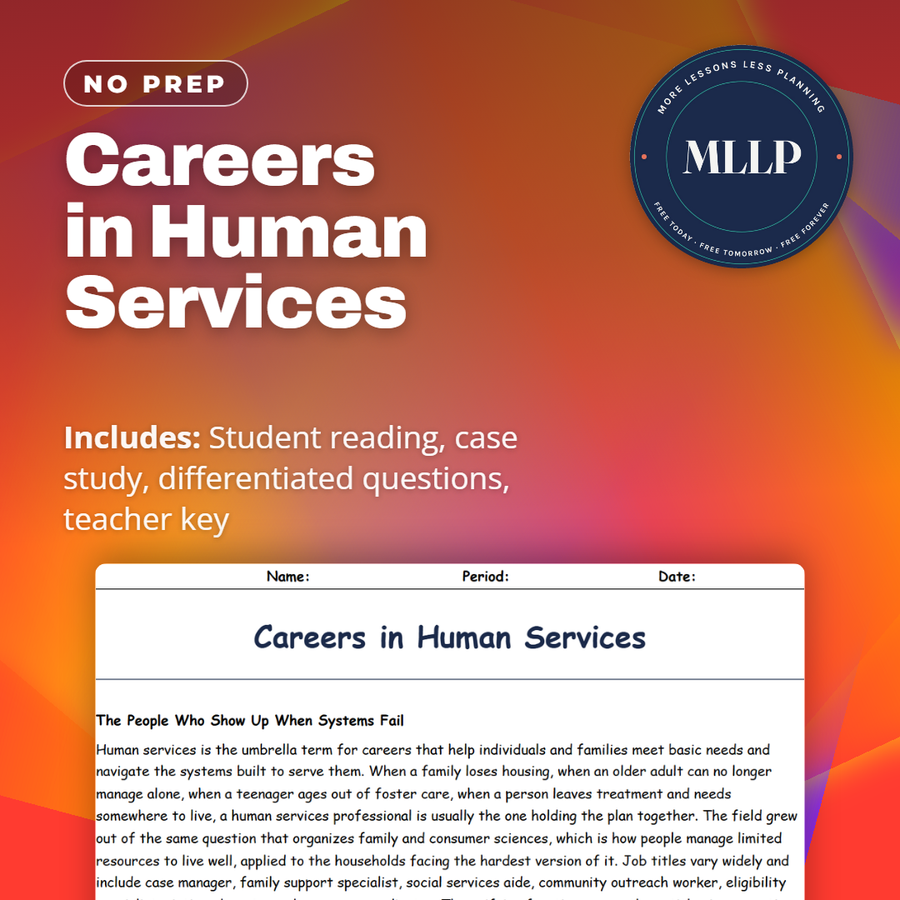
Careers in Human Services
Quality reviewed September 2026
Facts verified September 23, 2026
- Subject
- Career & Life Skills
- Grades
- Grades 9-12
- Length
- 9-page student worksheet
- Time
- About one 50-minute class period
- Great for
- Sub plans and independent work
- Includes
- Reading passage, comprehension questions + full answer key
- Format
- Print-and-go PDF
What students do
- Tomas's referral, made and marked complete but never confirmed, supplies both case study questions
- Match five terms, from case management to cultural humility, to their definitions
- Caseload size in a government office gets weighed against the flexibility and lower pay of a nonprofit
- Answer three short answer questions on boundaries, burnout, and the value of an FCS foundation
What it covers
- What case management actually is, and the legal line it cannot cross into clinical care
- Where human services jobs sit across government, nonprofit, and health care employers
- Secondary traumatic stress and the supervision that keeps workers in the field
Start reading this worksheet
The People Who Show Up When Systems Fail
Human services is the umbrella term for careers that help individuals and families meet basic needs and navigate the systems built to serve them. When a family loses housing, when an older adult can no longer manage alone, when a teenager ages out of foster care, when a person leaves treatment and needs somewhere to live, a human services professional is usually the one holding the plan together. The field grew out of the same question that organizes family and consumer sciences, which is how people manage limited resources to live well, applied to the households facing the hardest version of it. Job titles vary widely and include case manager, family support specialist, social services aide, community outreach worker, eligibility specialist, victim advocate, and program coordinator. The unifying function across those titles is connection. A case manager rarely provides food, housing, or therapy directly. Instead the job is assessing what a person needs, knowing which agencies provide it, understanding each program's eligibility rules, and then following through until the connection actually holds. That last part is what separates competent practice from good intentions. Making a referral takes two minutes. Confirming that the appointment happened, that the paperwork arrived, and that the family had transportation is the work. Human services exists because resources are fragmented across dozens of programs, and most people in crisis do not have the time or bandwidth to map that landscape alone.
Where the Jobs Actually Sit
Employment in human services is spread across three sectors and they operate differently enough that students should know which one they are applying to. Government agencies at the county and state level administer public benefit programs, child protective services, aging services, and workforce programs. These jobs typically require passing a civil service process, offer pension eligibility and stable benefits, and come with high caseloads and substantial documentation requirements. Nonprofit organizations run shelters, food assistance programs, domestic violence services, refugee resettlement, youth programs, and community health outreach. Nonprofits usually offer more flexibility and mission alignment and less money, and their funding depends on grants, which means positions sometimes end when a grant cycle does. Health care systems employ care coordinators and discharge planners who make sure a patient leaving the hospital has somewhere to go, someone to help, and a way to get medication. Schools employ family liaisons, homeless student coordinators required under federal law, and staff who connect families to community resources. Faith based and community organizations run their own programs, often filling gaps the formal system leaves. Entry level positions are widely available with an associate or bachelor's degree, and many agencies hire people with lived experience and strong communication skills into outreach roles. Advancement generally requires a bachelor's degree, and supervisory or clinical roles usually require a master's degree. Students should also understand that caseload size varies enormously between these sectors and is the single best predictor of what a day feels like. A worker carrying twenty families can follow through on each one, while a worker carrying ninety is triaging, and asking about typical caseload during an interview is more revealing than asking about job duties.
Licensure, Ethics, and the Legal Floor
Human services work is bounded by rules that exist because the people served are often in a vulnerable position, and knowing where those boundaries sit is part of professional competence. Social work is a licensed profession with a defined ladder, and clinical practice such as diagnosing or providing therapy requires a master's degree in social work plus supervised hours and a state license. A case manager without that license may coordinate services, advocate, and support a family, but may not provide clinical treatment, and blurring that line is both an ethical and a legal problem. Confidentiality is the governing principle of daily practice. Client information is shared only with consent or where the law requires disclosure, and health information carries additional protection under federal privacy law. The exceptions are narrow and important. Human services workers are mandated reporters of suspected child abuse or neglect and, in most states, of suspected abuse of vulnerable adults, and a credible threat of serious harm may also require action. Professional boundaries are a constant working challenge because the relationships are personal by design. Accepting gifts, lending money, socializing outside the professional relationship, or connecting on personal social media accounts all create dual relationships that compromise judgment and can harm the client. Good agencies train these rules explicitly and supervise them, since almost every serious ethical failure in this field began as a small kindness offered without a boundary.
Like what you read? The full reading, the case study, and every question set are in the free download below, along with the answer key.
Why this matters
This reading names a career path many students will enter without planning to, since school liaisons, shelter staff, and county caseworkers rarely appear on a career day poster the way nursing or teaching does. The reading is honest about a hazard most career materials skip entirely, secondary traumatic stress, and about the real countermeasures, supervision and realistic expectations, that keep people in the work instead of burning out within a year or two. Tomas's story also teaches a skill that generalizes past this one field, that good intentions without follow through can look identical to doing nothing at all.
From one teacher to another
Tomas made the referral, wrote the number on the back of his card, and marked the file complete, and six weeks later his client was facing eviction anyway. This worksheet uses that failure to teach what human services work actually is, the difference between government, nonprofit, and health care employers, and the legal line between coordinating services and providing clinical treatment. Students read about secondary traumatic stress and the countermeasures agencies use against it, then use the case study to name the two skills that would have changed Tomas's outcome. A short answer question asks why nearly every serious ethical failure in this field begins as a small kindness.
What you get
Download
Where should I send the next one?
Everything here is free and it stays that way. Leave your email and I'll send you the new lessons as they go up. You can unsubscribe from any one of them.
Related resources
Balancing Work, Family, and Personal Life
Careers in Culinary Arts and Hospitality
Careers in Early Childhood Education
Careers in Family and Consumer Sciences

Careers in Fashion and Interior Design
FCCLA and Student Leadership
Every lesson on this site is free to download and use. If one of them saved you a prep period, you can chip in a few bucks toward my three kids' daycare fund. That's genuinely where tips go.