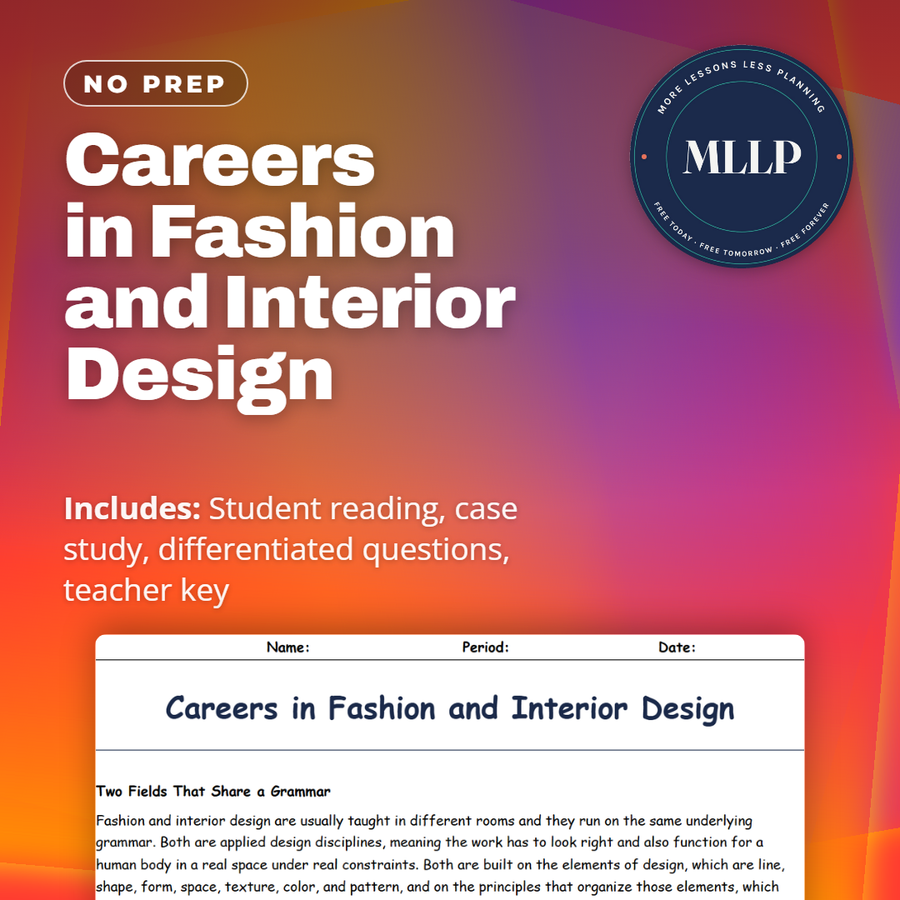
Careers in Fashion and Interior Design
Quality reviewed September 2026
Facts verified September 23, 2026
- Subject
- Career & Life Skills
- Grades
- Grades 9-12
- Length
- 9-page student worksheet
- Time
- About one 50-minute class period
- Great for
- Sub plans and independent work
- Includes
- Reading passage, comprehension questions + full answer key
- Format
- Print-and-go PDF
What students do
- Decide which of three multiple choice answers the reading actually supports on design, portfolios, and forecasting
- Jae's three bathroom sketches, each built around the same twenty eight inch doorway, anchor both case study questions
- Color forecasting gets compared to the seasonal cycles that shape both a clothing line and a room design
- Write three short answers on the spreadsheet half of design work, portfolios, and industry change
What it covers
- The shared design elements and principles running through fashion and interior work alike
- Fashion jobs beyond the runway, including technical design, sourcing, and quality assurance
- Universal design and the sustainability pressures reshaping both fields right now
Start reading this worksheet
Two Fields That Share a Grammar
Fashion and interior design are usually taught in different rooms and they run on the same underlying grammar. Both are applied design disciplines, meaning the work has to look right and also function for a human body in a real space under real constraints. Both are built on the elements of design, which are line, shape, form, space, texture, color, and pattern, and on the principles that organize those elements, which are balance, proportion, rhythm, emphasis, and unity. A designer who understands why a vertical stripe lengthens a silhouette understands why a tall narrow window changes how a room reads. Both fields also work in seasons and cycles, respond to the same cultural currents, and depend heavily on color forecasting, an industry practice in which specialized firms predict which palettes will sell one to two years ahead so that manufacturers can commit to dye lots and finishes in advance. The largest shared trait is the least glamorous. In both fields the majority of the work is not the initial creative flourish. It is specification, sourcing, measuring, revising, coordinating with people who build things, and solving problems that appear after the pretty drawing is approved. Students who love the sketch and dislike the spreadsheet often discover this late. The ones who thrive tend to be the people who find the constraint interesting rather than annoying, because the constraint is where the actual design happens. Both fields also share a client problem worth naming early. The person paying rarely speaks in design vocabulary, so a designer has to translate vague statements like it feels cold or I want it to look expensive into specific decisions about material, scale, and color. Learning to ask the question behind the complaint is a skill that separates working professionals from talented students.
Jobs That Never Touch a Runway
The fashion industry employs vastly more people in the pipeline behind a garment than in designing it. A technical designer translates a concept into a specification package with measurements, tolerances, stitch types, and construction details precise enough for a factory on another continent to execute without a phone call. A patternmaker creates the templates the garment is cut from and grades them across sizes. Sourcing specialists find fabrics and factories and negotiate on price, capacity, and delivery. Quality assurance staff inspect production against the specification. On the retail side, buyers decide what a store will carry and commit budget months ahead, planners forecast how much of each item will sell, and visual merchandisers control how a store or a website presents product. Costume design serves theater, film, and television with a research burden most people underestimate. Alterations and tailoring remain steady skilled trades, and the ability to fit a garment on an actual body is rarer and more valuable than students assume. Textile science and product development sit closer to a laboratory than a studio, testing durability, colorfastness, flammability, and performance. Sustainability roles have grown quickly as companies face pressure over waste and labor conditions in their supply chains. The unifying point is that a person who loves clothing but does not want to be a designer has dozens of doors available. It is also worth knowing that many of these roles pay better and offer steadier employment than design itself, because they sit closer to the money. Buyers commit millions of dollars of inventory and are compensated accordingly, while technical designers and sourcing specialists are difficult to replace once they know a factory network.
Designing Rooms People Have to Live In
Interior design divides along a line that matters for careers. Residential design works with homeowners on kitchens, baths, and whole houses, and the client relationship is personal, emotional, and sometimes difficult because the project is where the client sleeps. Commercial design serves offices, restaurants, hotels, retail, health care, and schools, and it runs on codes, budgets, and committees rather than personal taste. Health care design is its own specialty because layouts affect infection control, patient outcomes, and staff walking distances. The distinction between decorating and design is worth stating plainly. Decorating addresses finishes, furnishings, and color. Design also addresses space planning, circulation, lighting, and code compliance, including accessibility requirements under the Americans with Disabilities Act and life safety rules governing exits, corridor widths, and material flammability. Designers work in drawings and schedules, produce floor plans and elevations, specify products with model numbers and finishes, and coordinate with architects, contractors, and inspectors. Universal design is a philosophy running through the field that argues spaces should be usable by people across ages and abilities without special adaptation, which produces choices like lever handles, curbless showers, and varied counter heights that benefit everyone. Licensing varies by state, and where the title is regulated the NCIDQ examination is the standard, requiring both education and documented work experience before a candidate may sit for it.
Like what you read? The full reading, the case study, and every question set are in the free download below, along with the answer key.
Why this matters
Design work touches a decision nearly every student's family will eventually face, what to buy, what to build, and how to make a space work for someone whose needs are changing, and Jae's case study puts a real budget and a real doorway measurement behind that instead of an abstract lesson. The reading also widens what counts as a design career well past the sketch a student might picture, pointing to sourcing, quality assurance, and sustainability roles that pay steadily and use the same underlying skills. Universal design in particular reframes accessibility as something that benefits an entire household, not a special case built for one person.
From one teacher to another
Jae's family has twenty two hundred dollars, a grandmother moving into the first floor bedroom, and a doorway that is too narrow for her walker. This worksheet pairs that budget problem with the shared grammar behind fashion and interior design, the same elements and principles, the same client translation problem, and the same reliance on a documented portfolio over a transcript. Students read about jobs that never touch a runway, technical designers, buyers, and sourcing specialists, then use the case study to weigh a curbless shower against a wider doorway. A short answer question asks why students who love the sketch but dislike the spreadsheet often struggle in these fields.
What you get
Download
Where should I send the next one?
Everything here is free and it stays that way. Leave your email and I'll send you the new lessons as they go up. You can unsubscribe from any one of them.
Related resources
Balancing Work, Family, and Personal Life
Careers in Culinary Arts and Hospitality
Careers in Early Childhood Education
Careers in Family and Consumer Sciences
Careers in Human Services
FCCLA and Student Leadership
Every lesson on this site is free to download and use. If one of them saved you a prep period, you can chip in a few bucks toward my three kids' daycare fund. That's genuinely where tips go.