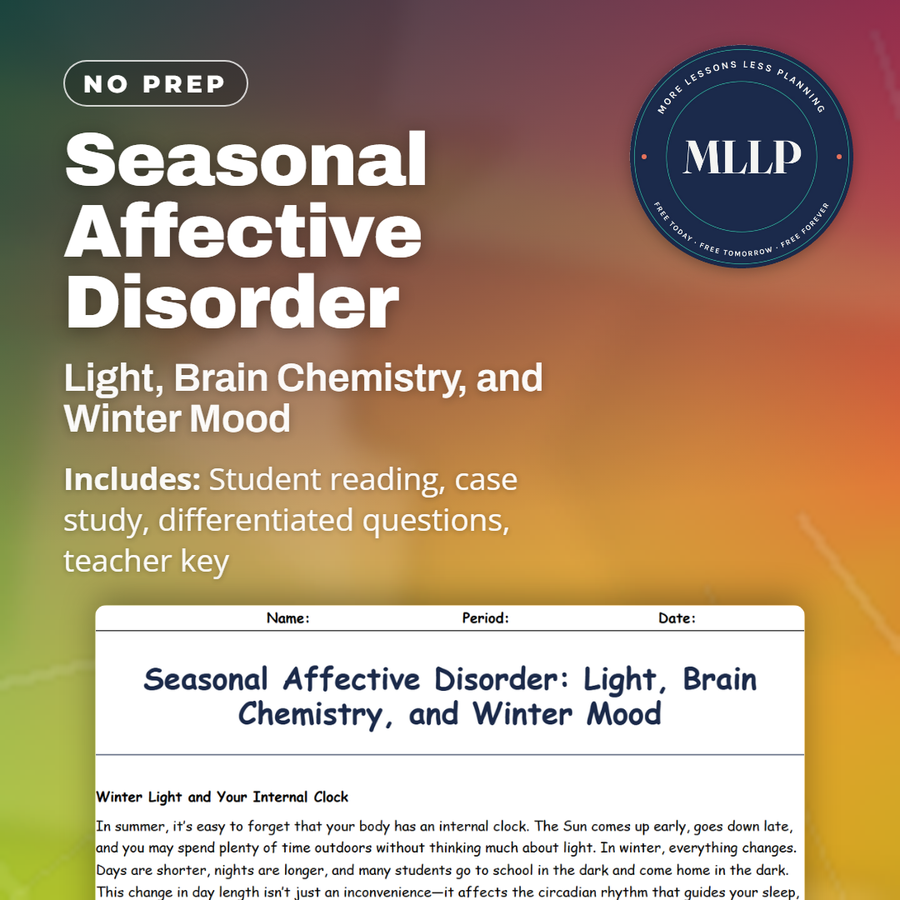
Seasonal Affective Disorder: Light, Brain Chemistry, and Winter Mood
Quality reviewed September 2026
Facts verified September 9, 2026
- Subject
- Science
- Grades
- Grades 9-12
- Length
- 8-page student worksheet
- Time
- About one 50-minute class period
- Great for
- Sub plans and independent work
- Includes
- Reading passage, comprehension questions + full answer key
- Format
- Print-and-go PDF
What students do
- Connect shorter winter days to circadian rhythm disruption and trace how melatonin and serotonin levels shift with reduced light exposure
- Distinguish between ordinary winter blues and Seasonal Affective Disorder using the severity table and criteria for daily functioning
- Analyze Leila's case study to identify which specific symptoms point to SAD rather than general stress or sadness
- Design an evidence-based plan using light therapy, sleep hygiene, or behavioral strategies to manage seasonal mood changes
What it covers
- Circadian rhythms, light, and the suprachiasmatic nucleus
- Brain chemistry of mood (melatonin, serotonin, neurotransmitters)
- SAD diagnosis and treatment strategies
Start reading this worksheet
Winter Light and Your Internal Clock
In summer, it’s easy to forget that your body has an internal clock. The Sun comes up early, goes down late, and you may spend plenty of time outdoors without thinking much about light. In winter, everything changes. Days are shorter, nights are longer, and many students go to school in the dark and come home in the dark. This change in day length may look like just an inconvenience, but it affects the circadian rhythm that guides your sleep, hunger, body temperature, and even mood. Your circadian rhythm is a roughly 24-hour cycle controlled by a small region in your brain called the suprachiasmatic nucleus (SCN). This area responds to light signals coming from your eyes. When bright light hits special cells in your retina, the SCN gets the message: “It’s daytime. Stay awake and alert.” When light fades in the evening, the SCN sends signals that allow melatonin, a hormone made by the pineal gland, to rise. Melatonin helps your body prepare for sleep. In winter, especially at higher latitudes, the Sun rises later and sets earlier. Many people spend most of their daylight hours indoors under relatively dim artificial light. That means the SCN doesn’t get the strong, clear “daytime” signal it expects. Your sleep–wake cycle can drift later, making it harder to fall asleep at a sensible time and harder to feel fully awake in the morning. Over weeks, this mismatch between your internal clock and the outside world can leave you feeling sluggish, unfocused, and unusually down. For some people, these seasonal changes are mild and annoying. For others, they contribute to a more serious condition known as Seasonal Affective Disorder (SAD).
Hormones, Neurotransmitters, and Winter Mood
To understand Seasonal Affective Disorder, it helps to remember that mood is not just “in your head” in a vague way. It is linked to brain chemistry. Two substances often mentioned in discussions of SAD are melatonin and serotonin. Melatonin, as you’ve learned, helps regulate sleep. Serotonin is a neurotransmitter, a chemical messenger that helps brain cells communicate. It plays a role in mood, appetite, and energy. In darker months, longer nights and weaker daylight can lead to higher melatonin levels for more of the day. That can make a person feel sleepy and low-energy even when they’ve technically had enough hours of sleep. At the same time, some studies suggest that serotonin activity may drop in winter for certain people, especially when they are not exposed to much bright light. Lower serotonin activity has been linked with depressed mood, irritability, and loss of interest in activities that used to be enjoyable. Of course, light and brain chemistry are not the whole story. Winter often brings changes in behavior that can also influence mood. People may exercise less, spend less time outdoors, and have more disrupted schedules due to holidays, exams, or weather. Social life can shrink if it’s hard to get around in snow and ice. All of these factors, including biology, environment, and habits, can combine to create a pattern of low mood that repeats each year. The key difference between ordinary “winter blahs” and Seasonal Affective Disorder is severity and impact on daily functioning. Here is a simple comparison: The table shows that SAD is not just “not liking winter.” It’s a recognizable pattern that can be serious enough to count as a form of seasonal depression, usually repeating at the same time each year.
Like what you read? The full reading, the case study, and every question set are in the free download below, along with the answer key.
Why this matters
By late November, Leila is convinced something is wrong with her, when really something entirely explainable is happening inside her brain. Shorter days mean less light reaching the brain's internal clock, and that alone is enough to throw off melatonin and serotonin.
Students frequently describe their own low winter mood as a personal failing before this reading, then start reaching for words like circadian rhythm instead. I think the severity table does the real work here, letting students separate ordinary winter blues from a pattern serious enough that a trusted adult needs to know about it. That distinction, more than the biology itself, is the part students remember afterward.
From one teacher to another
This worksheet helps destigmatize a real condition. Leila isn't weak or lazy; her brain chemistry is responding to environmental cues. The reading explains the mechanism clearly: fewer daylight hours mean less light reaching the SCN, which throws off melatonin production and may lower serotonin activity. Suddenly "I feel down every November" becomes "my brain is responding predictably to seasonal changes." The key is helping students recognize when sadness moves from normal winter blues into territory where professional help matters. I love that the worksheet ends with "know when to talk to a trusted adult" instead of pretending mood management is a solo problem.
What you get
Download
Where should I send the next one?
Everything here is free and it stays that way. Leave your email and I'll send you the new lessons as they go up. You can unsubscribe from any one of them.
Related resources
Biology of Evergreen Plants: The Science Behind Christmas Trees
Body Clocks and Midnight Countdowns: Circadian Rhythms at New Year’s
Calendars, Orbits, and the Science of New Year’s Day
Christmas on the Home Front: WWII Rationing and Resilience
Colorful Chemistry: Holiday Lights, Fireworks, and the Science of Glow
Crowded Skies: Holiday Air Travel and the Environment
Every lesson on this site is free to download and use. If one of them saved you a prep period, you can chip in a few bucks toward my three kids' daycare fund. That's genuinely where tips go.