Renting vs. Buying: Understanding Your Options
Quality reviewed September 2026
Facts verified September 23, 2026
- Subject
- Career & Life Skills
- Grades
- Grades 9-12
- Length
- 8-page student worksheet
- Time
- About one 50-minute class period
- Great for
- Sub plans and independent work
- Includes
- Reading passage, comprehension questions + full answer key
- Format
- Print-and-go PDF
What students do
- The Ortegas run real numbers on a $190,000 house against their $14,000 in savings
- Compare what a renter actually pays against what a mortgage payment bundles together as PITI
- Decide, using the reading's own break-even math, whether buying beats renting for a given timeline
- Equity, appreciation, and the risk that home values can fall get separated out from wishful thinking
What it covers
- The real up-front and monthly costs of renting versus buying
- Equity, appreciation, and the three-to-seven-year break-even point
- The Ortegas' decision to keep renting for one more year
Start reading this worksheet
Two Ways to Get a Roof
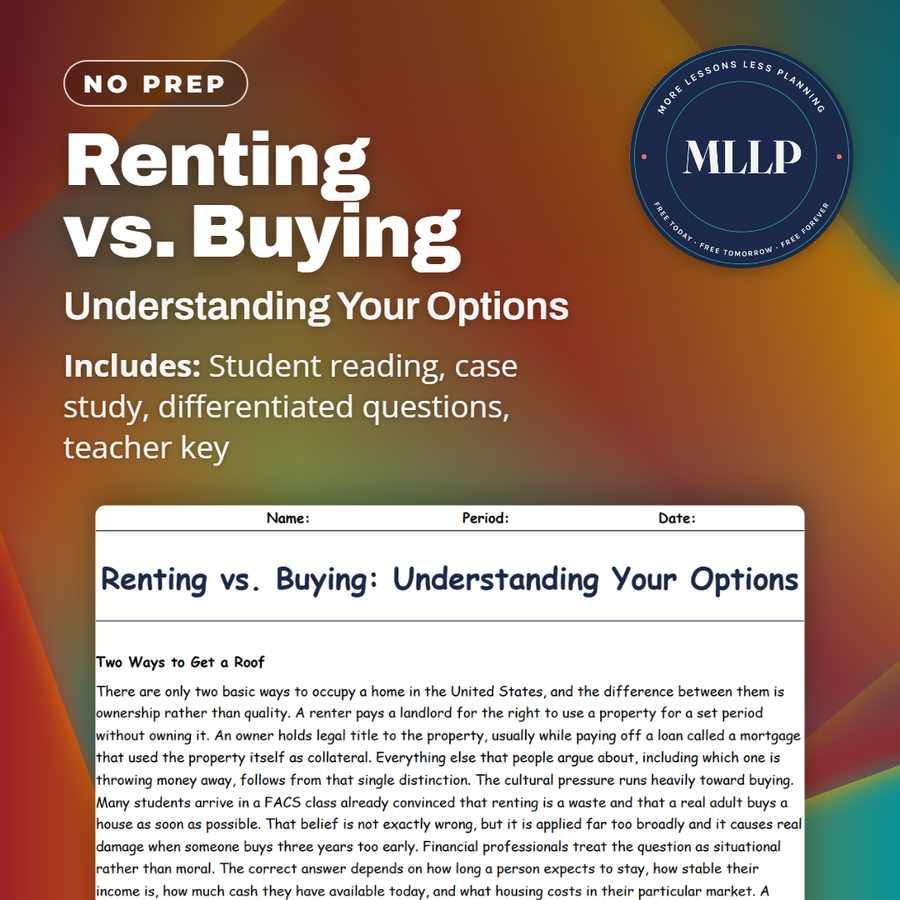
There are only two basic ways to occupy a home in the United States, and the difference between them is ownership rather than quality. A renter pays a landlord for the right to use a property for a set period without owning it. An owner holds legal title to the property, usually while paying off a loan called a mortgage that used the property itself as collateral. Everything else that people argue about, including which one is throwing money away, follows from that single distinction. The cultural pressure runs heavily toward buying. Many students arrive in a FACS class already convinced that renting is a waste and that a real adult buys a house as soon as possible. That belief is not exactly wrong, but it is applied far too broadly and it causes real damage when someone buys three years too early. Financial professionals treat the question as situational rather than moral. The correct answer depends on how long a person expects to stay, how stable their income is, how much cash they have available today, and what housing costs in their particular market. A person who buys well can build substantial wealth. A person who buys at the wrong moment can be trapped in a property they cannot sell without a loss. Understanding both sides honestly is what makes the decision a choice instead of a reflex, and the honest version starts with what each option actually costs.
The Real Cost of Renting
Renting costs are relatively simple to see, which is one of its underrated advantages. A renter pays a security deposit up front, typically equal to one month's rent and sometimes more, plus the first month's rent and occasionally the last month as well. That means moving into a place renting for nine hundred dollars often requires eighteen hundred to twenty-seven hundred dollars on day one. After that, monthly costs are rent plus whichever utilities the lease assigns to the tenant. Renters insurance, which covers a tenant's belongings and liability, has typically run fifteen to thirty dollars a month and is often required by landlords. What a renter does not pay is the part people forget. The landlord absorbs property taxes, the cost of a failed water heater, roof replacement, structural repairs, and the appliances that come with the unit. When the furnace dies in February, the renter makes a phone call rather than writing a four thousand dollar check. Renting also carries a real and underrated asset called mobility. A renter at the end of a lease can leave for a better job in another city with thirty to sixty days of notice. The trade-offs are equally real. Rent can rise at renewal, the landlord may decline to renew at all, and monthly payments build no ownership stake. A renter who pays for ten years owns nothing at the end of it. Renters also have limited control over the property itself, since painting, replacing fixtures, or renovating generally requires landlord permission, and improvements a tenant pays for stay with the building when the lease ends.
What Owning Actually Costs
Buying costs are larger, less obvious, and where most first-time buyers get surprised. The down payment is the cash paid up front, historically twenty percent of the purchase price, though many loan programs have allowed far less, including three to five percent for conventional loans and three and a half percent for FHA loans. Buyers who put down less than twenty percent usually must pay private mortgage insurance, which protects the lender rather than the buyer and adds a monthly charge. Closing costs, which cover the appraisal, title work, loan origination, and recording fees, typically add another two to five percent of the price at signing. The monthly payment itself is commonly summarized as PITI, meaning principal, interest, taxes, and insurance, because a mortgage payment bundles the loan repayment together with property taxes and homeowners insurance. Then come the costs that never appear in the listing. Maintenance and repairs are widely estimated at one to four percent of the home's value each year, so a two hundred thousand dollar house implies roughly two to eight thousand dollars annually in upkeep averaged over time. Homeowners association fees apply in many neighborhoods and condominiums. Owning also removes mobility, since selling a home takes months and costs real money in agent commissions, traditionally around five to six percent of the sale price. Owners do gain control and stability in exchange, since nobody can decline to renew their lease or raise the payment on a fixed-rate mortgage, and that predictability has real value across decades.
Like what you read? The full reading, the case study, and every question set are in the free download below, along with the answer key.
Why this matters
Nearly every student in this class will rent something before they ever consider buying, and the cultural message that renting wastes money follows most of them into that first lease unexamined. The reading's break-even math gives a concrete reason the Ortegas gave themselves permission to keep renting for another year instead of treating a down payment as proof of being a responsible adult.
From one teacher to another
The Ortegas priced out a house down the street from the two-bedroom they rent, and their trip to a housing counselor anchors the whole reading. Students work through what renting actually costs, a deposit plus first month, monthly rent, and renters insurance that has typically run fifteen to thirty dollars a month, against what buying costs: a down payment, closing costs, PMI, and a bundled PITI payment. The reading separates equity, the share of a home actually owned, from appreciation, which is not guaranteed and fell in many markets between 2007 and 2012. It closes on the break-even point, the three to seven years a buyer usually needs before ownership costs less than renting.
What you get
Download
Where should I send the next one?
Everything here is free and it stays that way. Leave your email and I'll send you the new lessons as they go up. You can unsubscribe from any one of them.
Related resources
Color Theory in the Home
Floor Plans and Space Planning
Furniture, Function, and Traffic Flow
Housing Needs vs. Housing Wants
Lighting and Window Treatments
Reading a Lease and Knowing Your Renter's Rights
Every lesson on this site is free to download and use. If one of them saved you a prep period, you can chip in a few bucks toward my three kids' daycare fund. That's genuinely where tips go.