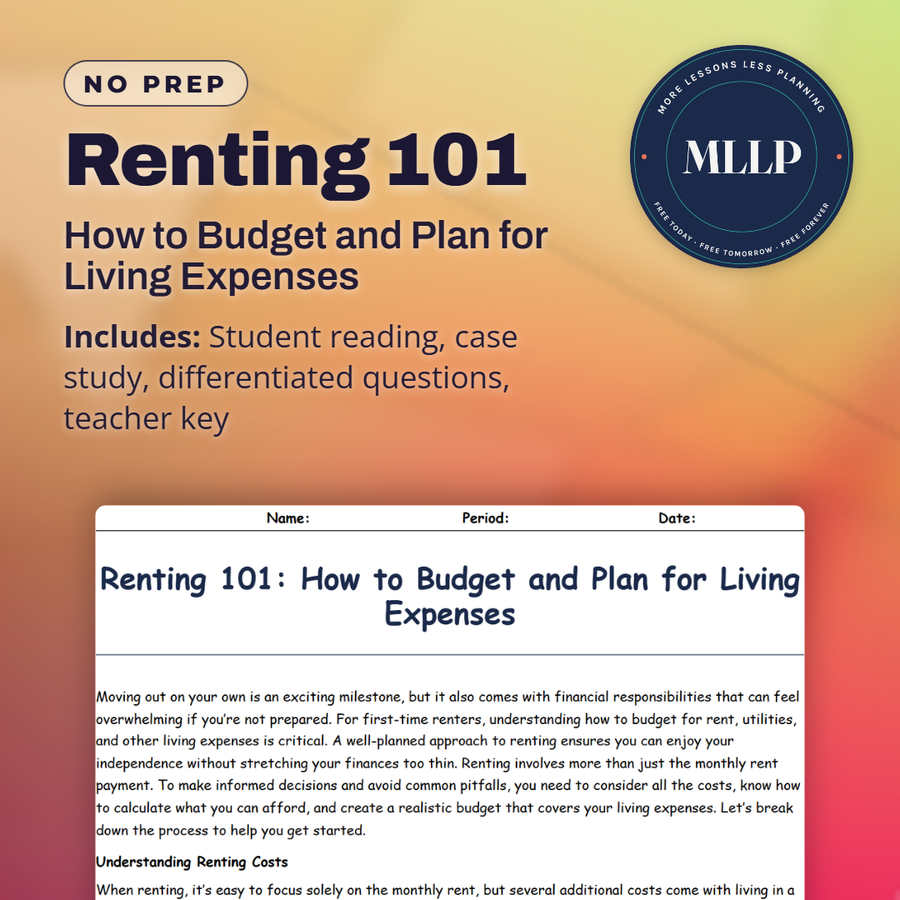
Renting 101: How to Budget and Plan for Living Expenses
Quality reviewed September 2026
Facts verified September 24, 2026
- Subject
- Career & Life Skills
- Grades
- Grades 9-12
- Length
- 7-page student worksheet
- Time
- About one 50-minute class period
- Great for
- Sub plans and independent work
- Includes
- Reading passage, comprehension questions + full answer key
- Format
- Print-and-go PDF
What students do
- Match utilities and a security deposit to definitions like costs for electricity and water and money held for damages, plus renter's insurance, an emergency fund, and groceries to their own definitions
- Fill in the blanks on the percentage of income the 30% rule recommends for rent, what a security deposit is, and what kind of costs to factor into a monthly budget
- Answer multiple choice questions on the purpose of a security deposit, the recommended share of income to spend on rent, and which item on the list isn't actually a utility
- Write short answers on three upfront costs of renting, why utilities matter for a rental budget, and how Alex switched to a $950 apartment to free up $250 a month for savings
What it covers
- The full cost of renting beyond monthly rent, including security deposits, utilities, renter's insurance, and application fees
- The 30% rule for figuring out how much rent you can afford based on take-home pay
- A case study on Alex, who chose a cheaper apartment to free up $250 a month after his first choice left him with only $730 for everything else
Start reading this worksheet
Moving out on your own is an exciting milestone, but it also comes with financial responsibilities that can feel overwhelming if you’re not prepared. For first-time renters, understanding how to budget for rent, utilities, and other living expenses is critical. A well-planned approach to renting ensures you can enjoy your independence without stretching your finances too thin. Renting involves more than just the monthly rent payment. To make informed decisions and avoid common pitfalls, you need to consider all the costs, know how to calculate what you can afford, and create a realistic budget that covers your living expenses. Let’s break down the process to help you get started.
Understanding Renting Costs
When renting, it’s easy to focus solely on the monthly rent, but several additional costs come with living in a rental property. These include: Rent: This is the fixed monthly amount you pay to live in the property. Rent varies based on location, size, and amenities. Security Deposit: Landlords typically require this one-time payment upfront. It’s held as insurance against property damage or unpaid rent. If you leave the property in good condition, you may get this money back. Utilities: Depending on your rental agreement, you may need to pay for electricity, water, gas, internet, and trash services. Some rentals include these in the rent, while others do not. Renter’s Insurance: This low-cost insurance protects your belongings in case of theft, fire, or other damages. Application Fees: Some landlords charge a fee to process your rental application and run background or credit checks. Understanding these costs helps you avoid surprises and ensures you budget appropriately.
How to Calculate Affordable Rent
A common guideline for determining how much rent you can afford is the 30% rule. This suggests that you spend no more than 30% of your gross monthly income on rent. For example, if your monthly income is $3,000, your rent should ideally not exceed $900. However, this rule is just a starting point. Your other financial obligations, such as student loans, car payments, and groceries, should also factor into your decision. To calculate affordable rent: Determine Your Monthly Income: Use your take-home pay (after taxes and deductions) rather than your gross income for a more accurate picture. List All Expenses: Include fixed expenses like car payments and variable expenses like food and entertainment. Subtract Expenses from Income: What’s left is your discretionary income, which should cover rent and utilities. For example, if your take-home pay is $2,500, and your fixed and variable expenses total $1,500, you have $1,000 left. Aim to spend less than $1,000 on rent and utilities combined to leave room for savings and unexpected costs.
Like what you read? The full reading, the case study, and every question set are in the free download below, along with the answer key.
Why this matters
Moving out for the first time comes with costs that don't show up until the lease is already signed, like security deposits and renter's insurance, and Alex's near-miss shows how quickly rent alone can eat a paycheck. The 30% rule gives students a number to check their own plans against instead of guessing what they can afford. For anyone thinking about a first apartment, whether that's next year or in five years, knowing to budget for utilities and an emergency fund before signing anything avoids the kind of squeeze Alex almost put himself in.
From one teacher to another
Rent is only the first number in the reading's breakdown of what an apartment actually costs, alongside the security deposit, utilities, renter's insurance, and sometimes an application fee. It explains the 30% rule for figuring out how much rent you can afford based on take-home pay, then walks through a full budgeting example with rent, utilities, groceries, transportation, entertainment, and savings adding up to $1,850 a month. Students finish with Alex, a recent graduate who nearly signed a lease that would have left him with only $730 for everything else, then switched to a cheaper one-bedroom that freed up $250 a month for savings.
What you get
Download
Where should I send the next one?
Everything here is free and it stays that way. Leave your email and I'll send you the new lessons as they go up. You can unsubscribe from any one of them.
Related resources
Debit vs. Credit Cards: How to Choose the Right Payment Method
Financial Scams Teens Should Know: Spotting and Avoiding Fraud
How to Build a Strong Credit Score from Day One
How to Read a Paycheck: Understanding Deductions and Net Pay
How to Start Saving for Retirement as a Teen
Insurance for Beginners: What Teens Need to Know About Coverage
Every lesson on this site is free to download and use. If one of them saved you a prep period, you can chip in a few bucks toward my three kids' daycare fund. That's genuinely where tips go.