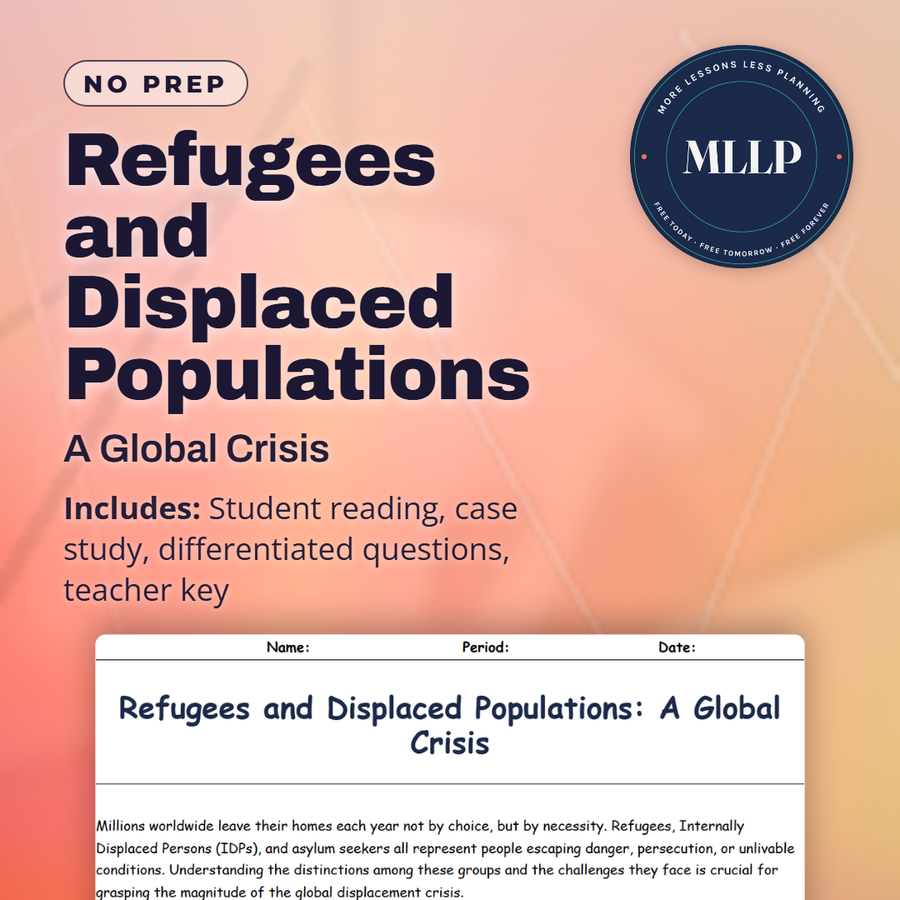
Refugees and Displaced Populations: A Global Crisis
Quality reviewed September 2026
Facts verified September 14, 2026
- Subject
- Social Studies
- Grades
- Grades 9-12
- Length
- 7-page student worksheet
- Time
- About one 50-minute class period
- Great for
- Sub plans and independent work
- Includes
- Reading passage, comprehension questions + full answer key
- Format
- Print-and-go PDF
What students do
- Match terms like Host Community, Stateless, and Persecution to their correct definitions
- Fill in the blank sentences on refugee law, Internally Displaced Persons, and humanitarian organizations
- Answer multiple choice questions on the definition of an IDP, challenges asylum seekers face, and the meaning of non-refoulement
- Write short answers on why refugee policies differ by country, risks children face in refugee camps, and how the international community can better support host nations
What it covers
- The legal differences between refugees, IDPs, and asylum seekers, and the protections each group has under international law
- Major causes of displacement, including war, climate change, and political persecution
- A case study on the Rohingya crisis and the refugee camps that formed in Bangladesh
Start reading this worksheet
Millions worldwide leave their homes each year not by choice, but by necessity. Refugees, Internally Displaced Persons (IDPs), and asylum seekers all represent people escaping danger, persecution, or unlivable conditions. Understanding the distinctions among these groups and the challenges they face is crucial for grasping the magnitude of the global displacement crisis.
Defining Refugees, IDPs, and Asylum Seekers
A refugee is someone who flees their country due to a well-founded fear of persecution, conflict, or violence and who requires international protection. In contrast, IDPs remain within their own country’s borders but cannot return home because of similar threats. An asylum seeker is an individual seeking refugee status in another country. These categories exist to ensure proper legal protections. Refugees often rely on international conventions and agencies like the United Nations High Commissioner for Refugees (UNHCR) to secure safety and assistance. However, the process of asylum can be lengthy, with many living in limbo while their claims are assessed.
Major Causes of Displacement
War is a prime driver of forced displacement. When conflict engulfs civilian areas, people must evacuate to survive. Climate change also fuels displacement—rising sea levels, droughts, or extreme weather events can devastate communities. Economic collapse, widespread famine, and political persecution complete a grim list of push factors. Civilians frequently have little warning. They may undertake perilous journeys, crossing borders under life-threatening conditions. In many cases, entire families spend months or years in refugee camps, hoping for stability. The scale of these movements challenges both regional neighbors and distant nations asked to share in the responsibility of resettlement.
Like what you read? The full reading, the case study, and every question set are in the free download below, along with the answer key.
Why this matters
Refugee, IDP, and asylum seeker sound interchangeable, but international law treats them as three different legal categories with three different sets of protections, and the difference decides whether someone gets support or gets turned away under the principle of non-refoulement. The Rohingya crisis shows what happens when hundreds of thousands of people cross into Bangladesh faster than a host community can absorb them.
Students almost always lump these categories together at the start, so I make them sort a few real scenarios into refugee, IDP, or asylum seeker before we open the reading. The Rohingya case study forces a harder question, what a host country owes people it never agreed to receive.
From one teacher to another
This reading sorts out the legal differences between refugees, IDPs, and asylum seekers, and walks through the main causes of forced displacement, from war to climate change. I like that the case study on the Rohingya crisis gives students a specific, recent example of what happens when hundreds of thousands of people cross into a neighboring country with limited resources to receive them. Students match terms like host community and persecution, fill in blanks about refugee law, and then answer questions about the risks displaced children face and how the international community can help. This pairs well with a unit on human rights or global crises.
What you get
Download
Where should I send the next one?
Everything here is free and it stays that way. Leave your email and I'll send you the new lessons as they go up. You can unsubscribe from any one of them.
Related resources
Birth Rates, Death Rates, and Life Expectancy Explained
Global Population Growth: Trends and Impacts
How Governments Shape Population Policies
Immigration vs. Emigration: What’s the Difference?
Mapping Population Density and Distribution Patterns
Overpopulation and Earth’s Carrying Capacity
Every lesson on this site is free to download and use. If one of them saved you a prep period, you can chip in a few bucks toward my three kids' daycare fund. That's genuinely where tips go.