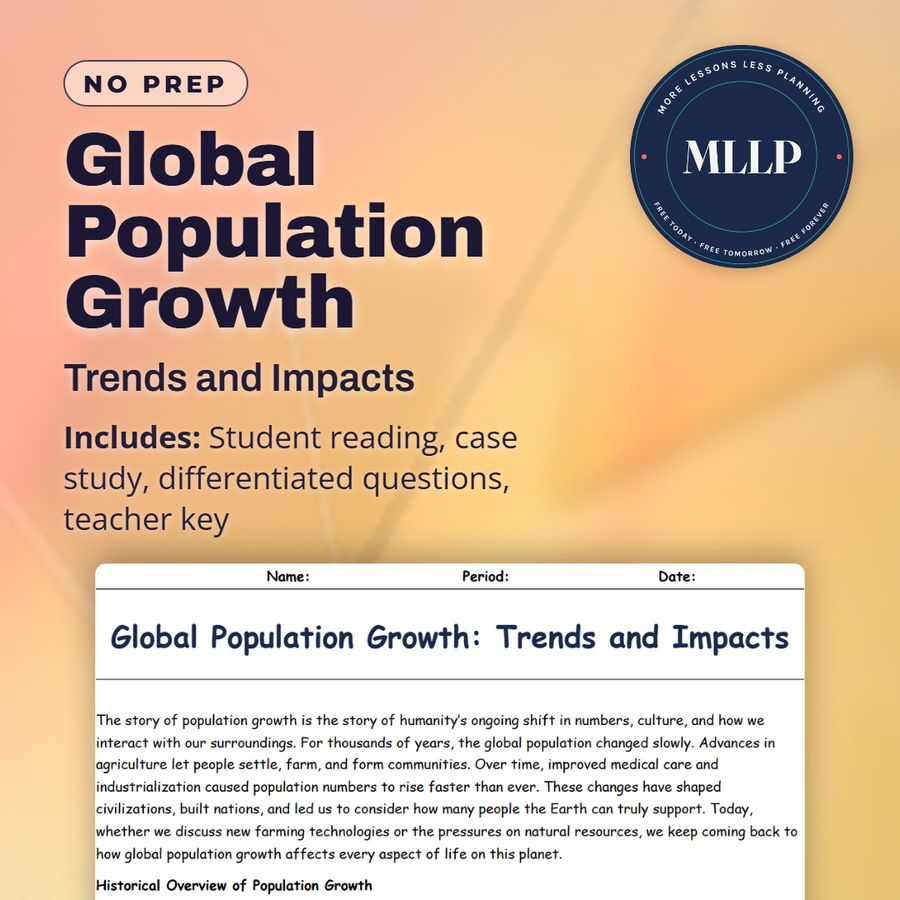
Global Population Growth: Trends and Impacts
Quality reviewed September 2026
Facts verified September 14, 2026
- Subject
- Social Studies
- Grades
- Grades 9-12
- Length
- 7-page student worksheet
- Time
- About one 50-minute class period
- Great for
- Sub plans and independent work
- Includes
- Reading passage, comprehension questions + full answer key
- Format
- Print-and-go PDF
What students do
- Match terms like Fertility, Deforestation, and Resource Scarcity to their correct definitions
- Fill in the blank sentences on population growth, resource scarcity, and farming technologies
- Answer multiple choice questions on the Industrial Revolution, the Green Revolution, and why developing countries often have higher birth rates
- Write short answers on how population growth creates both economic opportunities and environmental challenges, and how cultural beliefs shape family size
What it covers
- The history of population growth from early settlements through the Industrial Revolution and Green Revolution
- How population growth strains resources and the environment, from deforestation to water scarcity
- A case study on rapid population growth in Lagos, Nigeria, and its effects on housing, healthcare, and schools
Start reading this worksheet
The story of population growth is the story of humanity’s ongoing shift in numbers, culture, and how we interact with our surroundings. For thousands of years, the global population changed slowly. Advances in agriculture let people settle, farm, and form communities. Over time, improved medical care and industrialization caused population numbers to rise faster than ever. These changes have shaped civilizations, built nations, and led us to consider how many people the Earth can truly support. Today, whether we discuss new farming technologies or the pressures on natural resources, we keep coming back to how global population growth affects every aspect of life on this planet.
Historical Overview of Population Growth
Early human communities grew gradually. Diseases, limited resources, and a lack of advanced healthcare kept the death rate high, balancing any increases from births. People lived in smaller, scattered settlements and relied heavily on hunting, gathering, or basic farming. As centuries passed, tools improved. The Agricultural Revolution introduced stable food supplies, and people began to farm effectively, leading to population clusters near rivers or fertile land. With the Industrial Revolution, populations soared. Factories drew workers to cities, and medicine improved. Countries like Britain saw rapid urban growth, as new machines boosted production and provided jobs. As overall life expectancy began to increase, more people survived childhood, creating a cycle of growth. By the 20th century, the Green Revolution introduced high-yield crops that further fueled population expansion in many developing regions. These surges created both opportunities for progress and challenges to resource distribution.
Modern Trends and Factors Influencing Rapid Growth
In the modern era, the pace of population expansion varies by region. Many developing countries experience rapid growth due to higher fertility rates, improved medical care, and expanding economies. In contrast, some industrialized nations see relatively stable or declining populations due to lifestyle choices, later marriages, and widespread contraceptive use. Economic development, cultural norms, and public health strategies all play roles in population growth. When healthcare systems deliver vaccinations and prenatal care, more children survive. When economies improve, families may choose to have fewer children, focusing more on education and overall well-being. Additionally, urbanization has influenced birth rates, as city dwellers often have less space, which can lead to smaller family sizes. However, parts of the world still face limited healthcare access, contributing to higher birth rates and faster growth.
Like what you read? The full reading, the case study, and every question set are in the free download below, along with the answer key.
Why this matters
Lagos, Nigeria is caught between overcrowded neighborhoods and families still arriving in search of better opportunities. That split, strain on housing and schools beside real economic hope, is a more honest picture of population growth than a rising number alone.
Rapid growth looks like bad news at first glance, but weighing economic opportunity against environmental challenge catches most students off guard once they look closer. I save the question on cultural beliefs about family size for last, since that is usually where the easy verdict falls apart.
From one teacher to another
This reading traces global population growth from early farming communities through the Industrial Revolution and the Green Revolution, and it ties that history to what students see happening in cities today. I like that the case study on Lagos, Nigeria shows both sides of rapid growth, overcrowded neighborhoods and strained services, but also the optimism of families chasing better opportunities. The matching and fill-in-the-blank sections build vocabulary around fertility, deforestation, and resource scarcity before students weigh in with their own short answers. This pairs well with a unit on urbanization or resource distribution.
What you get
Download
Where should I send the next one?
Everything here is free and it stays that way. Leave your email and I'll send you the new lessons as they go up. You can unsubscribe from any one of them.
Related resources
Birth Rates, Death Rates, and Life Expectancy Explained
How Governments Shape Population Policies
Immigration vs. Emigration: What’s the Difference?
Mapping Population Density and Distribution Patterns
Overpopulation and Earth’s Carrying Capacity
Push and Pull Factors of Human Migration
Every lesson on this site is free to download and use. If one of them saved you a prep period, you can chip in a few bucks toward my three kids' daycare fund. That's genuinely where tips go.