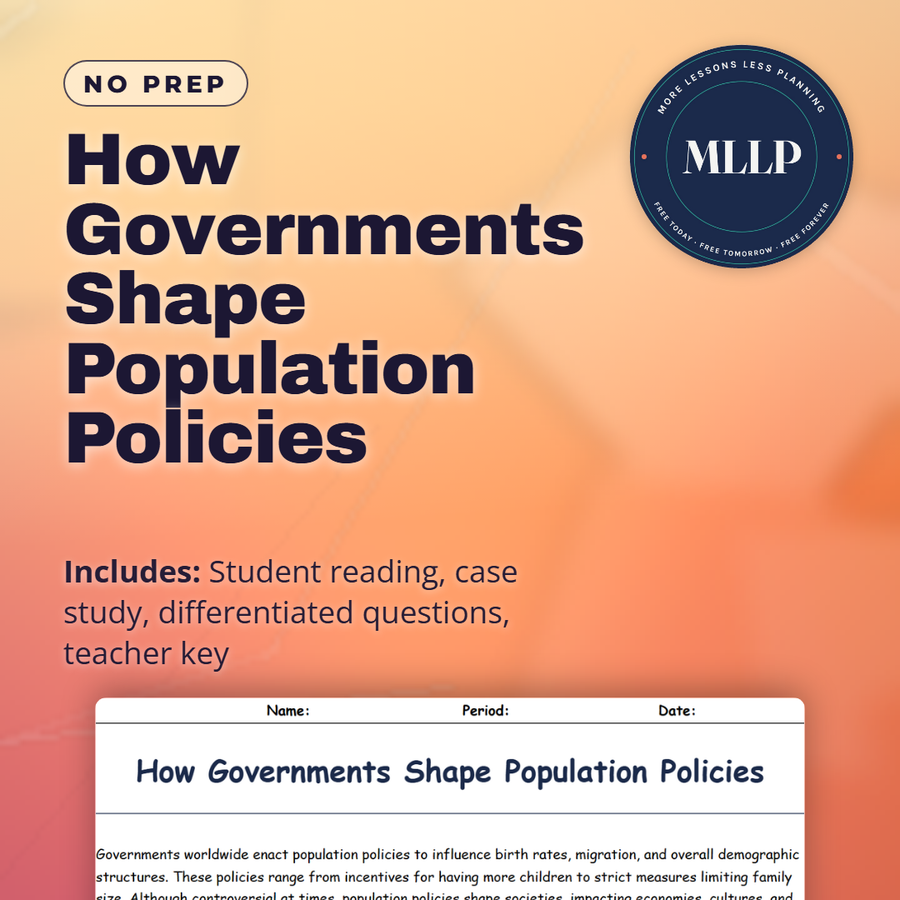
How Governments Shape Population Policies
Quality reviewed September 2026
Facts verified September 14, 2026
- Subject
- Social Studies
- Grades
- Grades 9-12
- Length
- 6-page student worksheet
- Time
- About one 50-minute class period
- Great for
- Sub plans and independent work
- Includes
- Reading passage, comprehension questions + full answer key
- Format
- Print-and-go PDF
What students do
- Match terms like Family Planning, Coercive Policy, and Gender Imbalance to their correct definitions
- Fill in the blank sentences on anti-natalist policy, political shifts, and family planning
- Answer multiple choice questions on anti-natalist aims, the downsides of strict family size limits, and why countries adopt pro-natalist policies
- Write short answers on how economic factors shape population policy and why a nation might reverse a family planning campaign
What it covers
- The difference between pro-natalist and anti-natalist policies, including China's One-Child Policy and France's family incentives
- Ethical questions raised by government population control, from individual rights to social equity
- A case study on Iran's shifting family planning policies from the 1980s to today
Start reading this worksheet
Governments worldwide enact population policies to influence birth rates, migration, and overall demographic structures. These policies range from incentives for having more children to strict measures limiting family size. Although controversial at times, population policies shape societies, impacting economies, cultures, and even the environment.
Pro-natalist vs. Anti-natalist Policies
A pro-natalist policy encourages higher birth rates. Nations with aging populations or labor shortages (like some European countries) may offer tax breaks, childcare subsidies, or extended parental leave to boost fertility. In contrast, anti-natalist policies aim to curb population growth through family planning education, contraception distribution, or legal limits on family size. Cultural and ethical debates swirl around these approaches. Critics argue that controlling reproduction can infringe on personal freedoms. Supporters suggest that strategic policies can stabilize economies and reduce strains on resources.
Famous Examples: China and France
China’s One-Child Policy stands as a prominent anti-natalist measure, introduced in 1979 to slow population growth. While effective in reducing birth rates, it also led to unintended consequences like gender imbalances and an aging society. Over time, China relaxed the policy to allow for two and then three children, reflecting shifting priorities. France, on the other hand, is known for its pro-natalist stance. Generous family benefits, subsidized childcare, and housing allowances encourage citizens to have more children. These measures aim to sustain a balanced population structure and address labor needs.
Like what you read? The full reading, the case study, and every question set are in the free download below, along with the answer key.
Why this matters
Iran spent the 1980s encouraging smaller families, then reversed course decades later to encourage larger ones. That reversal is the detail this reading builds around, since it shows population policy is not a fixed stance a country picks once but something that shifts as circumstances change.
Comparing China's One-Child Policy against France's family incentives shows students that pro-natalist and anti-natalist policies pull the same lever, family size, from opposite directions. What surprises them most is that a government would reverse a campaign at all, which is exactly what the Iran question asks them to explain.
From one teacher to another
This reading compares pro-natalist and anti-natalist population policies, using China's One-Child Policy and France's family incentives as concrete examples. I like that the case study on Iran shows how quickly a government can reverse course, moving from promoting smaller families in the 1980s to encouraging larger ones decades later. Students match key terms like coercive policy and reproductive rights, then fill in blanks and answer questions that ask them to think through why governments intervene in family size at all. This pairs well with a unit on government and demographics.
What you get
Download
Where should I send the next one?
Everything here is free and it stays that way. Leave your email and I'll send you the new lessons as they go up. You can unsubscribe from any one of them.
Related resources
Birth Rates, Death Rates, and Life Expectancy Explained
Global Population Growth: Trends and Impacts
Immigration vs. Emigration: What’s the Difference?
Mapping Population Density and Distribution Patterns
Overpopulation and Earth’s Carrying Capacity
Push and Pull Factors of Human Migration
Every lesson on this site is free to download and use. If one of them saved you a prep period, you can chip in a few bucks toward my three kids' daycare fund. That's genuinely where tips go.