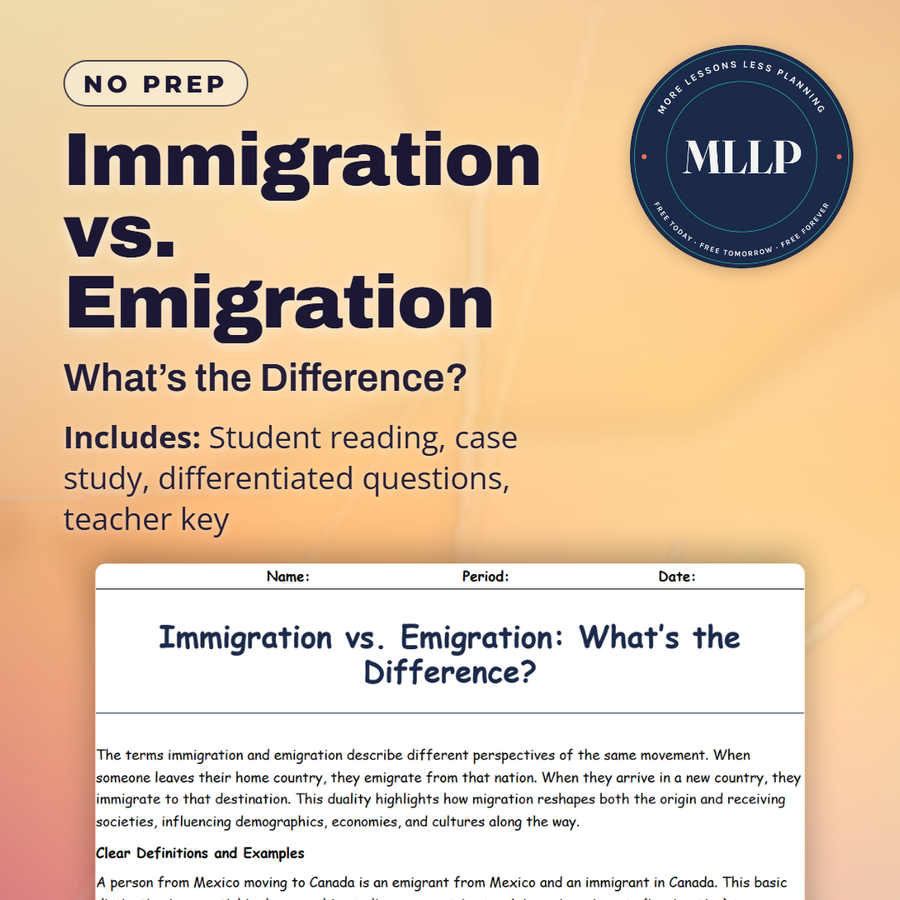
Immigration vs. Emigration: What’s the Difference?
Quality reviewed September 2026
Facts verified September 14, 2026
- Subject
- Social Studies
- Grades
- Grades 9-12
- Length
- 7-page student worksheet
- Time
- About one 50-minute class period
- Great for
- Sub plans and independent work
- Includes
- Reading passage, comprehension questions + full answer key
- Format
- Print-and-go PDF
What students do
- Match terms like Brain Drain, Remittances, and Assimilation to their correct definitions
- Fill in the blank sentences on immigration, migration rates, and immigration laws
- Answer multiple choice questions on the definition of emigration, how host countries benefit from immigration, and what causes immigration policy to tighten
- Write short answers on how emigration creates problems and benefits for a home country, and how immigrants balance assimilation with cultural identity
What it covers
- The difference between immigration and emigration, using clear definitions and examples
- Effects of migration on both home and host countries, including brain drain and remittances
- A case study on Irish emigration to the United States during the potato famine
Start reading this worksheet
The terms immigration and emigration describe different perspectives of the same movement. When someone leaves their home country, they emigrate from that nation. When they arrive in a new country, they immigrate to that destination. This duality highlights how migration reshapes both the origin and receiving societies, influencing demographics, economies, and cultures along the way.
Clear Definitions and Examples
A person from Mexico moving to Canada is an emigrant from Mexico and an immigrant in Canada. This basic distinction is essential in demographic studies, as countries track incoming migrants (immigration) to understand population changes, while origin nations note outflows (emigration) to gauge labor force shifts. Immigration often reflects pull factors like better job opportunities or family reunification. Emigration might signal economic or political push factors prompting individuals to seek a fresh start. Recognizing these two perspectives helps clarify the global flow of people across borders.
Impacts on Home Countries
When large numbers of people emigrate, home countries can experience a “brain drain,” losing skilled workers and professionals. This exodus might strain local economies, as fewer taxpayers remain to support public services. However, remittances sent back by emigrants can bolster a homeland’s economy, funding education and healthcare for relatives. Culturally, emigration may reduce traditional family structures, leaving behind elders or children. Some communities see entire generations depart, leading to declining populations. Yet returning migrants sometimes bring back new skills, investments, and ideas, sparking positive change.
Like what you read? The full reading, the case study, and every question set are in the free download below, along with the answer key.
Why this matters
The Irish emigration case study gives students push and pull factors working at once instead of as two separate terms. Leaving during the famine was the push, and whatever waited across the ocean was the pull, a cleaner way into immigration versus emigration than any definition alone.
Migration usually gets taught from one side only, the country people arrive in. Weighing what emigration costs and gives the home country catches most students off guard, and brain drain and remittances become concrete once they argue both directions at once.
From one teacher to another
This reading breaks down the difference between immigration and emigration, then walks through what each one means for the country people leave and the country they arrive in. I like that the case study on Irish emigration to the United States gives students a concrete historical example of push and pull factors working together. The matching section covers terms like brain drain and remittances, and the short answer questions ask students to weigh the costs and benefits on both sides of migration. This pairs well with a unit on migration patterns.
What you get
Download
Where should I send the next one?
Everything here is free and it stays that way. Leave your email and I'll send you the new lessons as they go up. You can unsubscribe from any one of them.
Related resources
Birth Rates, Death Rates, and Life Expectancy Explained
Global Population Growth: Trends and Impacts
How Governments Shape Population Policies
Mapping Population Density and Distribution Patterns
Overpopulation and Earth’s Carrying Capacity
Push and Pull Factors of Human Migration
Every lesson on this site is free to download and use. If one of them saved you a prep period, you can chip in a few bucks toward my three kids' daycare fund. That's genuinely where tips go.