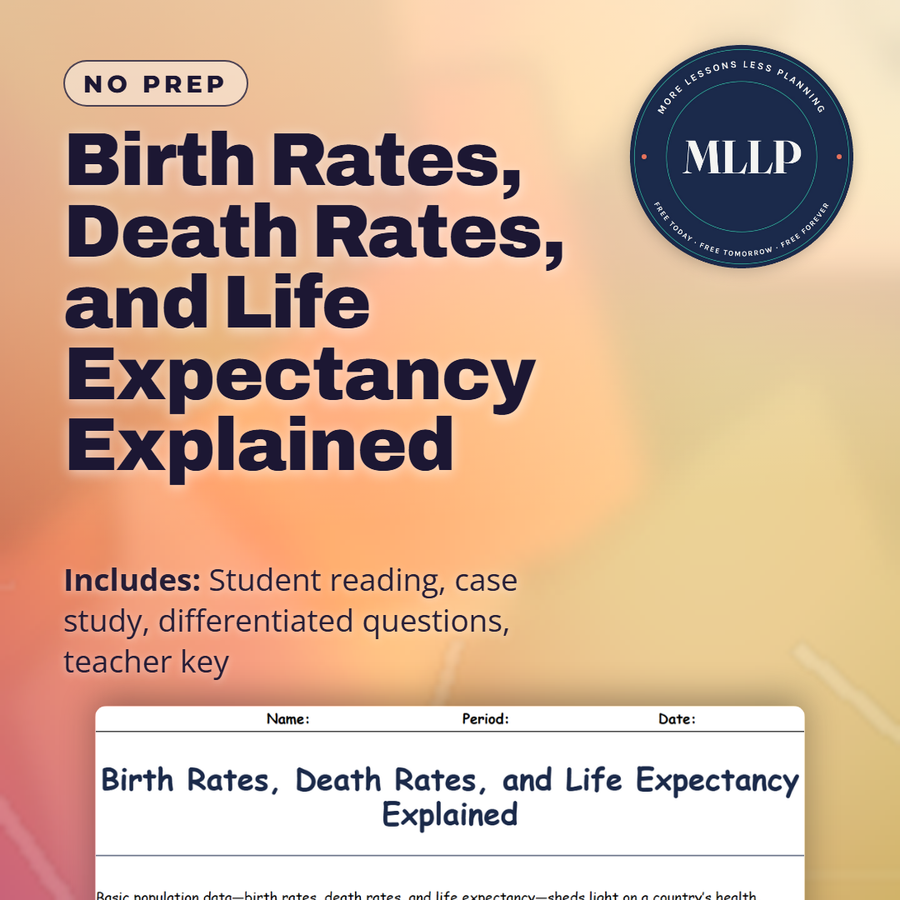
Birth Rates, Death Rates, and Life Expectancy Explained
Quality reviewed September 2026
Facts verified September 14, 2026
- Subject
- Social Studies
- Grades
- Grades 9-12
- Length
- 6-page student worksheet
- Time
- About one 50-minute class period
- Great for
- Sub plans and independent work
- Includes
- Reading passage, comprehension questions + full answer key
- Format
- Print-and-go PDF
What students do
- Match terms like Infant Mortality, Youth Bulge, and Longevity to their correct definitions
- Fill in the blank sentences on declining populations, longevity, and healthcare infrastructure
- Answer multiple choice questions on youth bulges, high death rates in developing countries, and low birth rates in industrialized societies
- Write short answers on how high birth rates both benefit and challenge a developing nation, and why some governments worry about having too few births
What it covers
- Definitions and calculations behind birth rate, death rate, and life expectancy
- How healthcare, economics, and development influence these population indicators
- A case study on Japan's aging population and its shrinking birth rate
Start reading this worksheet
Basic population data, namely birth rates, death rates, and life expectancy, sheds light on a country’s health, economics, and overall development. While these terms are often used in reports and news articles, each carries unique significance. Understanding them in detail helps students and policymakers alike see the bigger picture of a nation’s strengths, weaknesses, and future potential.
Definitions and Calculations
The birth rate is typically defined as the number of live births per 1,000 individuals in a population over a year. The death rate follows a similar structure, tracking the number of deaths per 1,000 individuals annually. These figures can be influenced by healthcare quality, cultural factors, and even climate. Life expectancy measures the average number of years a newborn can expect to live under current mortality conditions. If a nation experiences high infant mortality, overall life expectancy might be much lower. Conversely, access to modern medicine and stable social conditions often elevates life expectancy for most citizens.
Global Variations and Indicators
Countries with high birth rates can have rapidly expanding populations. Often, these places are in earlier stages of development, where large families remain the norm. On the flip side, nations with lower birth rates might see aging populations that can strain healthcare systems and pension funds. Death rates can rise due to conflicts, poor nutrition, or lack of medical facilities. In highly developed nations, death rates may still be relatively moderate or even higher than expected, mainly because they have a larger proportion of older adults. Life expectancy correlates closely with income, education, and healthcare infrastructure. Wealthier countries generally offer more medical resources, leading to longer lives.
Like what you read? The full reading, the case study, and every question set are in the free download below, along with the answer key.
Why this matters
Japan's shrinking birth rate has already closed schools and strained its pension system, turning an abstract statistic into something students can picture happening to real towns. I place that case study right after the definitions of birth rate and death rate so the vocabulary has somewhere to land.
Students assume a high birth rate is only good news for a developing country, so weighing both its benefits and its challenges slows them down. Working through youth bulge and longevity beside Japan's opposite problem shows population change cuts both ways depending on where a country sits in its development.
From one teacher to another
This reading walks through birth rates, death rates, and life expectancy and how they connect to a country's health and development. I like that the case study on Japan's aging society gives students a real example of what a shrinking birth rate looks like in practice, from school closures to pension strain. The matching and fill-in-the-blank sections reinforce terms like youth bulge and longevity before students apply them in the multiple choice and short answer questions. This pairs well with a unit on global population trends.
What you get
Download
Where should I send the next one?
Everything here is free and it stays that way. Leave your email and I'll send you the new lessons as they go up. You can unsubscribe from any one of them.
Related resources
Global Population Growth: Trends and Impacts
How Governments Shape Population Policies
Immigration vs. Emigration: What’s the Difference?
Mapping Population Density and Distribution Patterns
Overpopulation and Earth’s Carrying Capacity
Push and Pull Factors of Human Migration
Every lesson on this site is free to download and use. If one of them saved you a prep period, you can chip in a few bucks toward my three kids' daycare fund. That's genuinely where tips go.