Recognizing Child Abuse and Neglect
Quality reviewed September 2026
Facts verified September 23, 2026
- Subject
- Career & Life Skills
- Grades
- Grades 9-12
- Length
- 9-page student worksheet
- Time
- About one 50-minute class period
- Great for
- Sub plans and independent work
- Includes
- Reading passage, comprehension questions + full answer key
- Format
- Print-and-go PDF
What students do
- Marcus's own logged observations get checked against the reasonable suspicion standard the reading defines
- Identify the four categories CAPTA recognizes and where neglect fits among them
- Explain why a mandated reporter's job stops at noticing rather than investigating
- Explain why the reading warns against interviewing a child directly or promising to keep the report secret
What it covers
- The legal definitions behind physical abuse, neglect, emotional abuse, and sexual abuse
- Why reasonable suspicion, not proof, is the standard a mandated reporter has to meet
- Marcus's case study, where a pattern of small changes gets written down and reported correctly
Start reading this worksheet
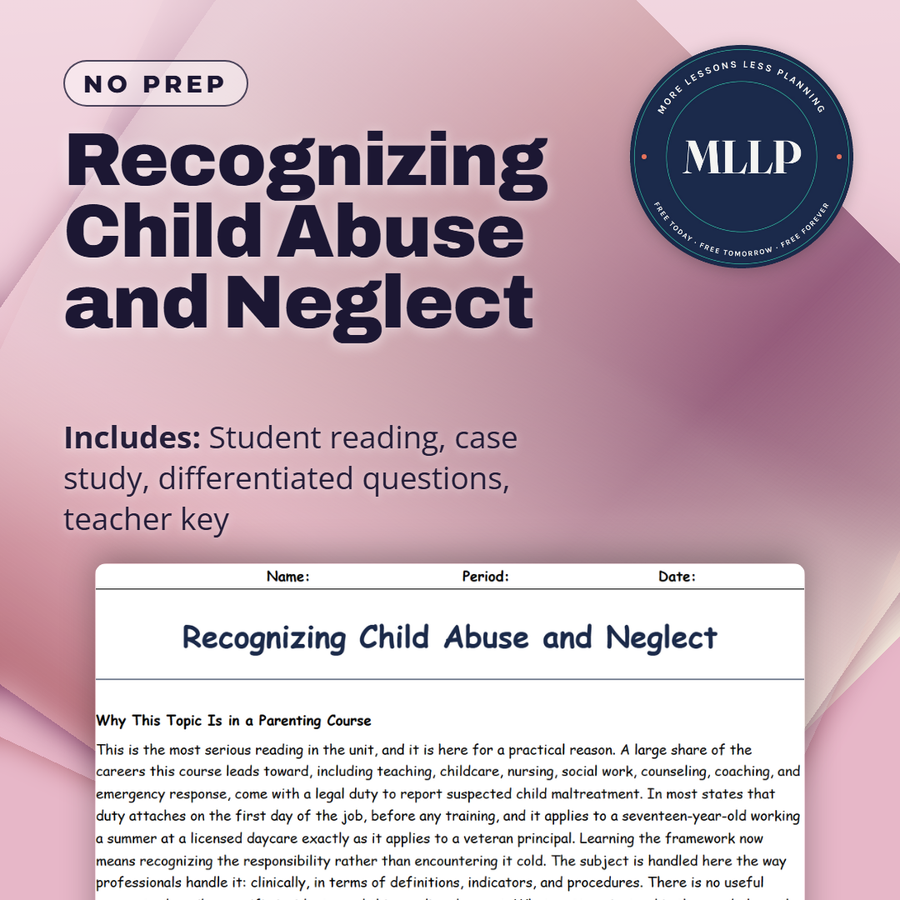
Why This Topic Is in a Parenting Course
This is the most serious reading in the unit, and it is here for a practical reason. A large share of the careers this course leads toward, including teaching, childcare, nursing, social work, counseling, coaching, and emergency response, come with a legal duty to report suspected child maltreatment. In most states that duty attaches on the first day of the job, before any training, and it applies to a seventeen-year-old working a summer at a licensed daycare exactly as it applies to a veteran principal. Learning the framework now means recognizing the responsibility rather than encountering it cold. The subject is handled here the way professionals handle it: clinically, in terms of definitions, indicators, and procedures. There is no useful reason to describe specific incidents, and this reading does not. What matters instead is the vocabulary, the legal standard, and the steps, because in a real situation an adult who has to invent a procedure under stress usually delays, and delay is the failure mode that causes harm. It also helps to name the emotional reality directly. Most people who make a report describe feeling sick about it, worried they are wrong, and worried about damaging a family. Those feelings are normal and they are not a reason to stay silent, which is precisely why the legal standard is written the way it is. It also helps to know that silence carries its own weight. Adults who said nothing and later learned they had been right describe that as far harder to live with than the discomfort of a report that turned out to go nowhere.
The Definitions the Law Uses
The federal Child Abuse Prevention and Treatment Act, usually shortened to CAPTA, sets the minimum definition that every state builds its own law on top of. In broad terms it covers any recent act or failure to act by a parent or caregiver that results in death, serious physical or emotional harm, or exploitation, or that presents an imminent risk of serious harm. State laws add the specifics, so the exact wording and the exact list of reporters differ depending on where a person works. Four categories are recognized. Physical abuse involves non-accidental physical injury inflicted by a caregiver. Neglect is the failure to meet a child's basic needs, including food, shelter, clothing, medical care, education, and adequate supervision, and it is by a wide margin the most frequently reported and substantiated category in the United States. Emotional or psychological abuse involves a pattern of caregiver behavior that damages a child's sense of worth or emotional development, such as persistent rejecting, terrorizing, or isolating. Sexual abuse involves any sexual activity with a child, and because children cannot legally consent, the presence or absence of physical force is not part of the definition. Two boundaries are worth stating plainly. Poverty by itself is not neglect, and a family that cannot afford something is not the same as a family that will not provide it. Cultural difference in parenting practice is likewise not abuse, and both distinctions are ones investigators are trained to make.
Patterns, Not Single Signs
Professionals do not look for one telltale sign, because there is no such thing, and treating any single observation as proof is how both false alarms and missed cases happen. What trained reporters look for is a pattern: several indicators appearing together, a change from a child's own baseline, or an explanation that does not fit what is observed. Categories of concern include injuries whose stated cause does not match their appearance or location, injuries in a child too young to be moving on their own, and repeated injuries with shifting explanations. On the neglect side, concerns include a child who is persistently hungry, chronically unwashed, dressed inadequately for the weather, frequently unsupervised for their age, or missing medical care for an identified condition. Behavioral indicators can include marked fearfulness around a particular adult, sudden withdrawal or aggression that represents a real change, developmental regression, or knowledge and behavior clearly outside the child's age range. Each of these has innocent explanations that are far more common than maltreatment. A bruise on a shin usually means a child ran into a table. That is exactly the point of a pattern-based approach, and it is also why the reporter's job stops at noticing. A reporter is not a diagnostician and is not expected to determine what happened. They are expected to notice carefully, write down what they actually observed rather than what they concluded, and hand it to people whose job is to find out.
Like what you read? The full reading, the case study, and every question set are in the free download below, along with the answer key.
Why this matters
A meaningful share of this course's career paths, teaching, coaching, childcare, nursing, carry the legal duty to report starting on day one of the job, often before any formal training happens. Giving students the vocabulary and the actual procedure now, while the stakes are still a worksheet, means the first time they use reasonable suspicion as a standard is not also the first time they have ever heard the phrase. The reading's closing point, that a single steady adult changes a child's trajectory, is one this course's students are already in a position to be for someone.
From one teacher to another
Marcus is nineteen and works afternoons in a preschool room, and this reading follows the exact process he uses when a pattern of small changes in one child adds up to something he cannot explain away. The passages are written the way professionals actually discuss this subject, in terms of legal definitions, indicators, and procedure rather than description, starting with the federal CAPTA framework and the four recognized categories of abuse and neglect. I preview this one before assigning it, since it covers mandated reporting law and names the national hotlines a reporter can use, and a topic like this can prompt a student to disclose something of their own. From there the reading walks through the reasonable suspicion standard, the actual steps of making a report, and what happens after a report is made, which is services far more often than removal. It closes on prevention, naming the specific supports that lower risk before anything happens, and on the finding that one steady adult, often a teacher, measurably changes a child's outcome.
What you get
Download
Where should I send the next one?
Everything here is free and it stays that way. Leave your email and I'll send you the new lessons as they go up. You can unsubscribe from any one of them.
Related resources
Are You Ready? The Realities of Parenthood
Caring for Children with Special Needs

Childcare Options and What They Cost
Childproofing and Child Safety
Feeding Infants and Young Children

Parenting Styles and How They Shape Kids
Every lesson on this site is free to download and use. If one of them saved you a prep period, you can chip in a few bucks toward my three kids' daycare fund. That's genuinely where tips go.