Reading a Care Label
Quality reviewed September 2026
Facts verified September 23, 2026
- Subject
- Career & Life Skills
- Grades
- Grades 9-12
- Length
- 8-page student worksheet
- Time
- About one 50-minute class period
- Great for
- Sub plans and independent work
- Includes
- Reading passage, comprehension questions + full answer key
- Format
- Print-and-go PDF
What students do
- Five basic shapes, always in the same order, cover almost everything a care label needs to say
- Explain the difference between a felted wool sweater and ordinary shrinkage
- Camille's ninety dollar sweater comes out of the dryer sized for a child, and the reading traces exactly why
- Match terms like felting shrinkage and dry clean only to what each one actually means
What it covers
- The five basic shapes on a care label and what each one governs
- Where care symbols get misread most often, especially the triangle and the square
- The FTC rule that makes a care label a legal document, not a suggestion
Start reading this worksheet
The Smallest Instruction Manual You Own
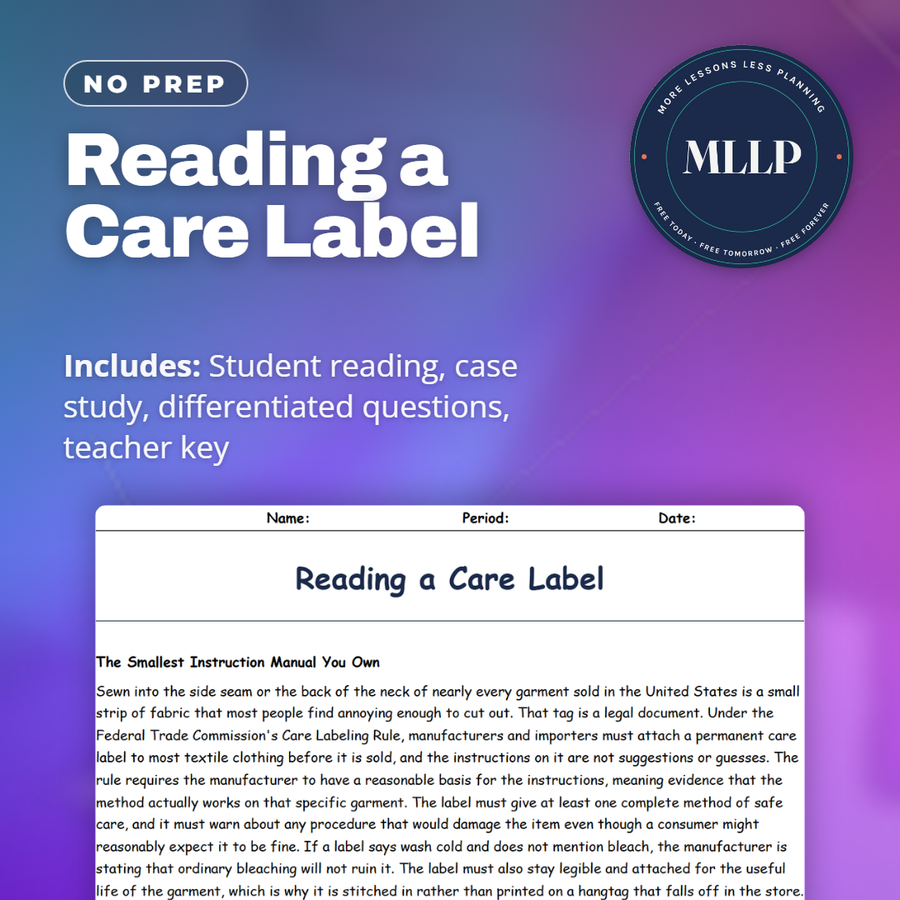
Sewn into the side seam or the back of the neck of nearly every garment sold in the United States is a small strip of fabric that most people find annoying enough to cut out. That tag is a legal document. Under the Federal Trade Commission's Care Labeling Rule, manufacturers and importers must attach a permanent care label to most textile clothing before it is sold, and the instructions on it are not suggestions or guesses. The rule requires the manufacturer to have a reasonable basis for the instructions, meaning evidence that the method actually works on that specific garment. The label must give at least one complete method of safe care, and it must warn about any procedure that would damage the item even though a consumer might reasonably expect it to be fine. If a label says wash cold and does not mention bleach, the manufacturer is stating that ordinary bleaching will not ruin it. The label must also stay legible and attached for the useful life of the garment, which is why it is stitched in rather than printed on a hangtag that falls off in the store. Two things a care label does not have to tell you: it does not have to list every method that would work, only one safe one, and it does not have to explain why. That leaves consumers to interpret a set of symbols that were never taught to most of them.
Five Shapes and What They Govern
The symbol system looks intimidating and is actually built on five basic shapes, each governing one stage of care, always appearing in the same order. A washtub, drawn as a bucket shape with a wavy top line, governs washing. A triangle governs bleaching. A square governs drying. An iron shape governs ironing and pressing. A circle governs professional dry cleaning. Once the five shapes are memorized, the rest of the system is modifiers layered onto them. Dots inside a symbol communicate temperature, and the count is consistent everywhere: one dot is the coolest setting, two dots is medium, three dots is hot, and additional dots continue upward for washing. A number inside the washtub gives the maximum water temperature in degrees Celsius instead, so a thirty inside a washtub means thirty degrees, roughly eighty-six Fahrenheit, which is a cold wash by American machine standards. Horizontal bars underneath a symbol call for gentleness: one bar means the permanent press or mild cycle, two bars means the delicate or gentle cycle, and no bar means normal. A hand shape inside the washtub means hand wash only. The genuinely universal rule is the last one, and it overrides everything: an X drawn across any symbol means do not do that at all, ever, regardless of what any other symbol suggests.
Where the Symbols Get Misread
A few symbols cause most of the laundry disasters. The triangle is the one consumers get wrong most often. An empty triangle means any bleach is allowed. A triangle with two diagonal lines inside means non-chlorine bleach only, which is oxygen bleach, safe for colors. A crossed-out triangle means no bleach of any kind, and pouring chlorine bleach on that garment will strip color permanently in a single wash. The square family causes the second wave of damage. A plain square means the item may be dried, a square with a circle inside means tumble drying is permitted, and the dots inside that circle set the dryer heat. A square with a single horizontal line drawn across the middle means dry flat, which matters enormously for knits, because hanging a wet sweater lets its own water weight stretch the shoulders out permanently. A square with three vertical lines means drip dry. The circle also generates confusion. A plain circle means dry clean, and the letter inside it is not for the consumer at all; it tells the professional cleaner which solvent to use. The important distinction is that dry clean and dry clean only mean different things. Dry clean is a recommendation and other methods may work. Dry clean only is a warning that home washing will damage the garment.
Like what you read? The full reading, the case study, and every question set are in the free download below, along with the answer key.
Why this matters
Camille's sweater did not fail because wool is fragile, it failed because a legal instruction sewn into the seam went unread, and this reading treats that gap, between what the label says and what a person actually checks before doing laundry, as worth closing. A ninety dollar mistake made once on paper is a lot cheaper than the same mistake made on an actual sweater bought with actual saved up money.
From one teacher to another
That small tag most people cut out of a shirt is a legal document under the FTC's Care Labeling Rule, and this reading explains what it is actually required to say and what it leaves out. It breaks the symbol system down into five shapes that always appear in the same order, washtub, triangle, square, iron and circle, along with the dots, bars and the crossed out X that modify them, and it connects each instruction back to a real cause, relaxation shrinkage, wool's felting shrinkage, or dye that has not fully set. The case study follows Camille, who saves for two months for a merino wool sweater, wears it twice, and washes it on warm with her darks because it is just one cuff with a coffee stain. The sweater comes out of the dryer sized for a child, and her sister finds the tag still sewn into the side seam with the two symbols that would have prevented it.
What you get
Download
Where should I send the next one?
Everything here is free and it stays that way. Leave your email and I'll send you the new lessons as they go up. You can unsubscribe from any one of them.
Related resources
Fashion Design and the Design Process
Fast Fashion and the Cost of Cheap Clothing
Hand Stitches and Basic Clothing Repairs
How Fabric Is Made: Woven, Knit, and Nonwoven
How to Read a Pattern
Laundry Basics: Sorting, Washing, and Stains
Every lesson on this site is free to download and use. If one of them saved you a prep period, you can chip in a few bucks toward my three kids' daycare fund. That's genuinely where tips go.