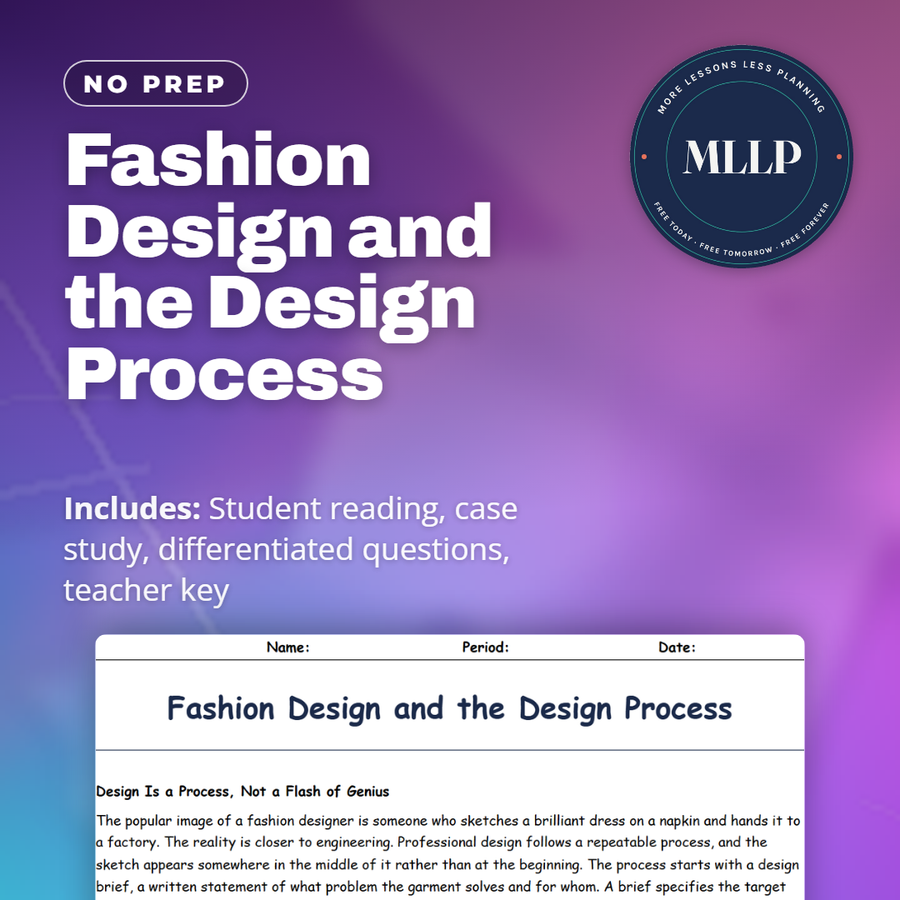
Fashion Design and the Design Process
Quality reviewed September 2026
Facts verified September 23, 2026
- Subject
- Career & Life Skills
- Grades
- Grades 9-12
- Length
- 8-page student worksheet
- Time
- About one 50-minute class period
- Great for
- Sub plans and independent work
- Includes
- Reading passage, comprehension questions + full answer key
- Format
- Print-and-go PDF
What students do
- The design brief pins down customer, price point, season and constraints before a single sketch happens
- Match design terms like mood board, tech pack and silhouette to their definitions
- Trace how a flat sketch and tech pack turn a concept into something a factory can build
- Luis's FCCLA brief shows why he could cut eight sketches down to one
What it covers
- The five stages of the fashion cycle from introduction to obsolescence
- The elements and principles of design, including balance, emphasis and proportion
- The path from a design brief to a finished sample, with a case study from an FCCLA competition
Start reading this worksheet
Design Is a Process, Not a Flash of Genius
The popular image of a fashion designer is someone who sketches a brilliant dress on a napkin and hands it to a factory. The reality is closer to engineering. Professional design follows a repeatable process, and the sketch appears somewhere in the middle of it rather than at the beginning. The process starts with a design brief, a written statement of what problem the garment solves and for whom. A brief specifies the target customer, the price point, the season, the occasion, and any hard constraints such as a required fabric, a sustainability standard, or a manufacturing limitation. Skipping the brief is the most common failure in student work, because a designer who has not defined the customer ends up designing for themselves and then cannot explain why any decision was made. Research comes next: studying what competitors are selling, what the customer actually buys, what colors and silhouettes are forecast for the season, and gathering visual inspiration into a mood board, a curated collection of images, textures, and colors that establishes the direction before any garment is drawn. Only then does ideation begin, and the first sketches are meant to be numerous and disposable. Designers sketch on a croquis, a simplified figure template, so that the proportions stay consistent and attention stays on the garment rather than the drawing. From dozens of quick concepts, a handful move forward.
The Elements a Designer Actually Controls
Fashion design uses the same elements as any visual art, adapted to a form that moves and is worn on a three-dimensional body. Line is the most powerful. Vertical lines carry the eye up and down and read as lengthening; horizontal lines carry it across; diagonal lines create movement and energy; and curved lines soften. Because clothing is covered in lines that exist for construction reasons, including seams, hems, plackets, and closures, a designer is placing lines whether or not they think of it that way. Silhouette is the overall outline of the garment seen from a distance, and it is what identifies an era instantly, which is why a photograph can be dated by shoulder width or skirt shape before any detail is visible. The main silhouettes include the A-line, the sheath, the empire, the hourglass, and the rectangular or shift shape. Color carries the strongest emotional weight and is usually what a customer notices first, and designers work with hue, value, and intensity, along with the seasonal color forecasts that the industry publishes years in advance. Texture is the surface quality of the fabric, and it determines how light behaves: matte surfaces absorb light and recede, shiny surfaces reflect it and appear larger, and heavily textured surfaces add visual weight. Pattern, meaning the printed or woven motif, interacts with all of these, and scale matters, since a print that looks balanced on a swatch can overwhelm a small garment.
Principles: How the Elements Are Arranged
If elements are the ingredients, principles are the rules for combining them. Balance concerns the visual weight on each side of a garment. Symmetrical balance, with both sides matching, reads as formal, stable, and traditional. Asymmetrical balance, such as a single shoulder detail or a diagonal closure, reads as modern and dynamic but requires the two sides to be weighted so the garment does not appear to be falling over. Proportion is the size relationship between parts, such as the length of a jacket against the skirt beneath it, and it is the principle most responsible for an outfit feeling subtly wrong when nothing specific looks bad. Emphasis creates a focal point, the place the eye lands first, and a well-designed garment has exactly one, since a garment with three competing focal points looks cluttered and a garment with none looks unfinished. Rhythm is the repetition that moves the eye through the design, created by repeated buttons, pleats, ruffles, or a recurring color. Unity, sometimes called harmony, is the sense that every choice belongs to the same idea, and it is the principle that separates a coherent collection from a pile of unrelated garments. These principles are also the vocabulary of critique. Saying a design does not work is useless feedback; saying the emphasis competes with the neckline detail and the proportion is bottom-heavy tells the designer exactly what to change.
Like what you read? The full reading, the case study, and every question set are in the free download below, along with the answer key.
Why this matters
A design brief is really just a set of decisions made before spending time or money, and that habit transfers directly to anything a student plans, from a class project to a part time job schedule. Luis's FCCLA story is proof that having an answer ready for a judge, a coach or an interviewer usually traces back to a decision that was made early, on paper, for a specific reason, not to a flash of talent in the moment.
From one teacher to another
Most students picture a fashion designer sketching a stroke of genius on a napkin, but this reading walks through why professional design runs on a repeatable process instead. Five passages cover the design brief, the elements and principles designers actually control, and the technical documents, the flat sketch and tech pack, that turn a concept into something a factory can build. The case study follows Luis, an FCCLA competitor who has to write a brief before his advisor will look at his sketches twice. Students see how naming a target customer and a hard constraint lets him throw out eight of eleven ideas on his own, and why a rectangular silhouette built for a bus commuter with a backpack becomes an answer he can defend to a judge in one sentence.
What you get
Download
Where should I send the next one?
Everything here is free and it stays that way. Leave your email and I'll send you the new lessons as they go up. You can unsubscribe from any one of them.
Related resources
Fast Fashion and the Cost of Cheap Clothing
Hand Stitches and Basic Clothing Repairs
How Fabric Is Made: Woven, Knit, and Nonwoven
How to Read a Pattern
Laundry Basics: Sorting, Washing, and Stains
Natural vs. Synthetic Fibers
Every lesson on this site is free to download and use. If one of them saved you a prep period, you can chip in a few bucks toward my three kids' daycare fund. That's genuinely where tips go.