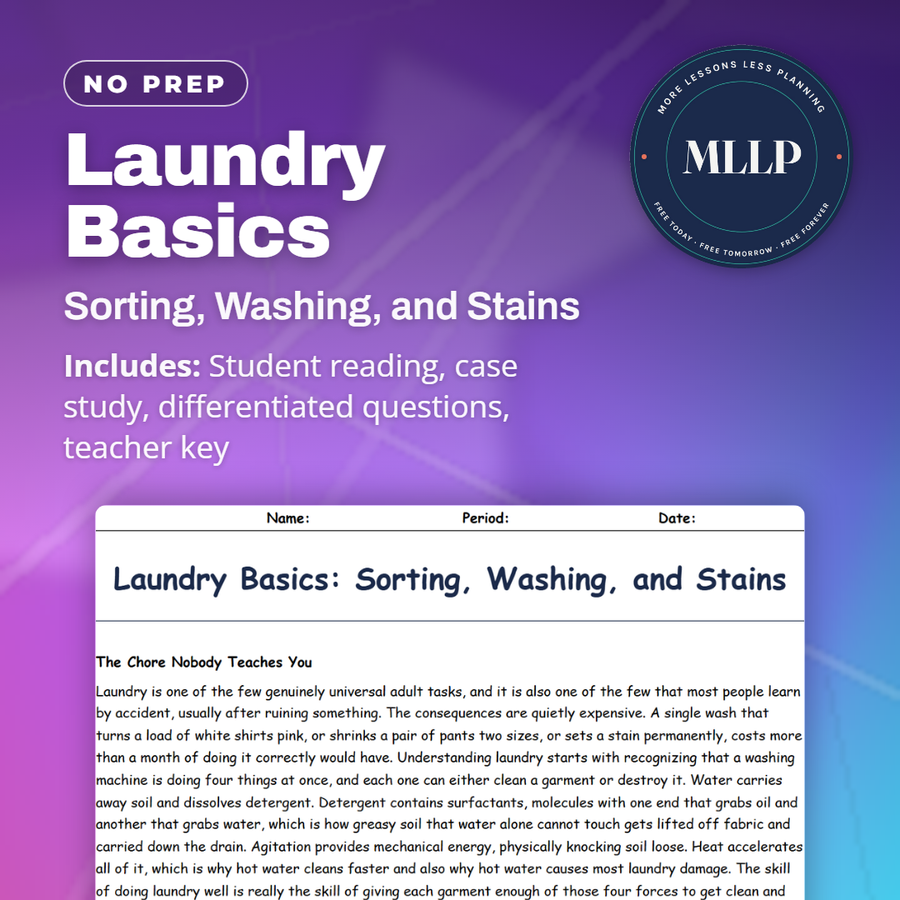
Laundry Basics: Sorting, Washing, and Stains
Quality reviewed September 2026
Facts verified September 23, 2026
- Subject
- Career & Life Skills
- Grades
- Grades 9-12
- Length
- 9-page student worksheet
- Time
- About one 50-minute class period
- Great for
- Sub plans and independent work
- Includes
- Reading passage, comprehension questions + full answer key
- Format
- Print-and-go PDF
What students do
- A washing machine only does four things, water, detergent, agitation and heat, and each one can ruin a garment
- The reading's three sorting lines, starting with color, get explained through why a load is only as safe as its most fragile item
- Identify which stains need cold water and why heat cooks them permanently into the fabric
- Terrence turns six white undershirts pink in his first week on his own, and the reading explains exactly what he skipped
What it covers
- Why sorting by color, fabric weight and soil level is not optional
- When to reach for hot, warm or cold water and why
- The one rule about bleach and ammonia that has nothing to do with getting clothes clean
Start reading this worksheet
The Chore Nobody Teaches You
Laundry is one of the few genuinely universal adult tasks, and it is also one of the few that most people learn by accident, usually after ruining something. The consequences are quietly expensive. A single wash that turns a load of white shirts pink, or shrinks a pair of pants two sizes, or sets a stain permanently, costs more than a month of doing it correctly would have. Understanding laundry starts with recognizing that a washing machine is doing four things at once, and each one can either clean a garment or destroy it. Water carries away soil and dissolves detergent. Detergent contains surfactants, molecules with one end that grabs oil and another that grabs water, which is how greasy soil that water alone cannot touch gets lifted off fabric and carried down the drain. Agitation provides mechanical energy, physically knocking soil loose. Heat accelerates all of it, which is why hot water cleans faster and also why hot water causes most laundry damage. The skill of doing laundry well is really the skill of giving each garment enough of those four forces to get clean and not one bit more. Almost every laundry disaster comes from applying too much of something: too much heat, too much agitation, too much bleach, or too many garments crammed into one drum.
Sorting Is Not Optional
Sorting exists because a single load applies identical treatment to everything inside it, so the load can only be as aggressive as its most fragile member can survive. Sort along three lines. Sort by color first, separating whites, lights, and darks, because dye that is not fully colorfast releases into the wash water and redeposits on lighter fabric. New red and dark blue garments are the most notorious offenders and are worth washing separately for their first few cycles. Sort by fabric type and weight second. Heavy items like jeans, towels, and canvas are abrasive and will physically wear down lightweight knits and delicates tumbling against them, and towels shed lint that clings permanently to synthetics. Delicates, anything with beading or lace, and anything labeled gentle cycle belong in their own load or in a mesh bag. Sort by soil level third, because heavily soiled work clothes release grime into the water that lightly worn shirts will pick up. A few habits go with sorting: close zippers so the teeth do not snag knits, fasten hooks, empty every pocket because a single forgotten tissue coats an entire load, and turn dark jeans and printed graphics inside out so abrasion happens on the inside face rather than on the part everyone sees.
Water Temperature Is a Real Decision
The temperature dial is the setting with the largest consequences and the least understanding behind it. Hot water cleans most effectively, dissolves detergent fully, and is the right choice for heavily soiled work clothes, sturdy whites, and items that need sanitizing such as bedding after an illness. It is also the setting that shrinks fabric, fades color fastest, and permanently sets protein stains. Warm water is the middle ground for moderately soiled everyday clothing. Cold water protects color and prevents shrinking, uses dramatically less energy because heating water is most of the electricity a washer consumes, and is the correct default for the majority of modern loads. Cold washing works far better than it used to for a specific reason: today's detergents contain enzymes, biological catalysts that break down particular soil types, and the common ones are engineered to remain active at low temperatures. Protease breaks down protein soils like blood and food, amylase attacks starches, and lipase targets fats. Those enzymes are also the reason hot water backfires on certain stains, because heat denatures protein, essentially cooking blood, egg, milk, or sweat into the fibers where no detergent can retrieve it. The practical rule is to wash cold by default, use warm for genuinely dirty everyday loads, and reserve hot for sanitizing and heavy soil on fabrics you know can take it.
Like what you read? The full reading, the case study, and every question set are in the free download below, along with the answer key.
Why this matters
Most students will do their own laundry for the first time within a couple of years of reading this, usually without anyone watching, which is exactly the setup in Terrence's story. A pink load of shirts or a permanent bloodstain is a cheap mistake to make on paper first instead of on a favorite shirt during the actual first month it happens.
From one teacher to another
Doing laundry wrong is one of the most common ways a garment gets ruined, and this reading breaks the machine down into the four forces at work, water, detergent, agitation and heat, and explains how sorting by color, fabric weight and soil level protects whatever is most fragile in the load. It covers when hot, warm or cold water actually makes sense, what detergent enzymes do at low temperatures, and a set of rules for treating protein, grease and tannin stains differently rather than reaching for the same fix every time. The case study follows Terrence through his first month doing laundry alone in his own apartment, where a new red shirt turns six white undershirts pink, a bloodstain gets set permanently by hot water and a dryer cycle, and an overloaded machine leaves everything still dirty. His neighbor's three sentences of advice cover two of his three mistakes, and the reading asks what would have fixed the third.
What you get
Download
Where should I send the next one?
Everything here is free and it stays that way. Leave your email and I'll send you the new lessons as they go up. You can unsubscribe from any one of them.
Related resources
Fashion Design and the Design Process
Fast Fashion and the Cost of Cheap Clothing
Hand Stitches and Basic Clothing Repairs
How Fabric Is Made: Woven, Knit, and Nonwoven
How to Read a Pattern
Natural vs. Synthetic Fibers
Every lesson on this site is free to download and use. If one of them saved you a prep period, you can chip in a few bucks toward my three kids' daycare fund. That's genuinely where tips go.