How to Read a Pattern
Quality reviewed September 2026
Facts verified September 23, 2026
- Subject
- Career & Life Skills
- Grades
- Grades 9-12
- Length
- 9-page student worksheet
- Time
- About one 50-minute class period
- Great for
- Sub plans and independent work
- Includes
- Reading passage, comprehension questions + full answer key
- Format
- Print-and-go PDF
What students do
- Pattern sizing has nothing to do with the number on a pair of jeans
- Explain the difference between wearing ease and design ease
- Match pattern terms like notions, nap and guide sheet to what each one means
- Aisha's finished shirt will not close, and the reading traces the mix-up back to store sizing
What it covers
- Why pattern sizing and store clothing sizing are two unrelated systems
- The symbols printed on a pattern, from the grainline arrow to a double notch
- Wearing ease and design ease, and why cutting to the exact body measurement backfires
Start reading this worksheet
The Envelope Is the Instruction Manual
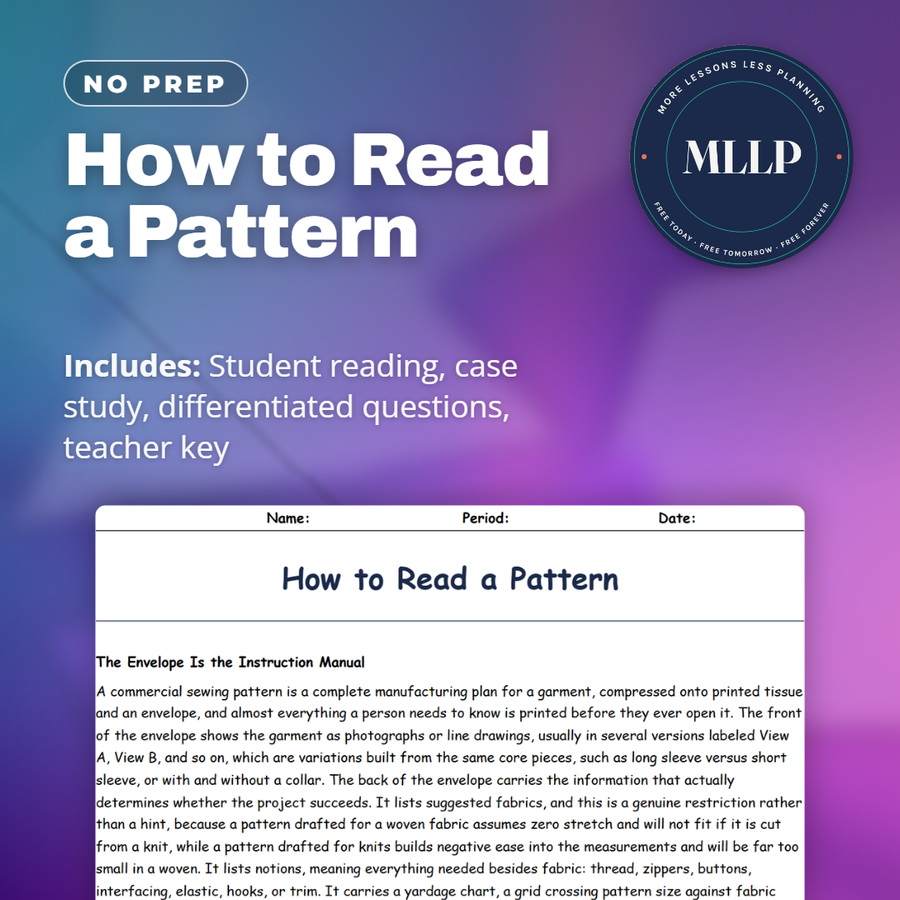
A commercial sewing pattern is a complete manufacturing plan for a garment, compressed onto printed tissue and an envelope, and almost everything a person needs to know is printed before they ever open it. The front of the envelope shows the garment as photographs or line drawings, usually in several versions labeled View A, View B, and so on, which are variations built from the same core pieces, such as long sleeve versus short sleeve, or with and without a collar. The back of the envelope carries the information that actually determines whether the project succeeds. It lists suggested fabrics, and this is a genuine restriction rather than a hint, because a pattern drafted for a woven fabric assumes zero stretch and will not fit if it is cut from a knit, while a pattern drafted for knits builds negative ease into the measurements and will be far too small in a woven. It lists notions, meaning everything needed besides fabric: thread, zippers, buttons, interfacing, elastic, hooks, or trim. It carries a yardage chart, a grid crossing pattern size against fabric width, since standard bolts come in widths around forty-five inches and sixty inches and a narrower fabric requires more length. Finally it lists body measurements and finished garment measurements, which are two different numbers and confuse more beginners than any other feature of the entire pattern.
Sizing: Why Your Pattern Size Is Not Your Store Size
The most reliable way to demoralize a first-time sewist is to let them choose a pattern by the number on their jeans. Pattern sizing and retail clothing sizing are unrelated systems. Retail sizing has drifted for decades through a marketing practice known as vanity sizing, in which manufacturers relabel progressively larger garments with smaller numbers, and there is no legal standard forcing consistency between brands. Pattern sizing, by contrast, has been tied to a fixed set of body measurements for many decades and has not drifted. The practical result is that a person who buys a size eight in a store commonly measures as a size fourteen or sixteen on a pattern envelope, and nothing is wrong with either the person or the pattern. The correct procedure is to ignore every number you have ever worn, take actual measurements, and compare them to the chart on the envelope. The essential measurements are the full bust or chest, the natural waist, which is the narrowest point of the torso and not where a waistband happens to sit, and the fullest part of the hips. Measure over the undergarments that will be worn with the finished garment, keep the tape snug but not tight, and keep it level all the way around. When measurements land in different sizes, which is extremely common, choose the size based on the area hardest to alter: for tops that is usually the bust or chest, and for pants and skirts that is usually the hip.
Ease: The Number Nobody Explains
Ease is the difference between the body measurement and the finished garment measurement, and understanding it resolves the frequent complaint that a completed garment came out enormous. Ease comes in two kinds. Wearing ease is the extra room required for the body to function, since a shirt cut to exactly the chest measurement would not allow the wearer to breathe deeply, raise an arm, or sit down. Typical wearing ease at the bust for a fitted woven garment runs a few inches, with additional allowances at the waist and hip. Design ease is extra fullness added purely for style, and it is entirely a designer's decision. An oversized jacket may carry eight or ten inches of design ease, which is exactly what makes it read as oversized rather than as a mistake. Both types are already built into the pattern pieces, which is why cutting a pattern down to match the body measurement exactly produces a garment that cannot be worn. Some patterns for knit fabrics use negative ease, meaning the finished garment is deliberately smaller than the body, relying on the knit to stretch, which is how leggings and fitted athletic wear are drafted. The finished garment measurements printed on the envelope or directly on the pattern tissue let a sewist see exactly how much ease a particular design includes before cutting anything.
Like what you read? The full reading, the case study, and every question set are in the free download below, along with the answer key.
Why this matters
A lot of students have a store size memorized and no idea what their actual measurements are, which is exactly the gap that cost Aisha a shirt's worth of fabric in this reading. Knowing the difference between a marketing number and a measured one is not limited to a sewing pattern, since the same confusion shows up anywhere a size chart and a body do not automatically agree, from a uniform order to a pair of work boots.
From one teacher to another
Pattern envelopes pack in most of what a project needs before the tissue even comes out, and this reading walks through the front and back of the envelope, the difference between body measurements and finished garment measurements, and why pattern sizing has stayed fixed for decades while store sizing has drifted through what the reading calls vanity sizing. It covers ease, the gap between a body measurement and the finished garment, and the standardized symbols on the tissue itself, the grainline, notches, dots and the lengthen or shorten lines. The case study follows Aisha, who buys a pattern in her usual store size for a fitted shirt and cuts into fabric she saved three paychecks for, only to find the finished shirt will not close across the chest. Her teacher has her measure her actual bust and compare it to the envelope chart before she understands what went wrong.
What you get
Download
Where should I send the next one?
Everything here is free and it stays that way. Leave your email and I'll send you the new lessons as they go up. You can unsubscribe from any one of them.
Related resources
Fashion Design and the Design Process
Fast Fashion and the Cost of Cheap Clothing
Hand Stitches and Basic Clothing Repairs
How Fabric Is Made: Woven, Knit, and Nonwoven
Laundry Basics: Sorting, Washing, and Stains
Natural vs. Synthetic Fibers
Every lesson on this site is free to download and use. If one of them saved you a prep period, you can chip in a few bucks toward my three kids' daycare fund. That's genuinely where tips go.