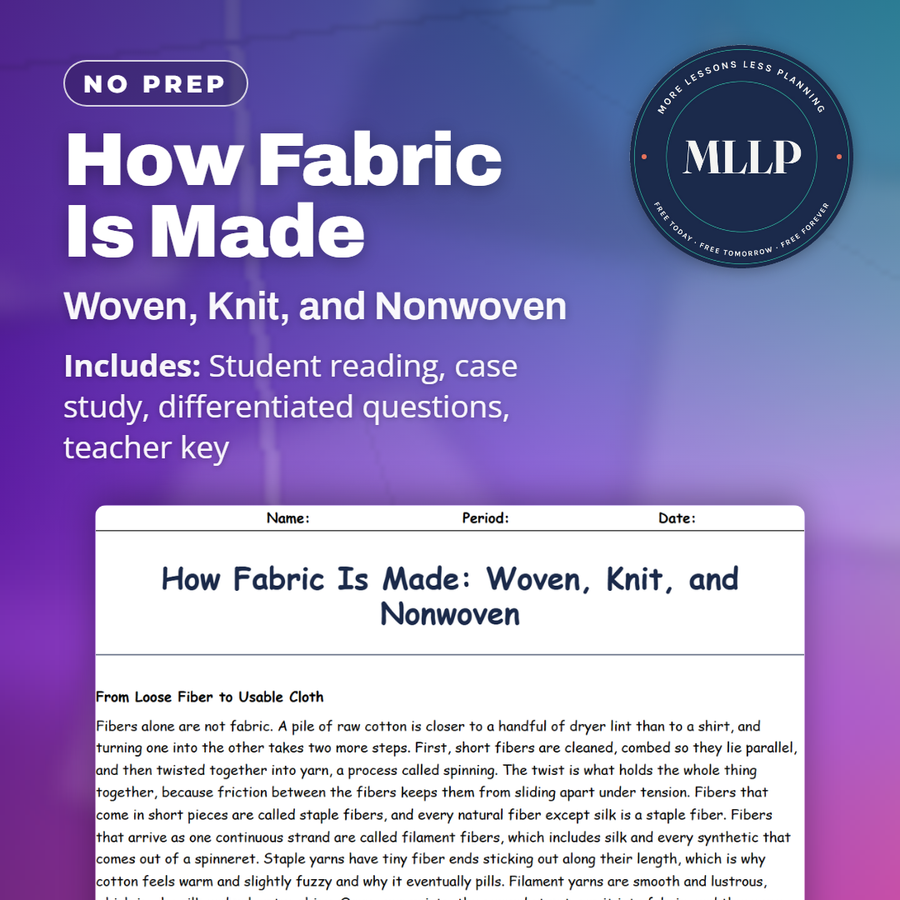
How Fabric Is Made: Woven, Knit, and Nonwoven
Quality reviewed September 2026
Facts verified September 23, 2026
- Subject
- Career & Life Skills
- Grades
- Grades 9-12
- Length
- 8-page student worksheet
- Time
- About one 50-minute class period
- Great for
- Sub plans and independent work
- Includes
- Reading passage, comprehension questions + full answer key
- Format
- Print-and-go PDF
What students do
- Spinning twists loose fiber into yarn, and three different constructions turn that yarn into fabric
- Match terms like selvage, wale and true bias to their definitions
- Compare why a satin weave snags while a twill weave like denim holds up
- Nia's tote bag frays apart within a week, and the reading explains exactly why
What it covers
- The three ways yarn becomes fabric, weaving, knitting and bonding fibers directly
- Why woven fabric frays at a cut edge and knit fabric does not
- Fabric grain and the true bias, and why a project can twist after the first wash
Start reading this worksheet
From Loose Fiber to Usable Cloth
Fibers alone are not fabric. A pile of raw cotton is closer to a handful of dryer lint than to a shirt, and turning one into the other takes two more steps. First, short fibers are cleaned, combed so they lie parallel, and then twisted together into yarn, a process called spinning. The twist is what holds the whole thing together, because friction between the fibers keeps them from sliding apart under tension. Fibers that come in short pieces are called staple fibers, and every natural fiber except silk is a staple fiber. Fibers that arrive as one continuous strand are called filament fibers, which includes silk and every synthetic that comes out of a spinneret. Staple yarns have tiny fiber ends sticking out along their length, which is why cotton feels warm and slightly fuzzy and why it eventually pills. Filament yarns are smooth and lustrous, which is why silk and polyester shine. Once yarn exists, the second step turns it into fabric, and there are only three ways to accomplish that. You can interlace two sets of yarn at right angles, which is weaving. You can loop a single yarn through itself over and over, which is knitting. Or you can skip yarn entirely and bond loose fibers directly together, which produces a nonwoven. Nearly every textile a person touches in a day belongs to one of those three construction methods, and each one behaves in a completely different way once it is cut.
Weaving: Two Directions, Locked Together
Woven fabric is made on a loom by interlacing two sets of yarn perpendicular to each other. The yarns running the length of the fabric are the warp; they are held under tension on the loom, which means they must be strong, and they run parallel to the finished edge of the fabric called the selvage. The yarns running across, over and under the warp, are the weft or filling. Because the two sets lock each other in place, woven fabric barely stretches along either yarn direction, holds its shape well, and frays when cut because the cut ends of the yarns are no longer anchored. How the weft crosses the warp defines the weave structure. In a plain weave, the weft passes over one warp yarn and under the next in a simple checkerboard, producing a flat, durable, reversible fabric such as muslin, broadcloth, chambray, and gingham. In a twill weave, the weft crosses two or more warp yarns before going under, and shifting that pattern one yarn over on each row creates the diagonal ridge, called a wale, that you can see on any pair of jeans. Twills are strong, drape well, and hide soil better than plain weaves, which is a large part of why denim became work clothing. In a satin weave, yarns float over four or more before interlacing, which produces a smooth, shiny surface and a fabric that snags easily because those long floats have nothing holding them down.
Knitting: One Yarn, Endless Loops
Knit fabric is built from loops rather than crossings, and that single structural difference explains everything a knit does. Because a loop can elongate and recover, knits stretch in ways woven fabric cannot, which is why t-shirts, socks, sweatshirts, and leggings are knitted while dress shirts and jeans are woven. Knits also resist wrinkles, because a bent loop simply springs back, and they conform to the body without needing the shaping seams a woven garment requires. The trade-off is stability. A knit can stretch out of shape, it can curl at a cut edge, and if one loop breaks the neighboring loops can release in sequence, which is the run that ends the life of a pair of tights. There are two families. Weft knits are made by feeding one yarn across the fabric, and they include jersey, which is smooth on the front and looped on the back and curls at the edges, and rib knit, which alternates raised and recessed columns and stretches strongly across its width, making it the standard for cuffs, waistbands, and collar bands. Weft knits are the ones that run. Warp knits use many yarns at once, each looping down its own column, and they resist running almost entirely. Tricot, used in linings and swimwear, and raschel, used in lace and mesh, are warp knits. Machine knitting is fast and cheap, which is why the majority of casual clothing sold today is knitted.
Like what you read? The full reading, the case study, and every question set are in the free download below, along with the answer key.
Why this matters
Every fiber choice on this reading's chart, cotton, polyester, wool, has a construction method sitting underneath it that most students have never had named for them, even though they can feel the difference between a t-shirt and a pair of jeans without being able to say why. Nia's tote bag is a cheap way to learn an expensive lesson, that a fabric chosen for how it looks in a store can fail within a week for reasons that were visible the moment scissors touched it.
From one teacher to another
Every piece of fabric a person touches starts as loose fiber that gets spun into yarn, and this reading covers the three separate ways that yarn becomes cloth, weaving two sets of yarn at right angles, knitting one yarn into a chain of loops, or bonding fibers directly together with no yarn at all. It walks through plain, twill and satin weaves, the two families of knits, and everyday nonwovens like interfacing and dryer sheets, then spends a full passage on fabric grain, the concept the reading calls the single most common reason a home sewn project hangs wrong. The case study follows Nia, who picks a heavy satin weave fabric for a tote bag because she likes the shine, and watches the cut edges shed threads across the table before the bag snags and frays within a week. Her teacher lays a scrap of denim next to the satin and asks her to look at what is actually different between the two surfaces.
What you get
Download
Where should I send the next one?
Everything here is free and it stays that way. Leave your email and I'll send you the new lessons as they go up. You can unsubscribe from any one of them.
Related resources
Fashion Design and the Design Process
Fast Fashion and the Cost of Cheap Clothing
Hand Stitches and Basic Clothing Repairs
How to Read a Pattern
Laundry Basics: Sorting, Washing, and Stains
Natural vs. Synthetic Fibers
Every lesson on this site is free to download and use. If one of them saved you a prep period, you can chip in a few bucks toward my three kids' daycare fund. That's genuinely where tips go.