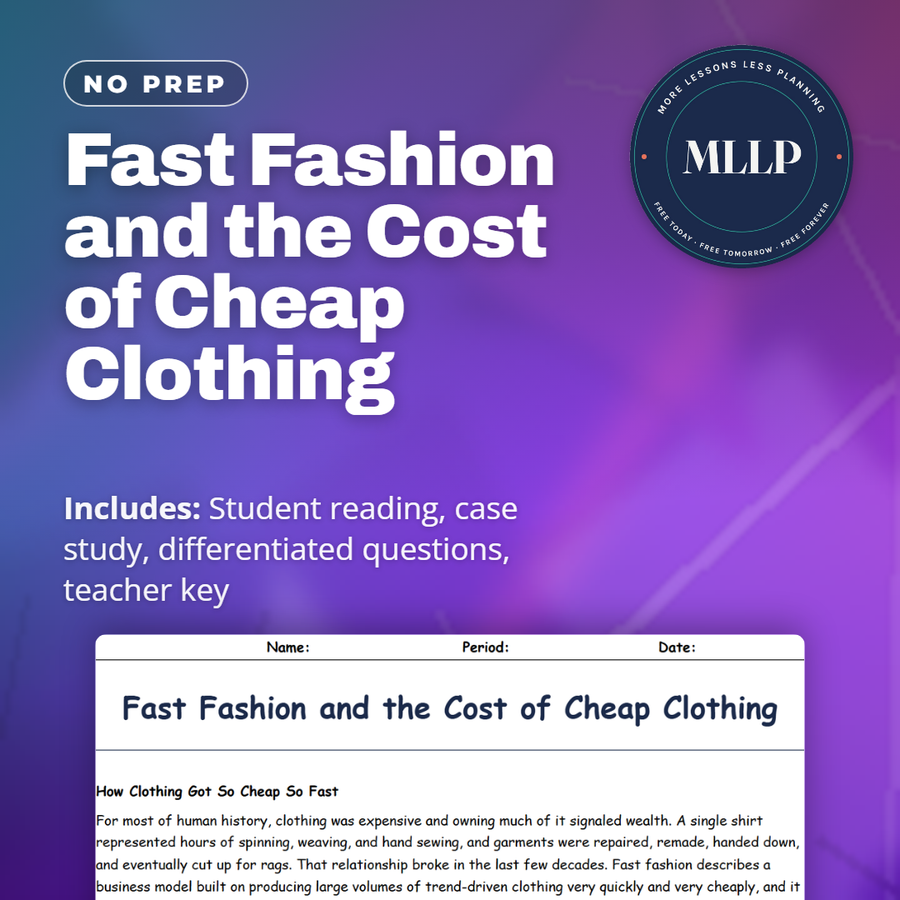
Fast Fashion and the Cost of Cheap Clothing
Quality reviewed September 2026
Facts verified September 23, 2026
- Subject
- Career & Life Skills
- Grades
- Grades 9-12
- Length
- 8-page student worksheet
- Time
- About one 50-minute class period
- Great for
- Sub plans and independent work
- Includes
- Reading passage, comprehension questions + full answer key
- Format
- Print-and-go PDF
What students do
- Fast fashion's micro-seasons trade durability for dozens of releases a year
- Match terms like cost per wear and greenwashing to their definitions
- The 2013 Rana Plaza collapse forced the industry to answer for its labor costs
- Explain why Grace's honest estimate of four wears mattered more than the price tag
What it covers
- The environmental toll of fast fashion, from cotton's water use to microplastic shedding
- The 2013 Rana Plaza factory collapse and what changed afterward
- The cost per wear formula, worked through with Grace's own numbers
Start reading this worksheet
How Clothing Got So Cheap So Fast
For most of human history, clothing was expensive and owning much of it signaled wealth. A single shirt represented hours of spinning, weaving, and hand sewing, and garments were repaired, remade, handed down, and eventually cut up for rags. That relationship broke in the last few decades. Fast fashion describes a business model built on producing large volumes of trend-driven clothing very quickly and very cheaply, and it works by compressing the time between a runway idea and a rack in a store from many months to a few weeks. Traditional fashion operated on roughly two to four seasons a year. Fast fashion retailers effectively run dozens of micro-seasons, releasing new items continuously so that shoppers who visit twice in a month find different merchandise both times. The strategy depends on newness rather than durability, since a garment that will be replaced in two months does not need to survive two years. The scale is enormous. Research compiled by the Ellen MacArthur Foundation found that global clothing production roughly doubled between 2000 and 2015, while the average number of times a garment was worn before disposal fell by around thirty-six percent. Both numbers moving in opposite directions at once is the entire story: more clothing produced, each piece used less. The result is that clothing has become one of the least expensive things a person buys and one of the most expensive things a society disposes of.
The Environmental Bill
The costs that do not appear on the price tag begin with water. Growing conventional cotton is water intensive, and widely cited estimates put the water required to produce a single cotton t-shirt at roughly two thousand seven hundred liters when irrigation, processing, and dyeing are counted together, which is comparable to what one person drinks over more than two years. Textile dyeing and finishing require large volumes of water and chemicals, and in regions where wastewater treatment is weak, untreated dye effluent enters rivers directly. Synthetic fibers introduce a different problem. Because a large share of clothing produced today is polyester or another synthetic, and because those fibers shed microscopic fragments during washing, laundry has become a significant source of microplastic pollution, with fragments small enough to pass through wastewater treatment and enter waterways and food chains. Disposal closes the loop. The United States Environmental Protection Agency has estimated that of the roughly seventeen million tons of textile waste generated in 2018, more than eleven million tons went to landfill, with additional volumes incinerated and only a modest share recycled. Synthetic garments in a landfill do not biodegrade in any meaningful timeframe. Donation is helpful but is not a solution by itself, since charities receive far more clothing than domestic resale markets can absorb, and much of the surplus is baled and exported, shifting the disposal problem to countries with even less infrastructure to handle it.
The Human Bill
Cheap clothing also depends on cheap labor, and the garment industry employs tens of millions of workers worldwide, a large majority of them women, frequently in countries where wages are low and labor protections are weakly enforced. The event that forced this into public view was the collapse of the Rana Plaza building outside Dhaka, Bangladesh, in April 2013. The building held garment factories producing for a number of international brands. Cracks had been discovered in the structure the previous day and the building had been evacuated, but workers were ordered back inside. It collapsed the following morning, killing one thousand one hundred thirty-four people and injuring thousands more, making it the deadliest garment industry disaster in modern history. The aftermath produced real changes, including the Accord on Fire and Building Safety in Bangladesh, a binding agreement signed by many international brands that funded independent factory inspections and remediation, and it made supply chain transparency a mainstream consumer demand. It also revealed how little most companies knew about their own production, since several brands initially could not confirm whether their clothing was made in the building. Progress since has been real but uneven, and the underlying economic pressure has not changed: when a retailer competes primarily on price and speed, that pressure travels down the supply chain and lands on the people with the least ability to refuse it.
Like what you read? The full reading, the case study, and every question set are in the free download below, along with the answer key.
Why this matters
A teenager with birthday money in a fast fashion store is exactly the customer this business model is built around, so the cost per wear math in this reading is a tool students can use the next time they are standing in that same aisle. It will not fix a global supply chain, but it changes one purchase from an impulse into a calculation, which is the only lever the reading claims an individual actually has.
From one teacher to another
Global clothing production roughly doubled between 2000 and 2015, while the Ellen MacArthur Foundation found the average garment got worn about thirty six percent less before it was thrown out. This reading traces where a cheap shirt actually costs money, starting with the water and dye behind a cotton t-shirt and the microplastics polyester sheds in the wash, then moving to the labor behind it, including the 2013 Rana Plaza factory collapse in Bangladesh. The case study follows Grace, who has ninety dollars of birthday money and a cart full of twenty dollar tops until her cousin makes her run the cost per wear math on her phone. Four shirts worn about four times each work out to five dollars a wear, and the secondhand wool coat she buys instead comes out to thirty two cents a wear if she gets a hundred wears from it this winter.
What you get
Download
Where should I send the next one?
Everything here is free and it stays that way. Leave your email and I'll send you the new lessons as they go up. You can unsubscribe from any one of them.
Related resources

Fashion Design and the Design Process
Hand Stitches and Basic Clothing Repairs
How Fabric Is Made: Woven, Knit, and Nonwoven
How to Read a Pattern

Laundry Basics: Sorting, Washing, and Stains

Natural vs. Synthetic Fibers
Every lesson on this site is free to download and use. If one of them saved you a prep period, you can chip in a few bucks toward my three kids' daycare fund. That's genuinely where tips go.