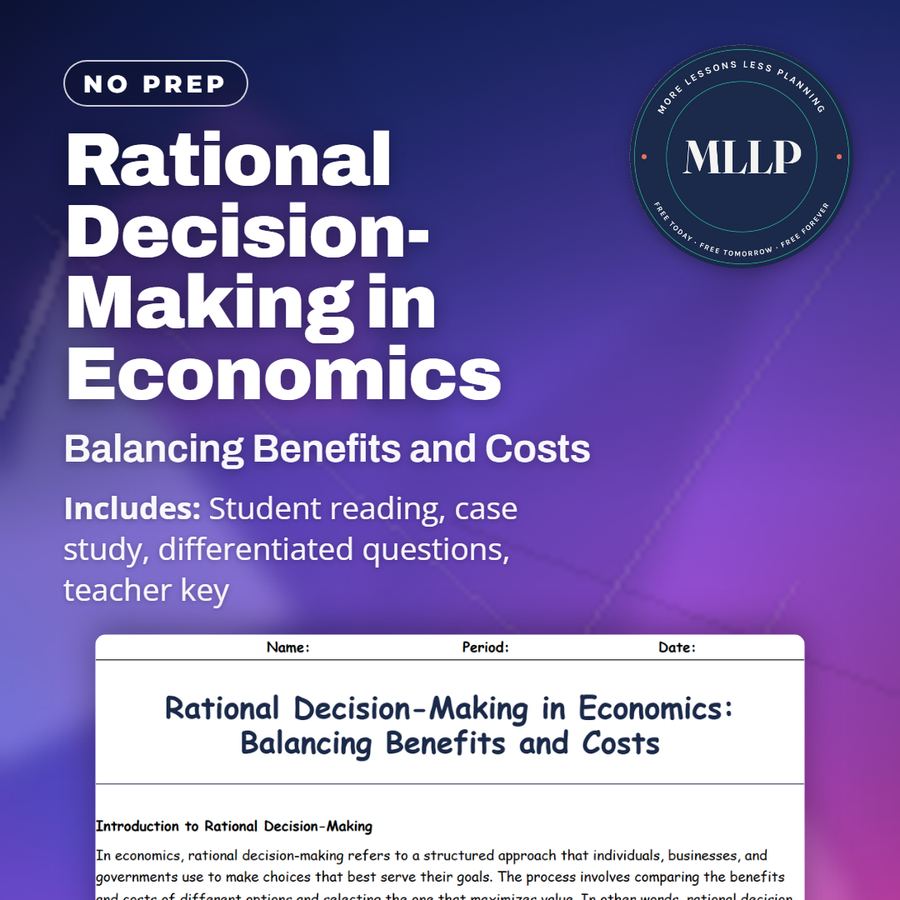
Rational Decision-Making in Economics: Balancing Benefits and Costs
Quality reviewed September 2026
Facts verified September 8, 2026
- Grades
- Grades 9-12
- Length
- 7-page student worksheet
- Time
- About one 50-minute class period
- Great for
- Sub plans and independent work
- Includes
- Reading passage, comprehension questions + full answer key
- Format
- Print-and-go PDF
What students do
- Conduct a cost-benefit analysis on personal decisions like buying a new phone, comparing benefits (faster processing, better camera, longer battery) against costs (purchase price, service fees, accessories)
- Analyze how a government health agency decides to launch a vaccination campaign by weighing public health benefits against program costs and implementation expenses
- Evaluate business decisions where companies hire new employees only if their productivity gain outweighs their salary and training costs
- Recognize limitations of rational decision-making when incomplete information, emotions, or personal biases influence the choices people actually make
What it covers
- Cost-benefit analysis as a structured method for weighing benefits and costs to determine if a choice is worthwhile
- Real-world applications across personal budgeting (phone purchases), business strategy (hiring staff, launching products), and government policy (vaccination programs)
- Recognition that while rational decision-making is a powerful tool, people sometimes lack complete information or are influenced by emotions that lead to non-rational choices
Start reading this worksheet
Introduction to Rational Decision-Making
In economics, rational decision-making refers to a structured approach that individuals, businesses, and governments use to make choices that best serve their goals. The process involves comparing the benefits and costs of different options and selecting the one that maximizes value. In other words, rational decision-making means choosing the course of action that provides the most benefit for the least cost. Think about a student deciding whether to work part-time while studying. They weigh the benefits (extra income, experience) against the costs (less time for studies, social life). If the benefits outweigh the costs, the rational choice is to work. Economists believe that people generally make rational decisions to improve their well-being or profit, even though these decisions may vary from one individual to another.
Understanding Cost-Benefit Analysis
Cost-benefit analysis is a key component of rational decision-making. This process involves listing all the benefits of a decision, alongside the costs, to evaluate whether the choice is worthwhile. A benefit might include monetary gain, convenience, or personal satisfaction, while costs could be time, money, or effort. In practical terms, if you’re deciding whether to buy a new phone, you would compare the cost of the phone with the benefit of having new features, faster processing, and improved functionality. If the added features are worth the price, the cost-benefit analysis suggests that purchasing the phone is a rational choice. This table outlines a simple cost-benefit analysis, showing how different factors can influence a decision.
Rational Choices and Resource Allocation
In economics, rational decision-making impacts how resources are allocated across an economy. Since resources are limited, individuals and organizations must make choices about how to use them most efficiently. For example, a business deciding to expand its operations might analyze the benefits of increased sales and profits against the costs of hiring new employees and purchasing more equipment. Governments also make rational choices to allocate resources effectively. For instance, a city government might compare the cost of building a new park with the expected benefits, such as increased public well-being and property values. By evaluating these options, rational decision-making helps ensure that resources are used where they can provide the most value.
Like what you read? The full reading, the case study, and every question set are in the free download below, along with the answer key.
Why this matters
An $800 phone with a better camera and faster processing is not automatically worth buying. It depends on whether those benefits outweigh the price tag and the extra twenty dollars a month in fees. That is cost-benefit analysis, the same weighing a government health agency uses deciding whether a vaccination campaign's cost is worth the outbreaks it prevents.
I put the vaccination and phone examples side by side on purpose, one clinical and one personal, so students see the logic is identical either way. Then we talk about where rational decision-making breaks down: incomplete information, emotion, bias. Recognizing those limits makes students more honest about how they decide.
From one teacher to another
I use this reading when helping students make more intentional choices. Cost-benefit analysis is a framework they can apply anywhere. We work through the phone example so they see how faster processing and a better camera have real value, but that value has to be weighed against the $800 price tag and $20 monthly fee increase. The vaccination case study shows how governments apply the same logic to massive public health decisions: initial costs are high, but preventing disease outbreaks saves money and lives in the long run. My students see that rational doesn't mean perfect, though. The worksheet acknowledges that emotions, incomplete information, and personal biases can push people away from purely rational choices. Understanding this helps them see their own decision-making more clearly.
What you get
- Answer Key
-
Student Worksheet
A student deciding whether to take a part-time job while in school weighs extra income and experience against fewer hours for classes and a social life, the same logic a city government uses when it compares a new park's cost to the boost it gives public well-being and property values. A different student who picks studying over a movie is running the identical math, valuing a stronger long-term grade above one evening of entertainment.
Download
Where should I send the next one?
Everything here is free and it stays that way. Leave your email and I'll send you the new lessons as they go up. You can unsubscribe from any one of them.
Related resources
Comparing Economic Systems: Market, Command, and Mixed
Economic Models and Theories: Simplifying Complex Concepts
Factors of Production: Building Blocks of the Economy
Marginal Analysis: Making the Most of Every Decision
Opportunity Cost: The True Cost of Every Decision
Production Possibilities Curve: Visualizing Choices and Trade-Offs
Every lesson on this site is free to download and use. If one of them saved you a prep period, you can chip in a few bucks toward my three kids' daycare fund. That's genuinely where tips go.