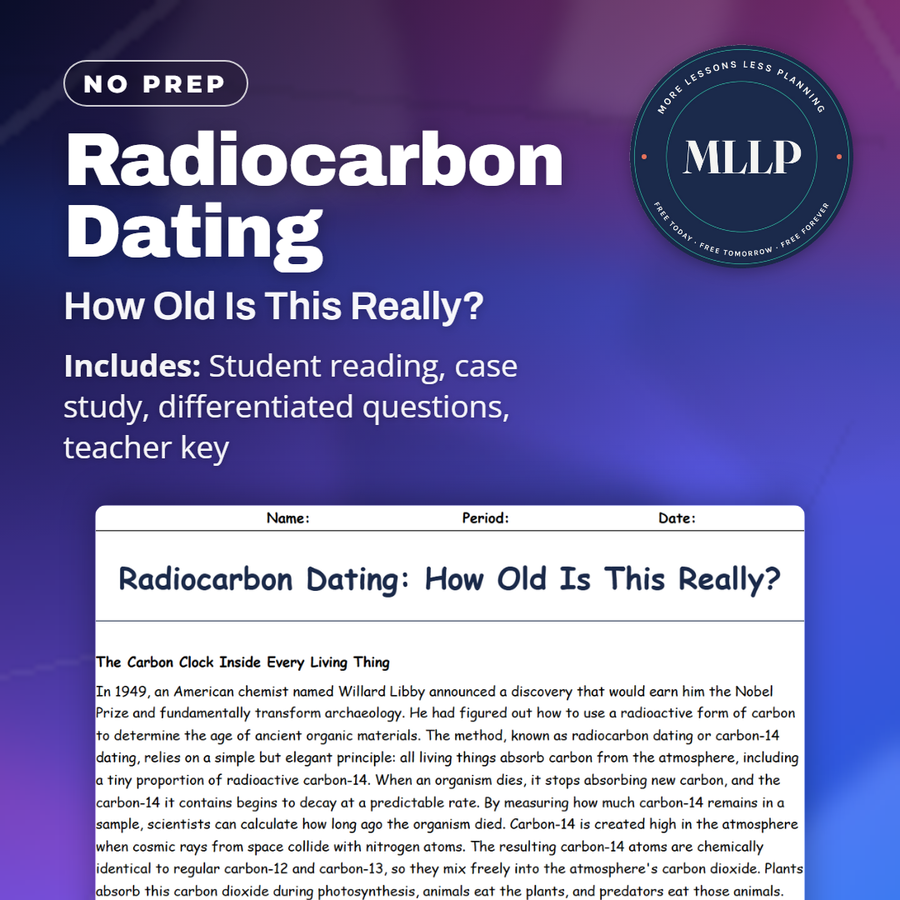
Radiocarbon Dating: How Old Is This Really?
Quality reviewed September 2026
Facts verified September 21, 2026
- Subject
- Social Studies
- Grades
- Grades 9-12
- Length
- 9-page student worksheet
- Time
- About one 50-minute class period
- Great for
- Sub plans and independent work
- Includes
- Reading passage, comprehension questions + full answer key
- Format
- Print-and-go PDF
What students do
- Carbon-14's 5,730-year half-life gets used to calculate how much of the original signal survives after three cycles
- Fill in three blanks on Libby's Nobel Prize, carbon-14's half-life, and the Shroud of Turin's date range
- Three multiple-choice questions test why raw dates need calibration and what AMS makes possible
- Judge whether a lab technician's carbon date exposes a supposedly medieval manuscript as a modern fake
What it covers
- Radiocarbon dating, carbon-14, and half-life calculations
- AMS technology and dating the Shroud of Turin
- Detecting a forged manuscript with a carbon date
Start reading this worksheet
The Carbon Clock Inside Every Living Thing
In 1949, an American chemist named Willard Libby announced a discovery that would earn him the Nobel Prize and fundamentally transform archaeology. He had figured out how to use a radioactive form of carbon to determine the age of ancient organic materials. The method, known as radiocarbon dating or carbon-14 dating, relies on a simple but elegant principle: all living things absorb carbon from the atmosphere, including a tiny proportion of radioactive carbon-14. When an organism dies, it stops absorbing new carbon, and the carbon-14 it contains begins to decay at a predictable rate. By measuring how much carbon-14 remains in a sample, scientists can calculate how long ago the organism died. Carbon-14 is created high in the atmosphere when cosmic rays from space collide with nitrogen atoms. The resulting carbon-14 atoms are chemically identical to regular carbon-12 and carbon-13, so they mix freely into the atmosphere's carbon dioxide. Plants absorb this carbon dioxide during photosynthesis, animals eat the plants, and predators eat those animals. As a result, all living organisms contain roughly the same proportion of carbon-14 relative to other carbon isotopes. This proportion remains constant as long as the organism is alive, because it is constantly taking in new carbon to replace what decays. The clock only starts ticking when the organism dies and the intake stops. Libby's breakthrough was realizing that this natural decay process could serve as a clock. Before his work, archaeologists had no reliable way to determine absolute dates for most sites. They relied on historical records where available, and guesswork where records did not exist. Radiocarbon dating gave them a tool that could date any organic material, from a campfire's charcoal to a mummy's bone to the wooden beam of an ancient building, as long as the material was less than about 50,000 years old.
Half-Life: The Countdown That Never Stops
The key concept behind radiocarbon dating is the half-life. Carbon-14 has a half-life of approximately 5,730 years, which means that every 5,730 years, half of the carbon-14 in a sample decays into nitrogen-14. After one half-life, 50 percent of the original carbon-14 remains. After two half-lives (about 11,460 years), 25 percent remains. After three half-lives (about 17,190 years), only 12.5 percent remains. This decay continues in a predictable pattern until the amount of carbon-14 left is too small to measure accurately. This is why radiocarbon dating has an upper limit of approximately 50,000 years. After about nine half-lives, the remaining carbon-14 is so minuscule that it falls below the detection threshold of even the most sensitive instruments. For anything older than 50,000 years, archaeologists must use different methods entirely, such as potassium-argon dating or luminescence dating. The predictability of the half-life is what makes the method work. If you know the starting ratio of carbon-14 to carbon-12 (which is roughly constant in the atmosphere) and you measure the current ratio in your sample, simple math gives you the elapsed time since the organism died. The fewer carbon-14 atoms remaining, the older the sample.
When Carbon-14 Gets It Wrong
Radiocarbon dating is powerful, but it is not foolproof. Several factors can produce inaccurate dates, and understanding these limitations is essential for any archaeologist working with the method. Contamination is the most common source of error. If newer carbon gets introduced to an old sample, through contact with plant roots, groundwater, or even careless handling in the lab, the sample will appear younger than it actually is. Conversely, if old carbon contaminates the sample (for example, from ancient limestone dissolved in groundwater), the date will appear too old. Careful sample preparation, including cleaning and chemical pretreatment, helps minimize contamination, but it cannot always be eliminated entirely. Another challenge is that the ratio of carbon-14 in the atmosphere has not remained perfectly constant over time. Variations in solar activity, volcanic eruptions, and changes in the earth's magnetic field have caused the atmospheric carbon-14 level to fluctuate. This means that the simple calculation based on a constant starting ratio does not always produce accurate calendar dates. To correct for these fluctuations, scientists have developed calibration curves that compare radiocarbon dates to independently dated records like tree rings and lake sediment layers. A raw radiocarbon date must be calibrated before it can be converted to a reliable calendar date. The method also has some inherent limitations in what it can date. Radiocarbon dating only works on organic materials, things that were once alive. It cannot date stone tools, pottery, metal objects, or geological formations directly. And because it relies on the death of the organism, it dates when the material stopped living, not when it was used by humans. A wooden beam in a building tells you when the tree was cut down, not when the building was constructed, which could have been years or even centuries later if recycled timber was used.
Like what you read? The full reading, the case study, and every question set are in the free download below, along with the answer key.
Why this matters
Radiocarbon dating is one of the few tools in this unit that shows up directly in fraud cases, and the case study is not far-fetched: manuscript and art forgery is a real, ongoing problem, and a carbon date is often the first test a suspicious buyer or museum will order. The reading's point that dating measures when an organism died, not when it was used, also matters here, since Sofia notes that ink could theoretically be painted onto genuinely old parchment, which is why one scientific test rarely settles a question by itself. Understanding half-life also gives students a real feel for exponential decay, the same math that shows up in medicine dosing and radioactive waste storage, dressed up here as a detective story instead of a formula on a whiteboard.
From one teacher to another
Willard Libby figured out in 1949 that every living thing absorbs a tiny, steady share of radioactive carbon-14, and that the moment an organism dies, that carbon starts decaying on a clock that never speeds up or slows down. That clock is carbon-14's half-life of about 5,730 years: half is gone after one half-life, a quarter after two, and by around nine half-lives there is too little left to measure, which is why the method stops working past roughly 50,000 years. The reading is careful to flag what can go wrong, contamination from newer or older carbon, and atmospheric fluctuations that make raw dates need calibration against tree rings before they mean anything in calendar years. Accelerator Mass Spectrometry solved the biggest practical problem by letting scientists date a sample as small as a single grain of wheat, which is how the Shroud of Turin was dated to 1260 to 1390 CE using postage-stamp-sized scraps. In the case study, lab technician Sofia Andersen runs a supposedly twelfth-century manuscript through AMS and finds the parchment itself is less than a hundred years old.
What you get
Download
Where should I send the next one?
Everything here is free and it stays that way. Leave your email and I'll send you the new lessons as they go up. You can unsubscribe from any one of them.
Related resources
3D Scanning and Virtual Archaeology
Beyond Carbon: Other Ways to Date the Past
Dating and Detection: The Science Behind Archaeology
GIS and Digital Mapping: Archaeology Meets Big Data
Ground-Penetrating Radar: X-Ray Vision for Dirt

LiDAR: Seeing Through the Jungle from the Sky
Every lesson on this site is free to download and use. If one of them saved you a prep period, you can chip in a few bucks toward my three kids' daycare fund. That's genuinely where tips go.