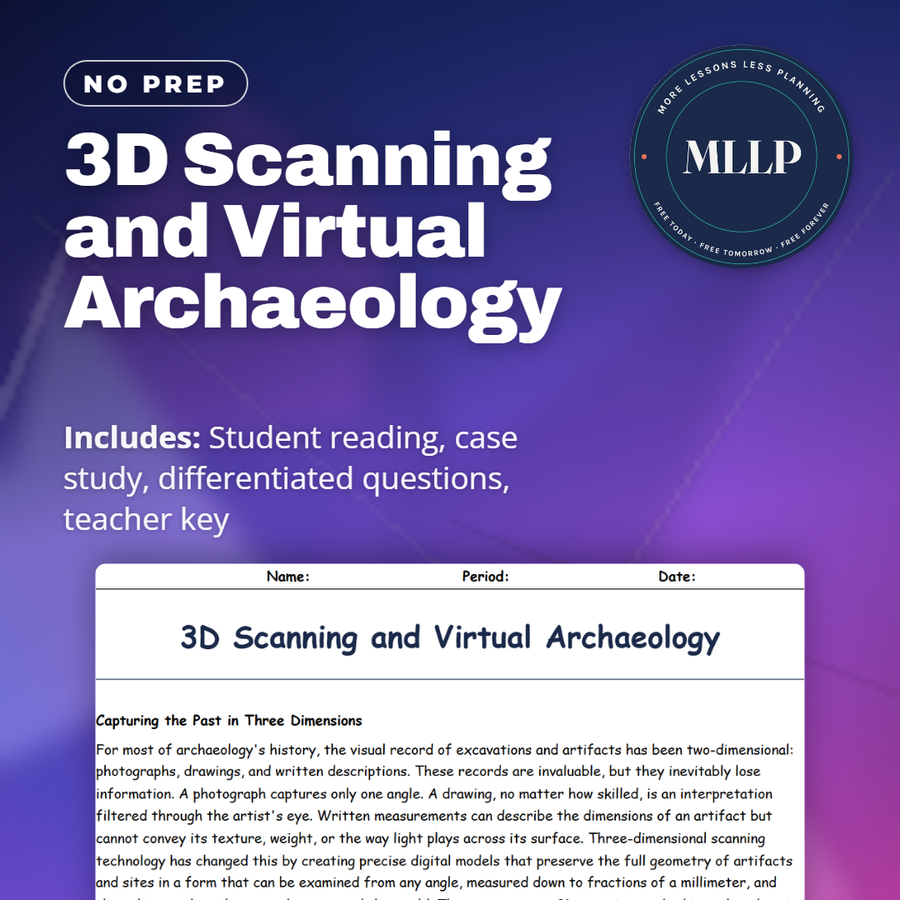
3D Scanning and Virtual Archaeology
Quality reviewed September 2026
Facts verified September 21, 2026
- Subject
- Social Studies
- Grades
- Grades 9-12
- Length
- 9-page student worksheet
- Time
- About one 50-minute class period
- Great for
- Sub plans and independent work
- Includes
- Reading passage, comprehension questions + full answer key
- Format
- Print-and-go PDF
What students do
- Match five terms, from photogrammetry to virtual reconstruction, to their definitions
- Three multiple-choice questions test how photogrammetry works and why CyArk scans sites at risk
- Answer three short-answer questions about accessible photogrammetry and VR's research uses at Stonehenge and Pompeii
- A case study follows museum director Ayumi Tanaka as a 3D-printed scarab lets a blind student feel ancient hieroglyphics
What it covers
- Photogrammetry and 3D printing for museum replicas
- Virtual reality reconstructions of Pompeii and Stonehenge
- CyArk's digital preservation of at-risk heritage sites
Start reading this worksheet
Capturing the Past in Three Dimensions
For most of archaeology's history, the visual record of excavations and artifacts has been two-dimensional: photographs, drawings, and written descriptions. These records are invaluable, but they inevitably lose information. A photograph captures only one angle. A drawing, no matter how skilled, is an interpretation filtered through the artist's eye. Written measurements can describe the dimensions of an artifact but cannot convey its texture, weight, or the way light plays across its surface. Three-dimensional scanning technology has changed this by creating precise digital models that preserve the full geometry of artifacts and sites in a form that can be examined from any angle, measured down to fractions of a millimeter, and shared instantly with researchers around the world. The most common 3D scanning method in archaeology is photogrammetry, which creates three-dimensional models from overlapping photographs. The process involves taking dozens or even hundreds of photographs of an object or site from different angles, then using specialized software to analyze the differences between images and calculate the three-dimensional shape of the subject. The result is a detailed digital model with accurate color and texture information that can be rotated, measured, and manipulated on a computer screen. Photogrammetry has become remarkably accessible in recent years. While professional-grade systems can cost tens of thousands of dollars, researchers have achieved impressive results using consumer-grade digital cameras and free or low-cost software. Some archaeologists have even used smartphones to create usable 3D models of artifacts in the field, democratizing a technology that was once restricted to specialized labs. The barrier to entry is now lower than ever, which means that more archaeological data is being preserved in three dimensions than at any point in history.
Print the Past: 3D Replicas
One of the most practical applications of 3D scanning in archaeology is the creation of physical replicas using 3D printing technology. Once an artifact has been scanned and a digital model created, that model can be sent to a 3D printer to produce an exact physical copy in plastic, resin, or even metal. These replicas serve a variety of purposes that the original artifacts cannot. Museums have been among the most enthusiastic adopters of 3D-printed replicas. Many museums face a dilemma: their most important artifacts are too fragile, too valuable, or too culturally sensitive to be handled by visitors, but handling objects creates a deeper learning experience than looking at them behind glass. 3D-printed replicas solve this problem by allowing visitors to pick up, examine, and even take home copies of artifacts that they could never touch in their original form. Museums serving visually impaired visitors have found 3D replicas especially valuable, as they provide tactile access to objects that would otherwise be experienced only through sight. Replicas also play an important role in research. When artifacts are held in museums on different continents, physically comparing them requires expensive and time-consuming travel. With 3D scans, researchers can examine and compare artifacts digitally from anywhere, or print replicas for hands-on study. Experimental archaeologists, who recreate ancient techniques to understand how things were made and used, have used 3D-printed replicas to test hypotheses about tool use without risking damage to irreplaceable originals. In cases where artifacts have been destroyed, stolen, or lost, 3D scans and replicas become the only surviving record of the original object. After the Islamic State destroyed artifacts in the Mosul Museum in Iraq, 3D scans that had been made before the destruction allowed some of the objects to be virtually reconstructed and, in some cases, physically replicated. The replicas are not substitutes for the originals, but they preserve the form and details of objects that would otherwise be lost to history.
Virtual Reality Meets Ancient Reality
Beyond individual artifacts, 3D technology is being used to create immersive virtual reconstructions of entire archaeological sites and ancient cities. Using a combination of excavation data, architectural analysis, and 3D modeling, researchers can build digital environments that show what a site looked like when it was intact and occupied. Visitors can then explore these reconstructions using virtual reality headsets, walking through ancient streets, entering buildings, and experiencing spaces that no longer exist in the physical world. The potential for education and public engagement is enormous. Virtual reconstructions allow people to experience ancient environments in a way that photographs and text cannot match. Standing in a virtual Roman forum, looking up at virtual columns and hearing the sounds of a virtual marketplace, creates a visceral connection to the past that reading about it simply cannot achieve. Several archaeological sites now offer VR experiences alongside their physical tours, including Pompeii, Stonehenge, and the Acropolis in Athens. Virtual reconstructions also serve as research tools. By building detailed digital models of a site, archaeologists can test hypotheses about how spaces were used, how buildings were constructed, and how sightlines and acoustics worked. At Stonehenge, virtual modeling has been used to simulate how the monument looked at different stages of construction and to test theories about its astronomical alignment. At Pompeii, 3D models have helped researchers understand how water flowed through the city's streets and where crowds would have gathered for public events.
Like what you read? The full reading, the case study, and every question set are in the free download below, along with the answer key.
Why this matters
When the Islamic State destroyed artifacts in the Mosul Museum, the scans made years earlier were the only reason any of those objects could be virtually reconstructed afterward. That is the stakes behind a technology that might otherwise sound like a museum gimmick. Students growing up now will decide how their own communities record what matters before a flood, a fire, or a conflict takes it away, and the same photogrammetry techniques described here run on a smartphone, not a lab. The reading also raises a real question worth sitting with: a replica scarab is not the original object, so when does a copy count as a genuine connection to the past, and when does it fall short.
From one teacher to another
Photogrammetry turns a stack of overlapping photographs into a precise digital model, and this reading walks through how archaeologists use that model for three different jobs. Museums print physical replicas so visitors, including people who are blind, can hold objects the originals could never survive touching. Virtual reality lets someone stand in a reconstructed Roman forum at Pompeii or test how Stonehenge's stones lined up with the sky. The last passage turns urgent: CyArk has scanned heritage sites in more than 40 countries, including Bagan after its 2016 earthquake and Mosul after the destruction there, because a digital record is sometimes the only thing left. The case study follows a museum director whose 3D-printed scarab lets a teenage girl trace ancient hieroglyphics with her fingers for the first time.
What you get
Download
Where should I send the next one?
Everything here is free and it stays that way. Leave your email and I'll send you the new lessons as they go up. You can unsubscribe from any one of them.
Related resources
Beyond Carbon: Other Ways to Date the Past
Dating and Detection: The Science Behind Archaeology
GIS and Digital Mapping: Archaeology Meets Big Data
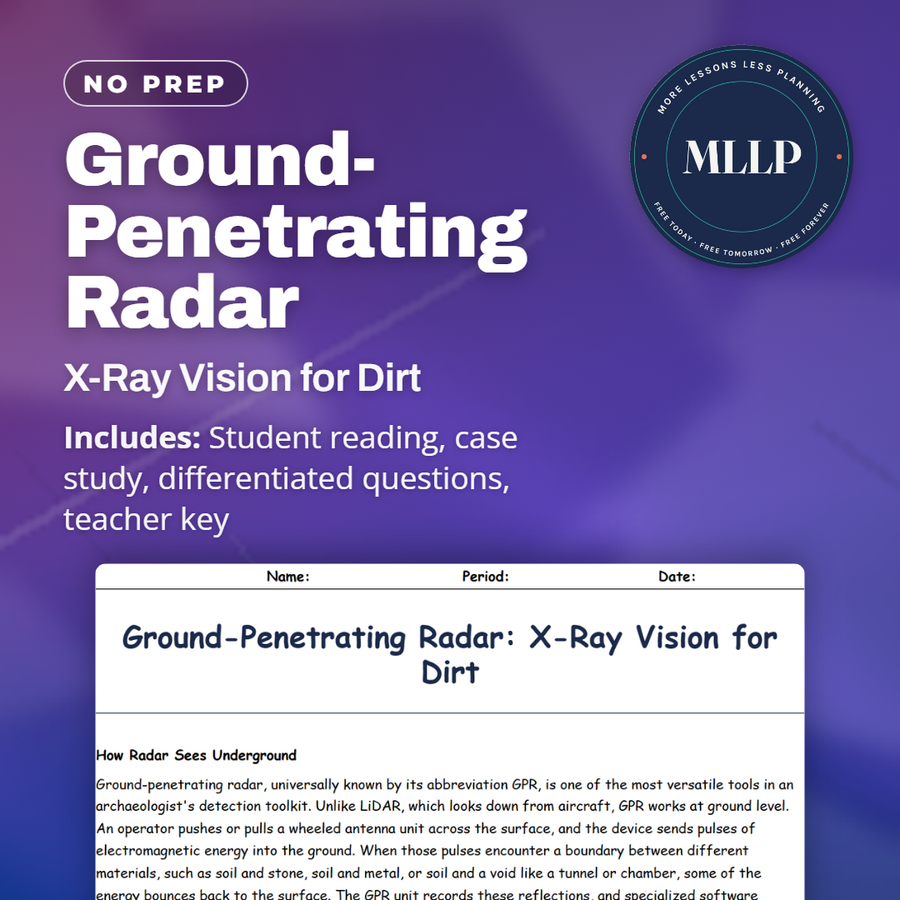
Ground-Penetrating Radar: X-Ray Vision for Dirt
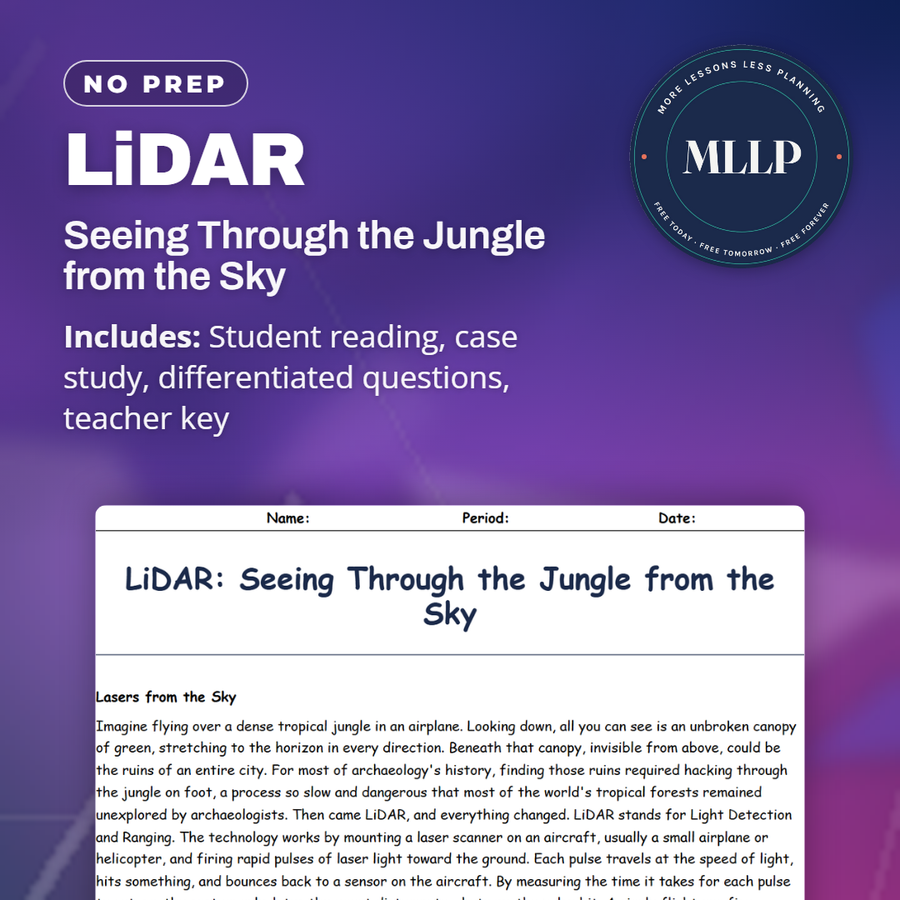
LiDAR: Seeing Through the Jungle from the Sky
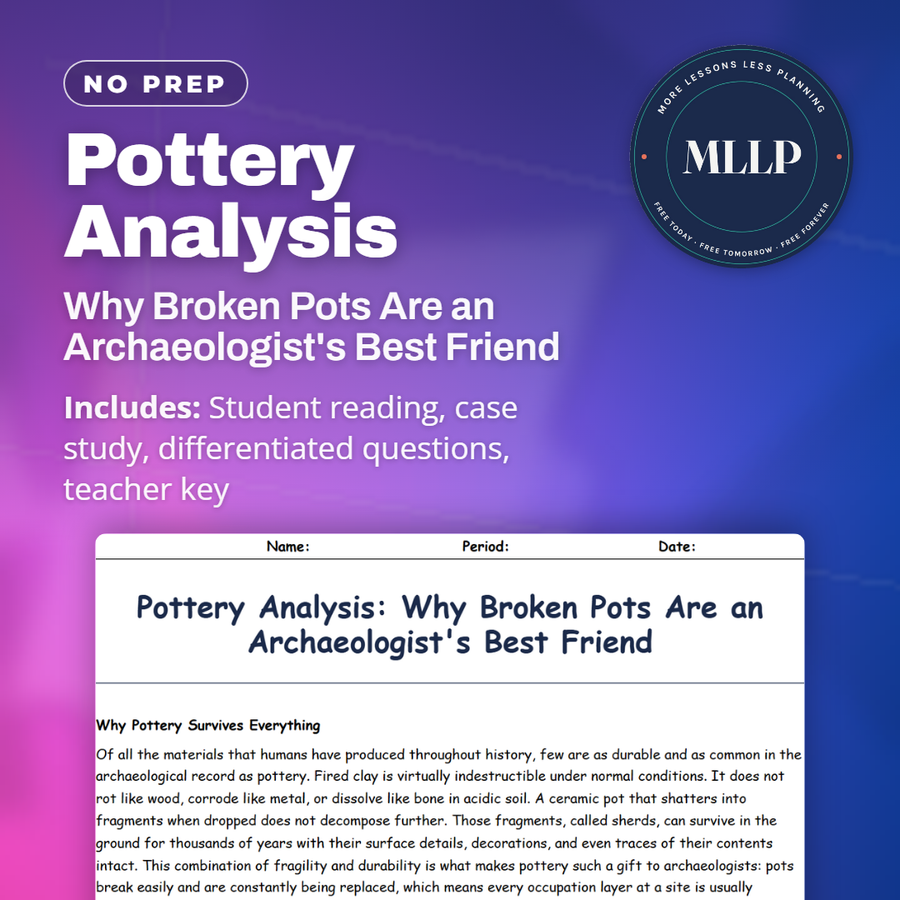
Pottery Analysis: Why Broken Pots Are an Archaeologist's Best Friend
Every lesson on this site is free to download and use. If one of them saved you a prep period, you can chip in a few bucks toward my three kids' daycare fund. That's genuinely where tips go.