
Beyond Carbon: Other Ways to Date the Past
Quality reviewed September 2026
Facts verified September 21, 2026
- Subject
- Social Studies
- Grades
- Grades 9-12
- Length
- 9-page student worksheet
- Time
- About one 50-minute class period
- Great for
- Sub plans and independent work
- Includes
- Reading passage, comprehension questions + full answer key
- Format
- Print-and-go PDF
What students do
- Five dating methods, from dendrochronology to obsidian hydration, get matched to what each one actually measures
- Fill in three blanks on bristlecone pine tree-ring records, potassium's half-life, and the battleship curve
- Three multiple-choice questions ask why potassium-argon suits volcanic rock near East African fossil sites
- Explain why Dr. Yazzie's pueblo beams gave two different construction dates a century apart
What it covers
- Dendrochronology, thermoluminescence, and potassium-argon dating
- Obsidian hydration and seriation for relative dating
- A pueblo beam case study distinguishing tree-cutting dates from construction dates
Start reading this worksheet
Tree Rings: Nature's Calendar
Of all the dating methods available to archaeologists, dendrochronology, the study of tree rings, may be the most precise. Under the right conditions, it can tell you not just the century or decade, but the exact year, and sometimes even the season, when a piece of wood was cut. The principle is straightforward: trees in temperate climates produce one growth ring per year. In a good year with plenty of rain, the ring is wide. In a drought year, the ring is narrow. This creates a distinctive pattern of wide and narrow rings that is shared by all trees of the same species growing in the same region during the same time period. By matching the ring patterns of living trees to those found in old timbers from buildings, and those in turn to even older wood from archaeological sites, scientists have built continuous tree-ring records stretching back thousands of years. The longest unbroken sequence, based on bristlecone pine trees in the American Southwest, extends more than 8,000 years into the past. In Europe, oak chronologies reach back over 10,000 years. These master chronologies serve as reference libraries. When an archaeologist finds a piece of wood at a site, they can compare its ring pattern to the master chronology and, if there is a match, determine exactly when the tree grew and when its outermost ring was formed. Dendrochronology has produced some remarkable results. It pinpointed the construction of Pueblo Bonito in Chaco Canyon, New Mexico, to specific years between 850 and 1130 CE. It showed that the timbers in the roof of a medieval Norwegian church were cut in exactly 1170 CE. It has even been used to authenticate musical instruments, confirming that the wood in a famous Stradivarius violin was cut in the late seventeenth century. Perhaps most importantly, dendrochronology has been used to calibrate radiocarbon dates, correcting the fluctuations in atmospheric carbon-14 that can throw off the carbon dating clock.
Light and Heat: Thermoluminescence Dating
Not everything archaeologists find is organic. Pottery, brick, and burned stone cannot be radiocarbon dated because they contain no carbon-14. For these materials, scientists turn to luminescence dating, a family of methods that measure the energy stored in crystalline minerals since they were last heated or exposed to sunlight. Thermoluminescence, or TL, dating works on materials that have been heated to high temperatures, such as pottery fired in a kiln or stones that were part of a hearth. When mineral crystals in clay or rock are heated above about 500 degrees Celsius, they release all of their stored energy and the clock resets to zero. After that, the crystals begin absorbing energy again from natural background radiation in the surrounding soil. The longer they sit in the ground, the more energy they accumulate. In the lab, scientists heat the sample and measure the light it emits, which is proportional to the amount of stored energy and therefore to the time since it was last fired. A related technique called optically stimulated luminescence, or OSL, works on sediments that have been exposed to sunlight rather than heat. When mineral grains are exposed to sunlight, their stored energy is released, resetting the clock. Once the grains are buried and shielded from light, they begin accumulating energy again. OSL is particularly useful for dating the sediment layers themselves rather than the artifacts within them, which helps archaeologists establish when a layer was deposited. Luminescence dating fills an important gap. It can date materials from roughly 100 years ago to about 500,000 years ago, covering a range that overlaps with radiocarbon dating at the recent end and extends far beyond it at the older end. It is especially valuable in regions where organic materials do not preserve well, such as desert environments where pottery fragments may be the most common finds.
When Carbon Won't Work
For sites older than 50,000 years, which is the upper limit of radiocarbon dating, archaeologists and geologists rely on methods with much longer time ranges. The most important of these is potassium-argon dating, which measures the decay of a radioactive isotope of potassium (potassium-40) into argon gas (argon-40). Potassium-40 has an extremely long half-life of 1.25 billion years, making this method ideal for dating volcanic rocks that are hundreds of thousands to billions of years old. Potassium-argon dating has been essential for understanding human evolution. Some of the most important early hominin fossil sites in East Africa, such as Olduvai Gorge in Tanzania and sites along the Great Rift Valley in Ethiopia, are located near volcanic formations. When a volcano erupts, the fresh lava contains potassium-40 but no argon-40 because the gas escapes during eruption. After the lava cools and solidifies, the potassium-40 begins decaying into argon-40, which is trapped in the rock. By measuring the ratio of potassium-40 to argon-40, scientists can determine when the volcanic eruption occurred and therefore the age of the rock layer. If fossils or artifacts are found sandwiched between two dated volcanic layers, their age can be bracketed with high confidence. Obsidian hydration is another specialized method. Obsidian is a volcanic glass that was widely used for making sharp cutting tools in many ancient cultures. When a fresh surface of obsidian is exposed, either by fracturing during tool-making or by volcanic eruption, it begins to absorb water from its surroundings, forming a thin hydration layer that grows over time. By measuring the thickness of this layer under a microscope, scientists can estimate how long ago the surface was exposed. The method is less precise than radiocarbon or potassium-argon dating because the rate of hydration varies with temperature and the chemical composition of the obsidian, but it is useful for comparing the relative ages of obsidian tools from the same site.
Like what you read? The full reading, the case study, and every question set are in the free download below, along with the answer key.
Why this matters
The reading mentions that dendrochronology was used to confirm the wood in a famous Stradivarius violin was cut in the late seventeenth century, the same method that can catch a forged one. Dating tools like potassium-argon are also how scientists built the timeline of human evolution in East Africa, bracketing fossils between two volcanic layers instead of guessing at their age. Students who go on to work in museums, insurance, or auction houses will run into exactly this kind of authentication question: is this object what it claims to be, and what evidence would prove it either way.
From one teacher to another
Tree rings can pin a wooden beam to the exact year it was cut, and this reading covers four ways archaeologists date things that radiocarbon cannot touch. Thermoluminescence dates pottery and hearth stones by measuring energy trapped in minerals since they were last heated, filling the range between a few centuries and half a million years. Potassium-argon dating works upward from there, dating the volcanic rock layers that bracket early hominin fossils in East Africa. Seriation needs no lab at all: it orders artifacts by tracking how a pottery style rises, peaks, and fades. In the case study, Dr. Ben Yazzie sends beam samples to a dendrochronology lab and learns that two of his twelve roof beams were cut more than a century before the rest, evidence of recycled timber from an older building on the same site.
What you get
Download
Where should I send the next one?
Everything here is free and it stays that way. Leave your email and I'll send you the new lessons as they go up. You can unsubscribe from any one of them.
Related resources

3D Scanning and Virtual Archaeology
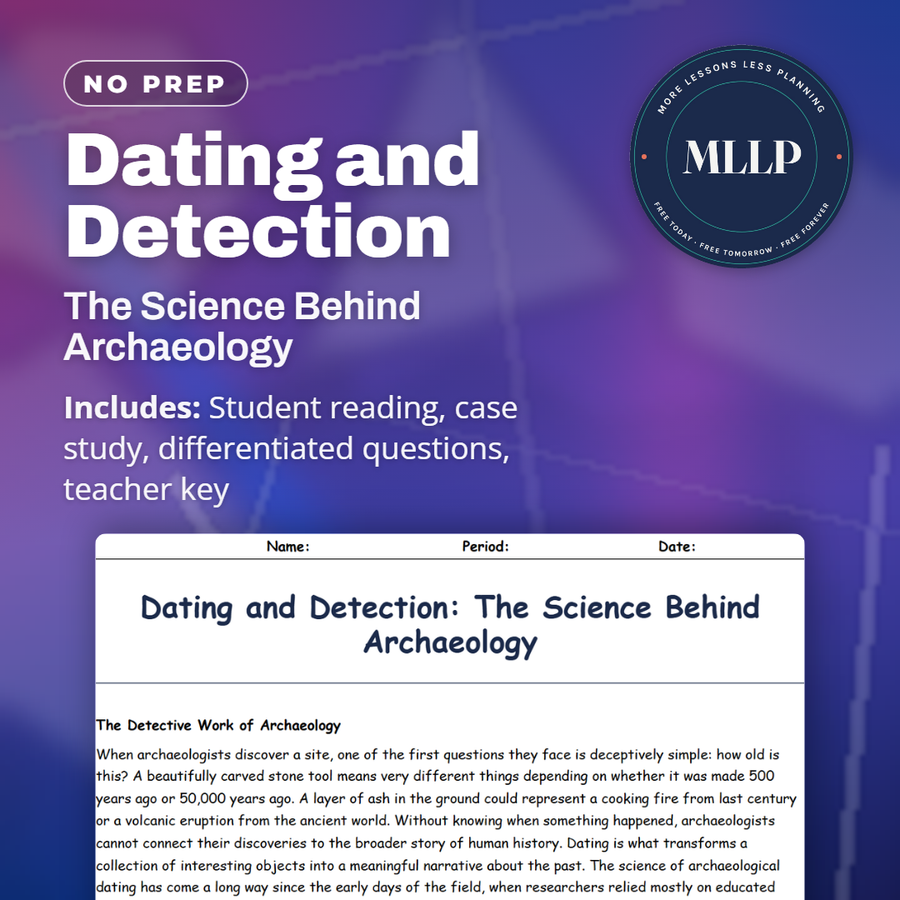
Dating and Detection: The Science Behind Archaeology
GIS and Digital Mapping: Archaeology Meets Big Data

Ground-Penetrating Radar: X-Ray Vision for Dirt

LiDAR: Seeing Through the Jungle from the Sky

Pottery Analysis: Why Broken Pots Are an Archaeologist's Best Friend
Every lesson on this site is free to download and use. If one of them saved you a prep period, you can chip in a few bucks toward my three kids' daycare fund. That's genuinely where tips go.