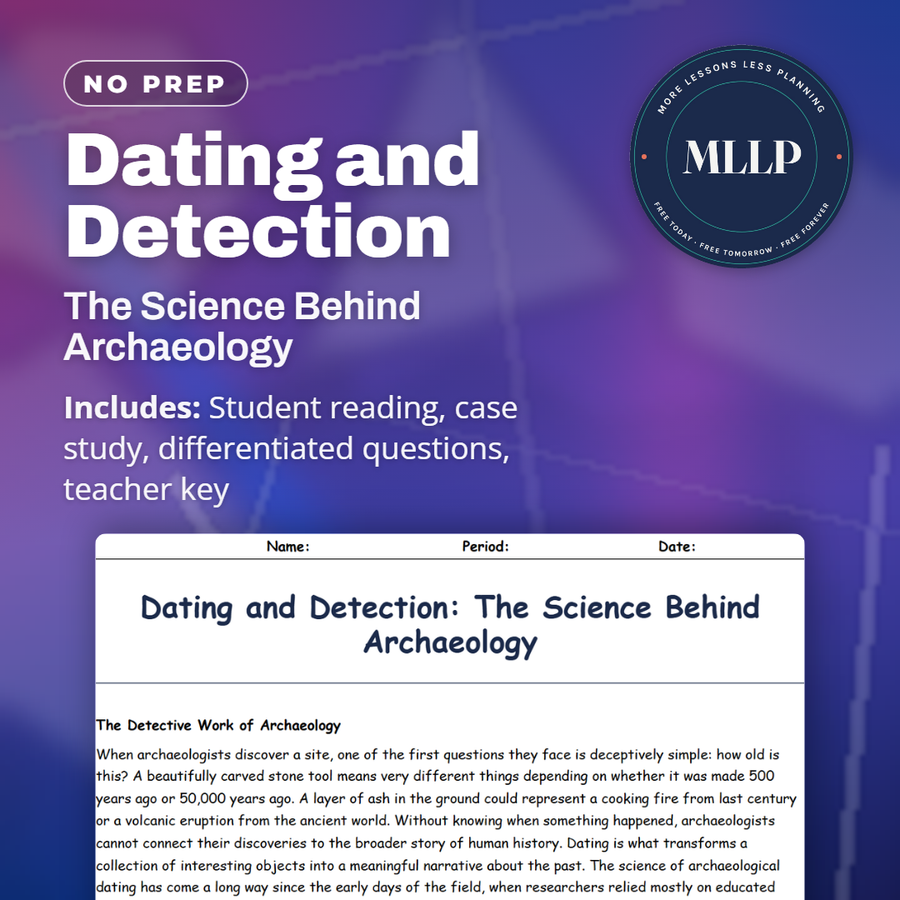
Dating and Detection: The Science Behind Archaeology
Quality reviewed September 2026
Facts verified September 21, 2026
- Subject
- Social Studies
- Grades
- Grades 9-12
- Length
- 9-page student worksheet
- Time
- About one 50-minute class period
- Great for
- Sub plans and independent work
- Includes
- Reading passage, comprehension questions + full answer key
- Format
- Print-and-go PDF
What students do
- Stratigraphy and radiocarbon dating get compared side by side as relative and absolute methods
- Match five terms, including chronology and calibration, to their definitions
- Three fill-in-the-blank items name stratigraphy, radiocarbon, and what LiDAR stands for
- Explain how Dr. Rivera untangles a bone that dated younger than the layer above it
What it covers
- Relative dating with stratigraphy versus absolute dating with radiocarbon
- LiDAR, ground-penetrating radar, and satellite survey before excavation
- A case study resolving contradictory stratigraphy and radiocarbon dates in Peru
Start reading this worksheet
The Detective Work of Archaeology
When archaeologists discover a site, one of the first questions they face is deceptively simple: how old is this? A beautifully carved stone tool means very different things depending on whether it was made 500 years ago or 50,000 years ago. A layer of ash in the ground could represent a cooking fire from last century or a volcanic eruption from the ancient world. Without knowing when something happened, archaeologists cannot connect their discoveries to the broader story of human history. Dating is what transforms a collection of interesting objects into a meaningful narrative about the past. The science of archaeological dating has come a long way since the early days of the field, when researchers relied mostly on educated guesses and comparisons to known objects. Today, archaeologists have access to a sophisticated toolkit of methods that can determine the age of a site or artifact with remarkable precision. Some methods can pinpoint a date to within a single year. Others work on a scale of millions of years. The key is knowing which method to use and when, because no single technique works for every situation. But dating is only half the challenge. Before you can date a site, you have to find it first. Modern archaeologists increasingly rely on advanced detection technologies that can locate buried ruins, hidden cities, and sunken ships without ever breaking ground. These non-invasive methods have transformed the field, allowing researchers to survey vast areas quickly and cheaply while preserving fragile sites for future study.
Old vs. Really Old: Relative and Absolute Dating
Archaeological dating methods fall into two broad categories: relative dating and absolute dating. Understanding the difference between these two approaches is fundamental to how archaeologists reconstruct the timeline of human history. Relative dating tells you that one thing is older or younger than another, but it does not give you a specific date in years. Think of it like organizing a stack of photographs. If you find a photo of your parents at their wedding and another of them holding you as a baby, you know the wedding photo is older even if neither photo has a date printed on it. The most important relative dating method in archaeology is stratigraphy, which is based on the principle that deeper layers of soil were deposited before the layers above them. If you find a pottery fragment in a lower layer and a coin in an upper layer, you know the pottery is older than the coin, even if you cannot say exactly how old either one is. Absolute dating, by contrast, provides a specific age or date range in calendar years. The most famous absolute dating method is radiocarbon dating, which measures the decay of a radioactive form of carbon found in all living things. When an organism dies, its carbon-14 begins to decay at a known rate, and by measuring how much remains, scientists can calculate when the organism died. Radiocarbon dating works on organic materials like wood, bone, and charcoal, and it is effective for materials up to about 50,000 years old. For older materials, archaeologists turn to other methods like potassium-argon dating, which can date volcanic rocks millions of years old. Neither relative nor absolute dating is inherently better than the other. They serve different purposes and work best when used together. A stratigraphy-based relative sequence provides the framework, and absolute dates from specific layers pin that sequence to the calendar. When the two approaches agree, archaeologists can be confident in their timeline. When they disagree, it signals that something unexpected is going on, which often leads to the most interesting discoveries.
Finding Sites Without Digging
For most of archaeology's history, finding new sites required boots on the ground. Researchers would walk across landscapes looking for telltale signs: pottery fragments on the surface, unusual mounds, discolored soil, or local knowledge passed down through generations. This kind of pedestrian survey is still important, but it is slow, expensive, and limited by terrain. You cannot walk through dense jungle or survey the bottom of the ocean. The development of remote sensing technologies has transformed site detection. LiDAR, which stands for Light Detection and Ranging, fires millions of laser pulses from an aircraft and measures how they bounce back from the ground. The technology can see through forest canopy to reveal the shape of the earth below, and it has uncovered thousands of previously unknown structures in places like Guatemala and Cambodia. Ground-penetrating radar sends electromagnetic waves into the soil and records reflections from buried objects, walls, and voids. It has been used to map buried cemeteries, locate hidden rooms in pyramids, and find unmarked graves. Satellite imagery, analyzed with multispectral sensors that detect wavelengths invisible to the human eye, has identified ancient roads, irrigation systems, and even individual buildings from orbit. These technologies have not replaced traditional excavation. They have changed what comes before it. Instead of digging blind, archaeologists can now create detailed maps of what lies underground before they ever pick up a trowel. This means fewer wasted excavation seasons, less destruction of fragile sites, and better-targeted research questions. The combination of advanced detection and precise dating methods has made modern archaeology more scientific, more efficient, and more capable of answering big questions about the human past.
Like what you read? The full reading, the case study, and every question set are in the free download below, along with the answer key.
Why this matters
The reading argues that without dating, archaeology is just organized treasure hunting, and that distinction matters outside the classroom too. When a viral post claims an object is thousands of years older than it is, or when a seller wants to convince a buyer that an artifact is ancient, the same relative and absolute methods described here are what separates a documented find from a guess. Dr. Rivera's conflicting dates also show that good archaeology means questioning your own results instead of publishing the first number that comes back from the lab, a habit worth carrying into any field that runs on data.
From one teacher to another
A stone tool means something different depending on whether it is 500 years old or 50,000, so this reading opens with the two-track system archaeologists use to answer that question. Stratigraphy is relative dating: a coin above a pottery sherd is younger, full stop, even without a calendar year attached. Radiocarbon and potassium-argon are absolute dating: they turn decay rates into an actual number of years. The reading then shifts to how sites get found at all, covering LiDAR pulses that see through jungle canopy, ground-penetrating radar that maps buried walls, and satellite sensors that spot ancient roads from orbit. In the case study, Dr. Maria Rivera has to figure out why a bone from her site's lowest layer dated younger than charcoal from the layer above it, a contradiction that points to burrowing animals moving material between layers.
What you get
Download
Where should I send the next one?
Everything here is free and it stays that way. Leave your email and I'll send you the new lessons as they go up. You can unsubscribe from any one of them.
Related resources
3D Scanning and Virtual Archaeology

Beyond Carbon: Other Ways to Date the Past
GIS and Digital Mapping: Archaeology Meets Big Data
Ground-Penetrating Radar: X-Ray Vision for Dirt

LiDAR: Seeing Through the Jungle from the Sky
Pottery Analysis: Why Broken Pots Are an Archaeologist's Best Friend
Every lesson on this site is free to download and use. If one of them saved you a prep period, you can chip in a few bucks toward my three kids' daycare fund. That's genuinely where tips go.