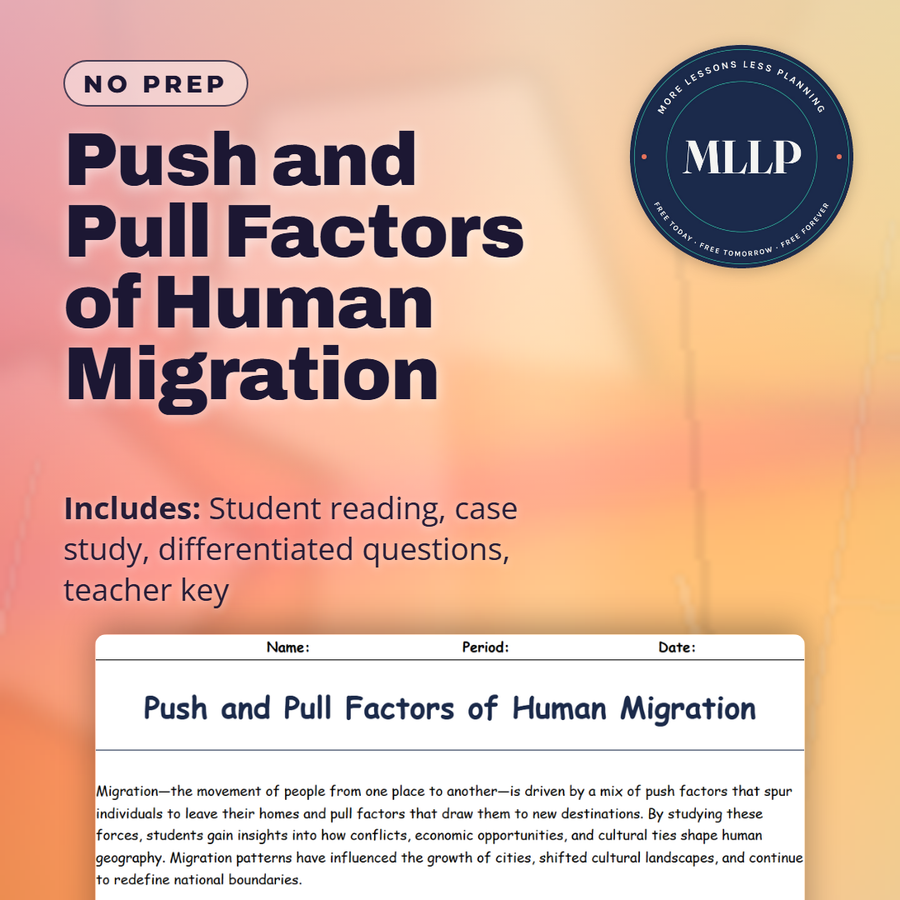
Push and Pull Factors of Human Migration
Quality reviewed September 2026
Facts verified September 14, 2026
- Subject
- Social Studies
- Grades
- Grades 9-12
- Length
- 7-page student worksheet
- Time
- About one 50-minute class period
- Great for
- Sub plans and independent work
- Includes
- Reading passage, comprehension questions + full answer key
- Format
- Print-and-go PDF
What students do
- Match terms like Brain Drain, Diaspora, and Forced Migration to their correct definitions
- Fill in the blank sentences on voluntary migration, push factors, and pull factors
- Answer multiple choice questions on identifying pull factors, why forced migrants leave home, and the effects of migration on urban areas
- Write short answers on how conflict pushes people to migrate, how immigration can benefit a host country, and why migrants sometimes return home
What it covers
- The difference between push factors and pull factors, and between voluntary and forced migration
- How migration reshapes cities and cultures through neighborhoods, cuisine, and traditions
- A case study on the Syrian civil war and the migration wave it triggered across the region and into Europe
Start reading this worksheet
Migration, the movement of people from one place to another, is driven by a mix of push factors that spur individuals to leave their homes and pull factors that draw them to new destinations. By studying these forces, students gain insights into how conflicts, economic opportunities, and cultural ties shape human geography. Migration patterns have influenced the growth of cities, shifted cultural landscapes, and continue to redefine national boundaries.
Key Push and Pull Factors
Push factors include conditions like poverty, lack of jobs, conflict, or environmental disasters that motivate people to seek better prospects elsewhere. For instance, drought or chronic food shortages might force families off their land. Pull factors range from the promise of higher wages to access to education or political freedoms in another area. Socio-political turmoil, such as civil wars or oppressive regimes, stands out as a strong push factor. Meanwhile, robust economies, stable governments, or relatives already living abroad often act as powerful pull factors. The interplay of these elements determines migration flows across the globe.
Voluntary and Forced Migration
Not all migration is the same. Voluntary migration happens when people choose to relocate for opportunities, like a new job or better living conditions. Forced migration occurs when individuals have no real choice, fleeing threats such as violence, persecution, or natural disasters. Refugees escaping conflict zones illustrate forced migration, relying on international laws for protection. Economic migrants, on the other hand, may weigh push factors like low wages against pull factors like higher salaries in destination countries. Each migrant’s situation is unique, reflecting a combination of personal aspirations and external pressures.
Like what you read? The full reading, the case study, and every question set are in the free download below, along with the answer key.
Why this matters
A neighborhood's restaurants, language signs, and festivals often trace back to a push factor and a pull factor working together somewhere in the past. The Syrian civil war shows that pairing at full scale: war pushed families out of their homes while the hope of safety in Turkey, Lebanon, Jordan, or Europe pulled them toward specific destinations.
Students tend to treat migration as one motive, usually just danger, so separating push factors from pull factors and voluntary from forced migration gives them sharper vocabulary before we get to Syria. Once they can name brain drain and diaspora, questions about how immigration reshapes a host country stop feeling abstract.
From one teacher to another
This reading separates push factors from pull factors and voluntary migration from forced migration before applying those ideas to a real crisis. I like that the case study on Syria traces the whole arc, from families displaced inside the country to the journeys some made toward Turkey, Lebanon, Jordan, and Europe, and the strain that placed on host nations. Students match terms like diaspora and assimilation, complete fill-in-the-blank sentences, and then use short answer questions to think through how conflict and immigration reshape both origin and host countries. This pairs well with a unit on refugees and displacement.
What you get
Download
Where should I send the next one?
Everything here is free and it stays that way. Leave your email and I'll send you the new lessons as they go up. You can unsubscribe from any one of them.
Related resources
Birth Rates, Death Rates, and Life Expectancy Explained
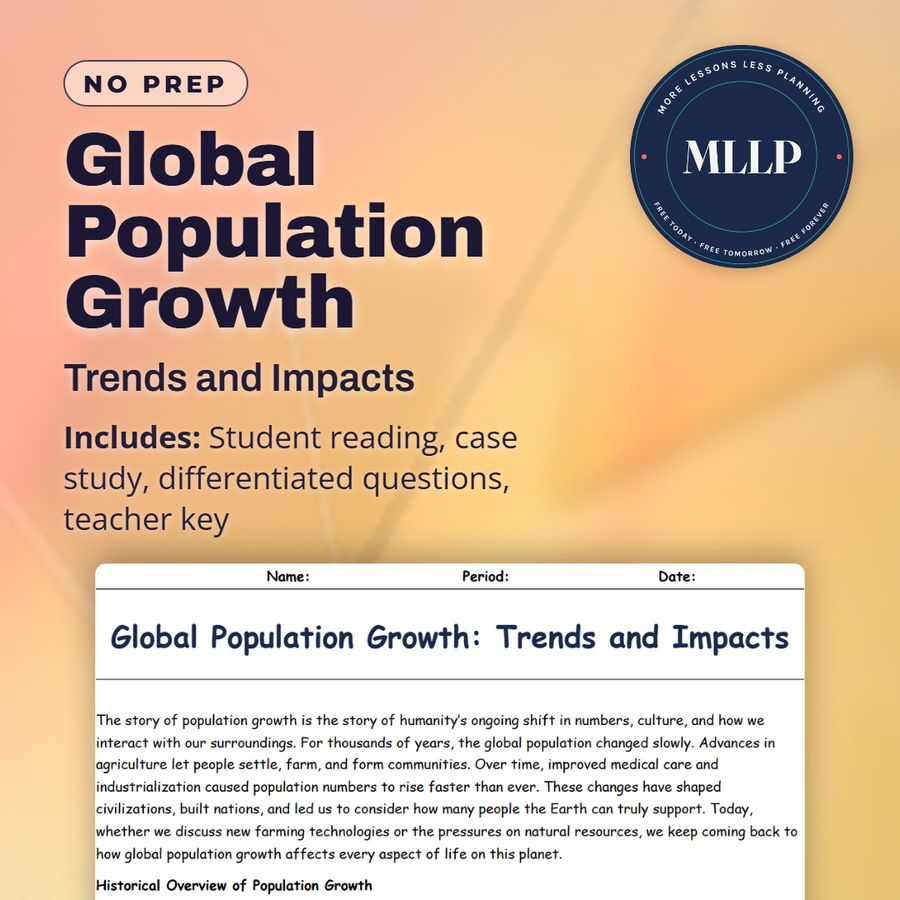
Global Population Growth: Trends and Impacts
How Governments Shape Population Policies
Immigration vs. Emigration: What’s the Difference?
Mapping Population Density and Distribution Patterns
Overpopulation and Earth’s Carrying Capacity
Every lesson on this site is free to download and use. If one of them saved you a prep period, you can chip in a few bucks toward my three kids' daycare fund. That's genuinely where tips go.