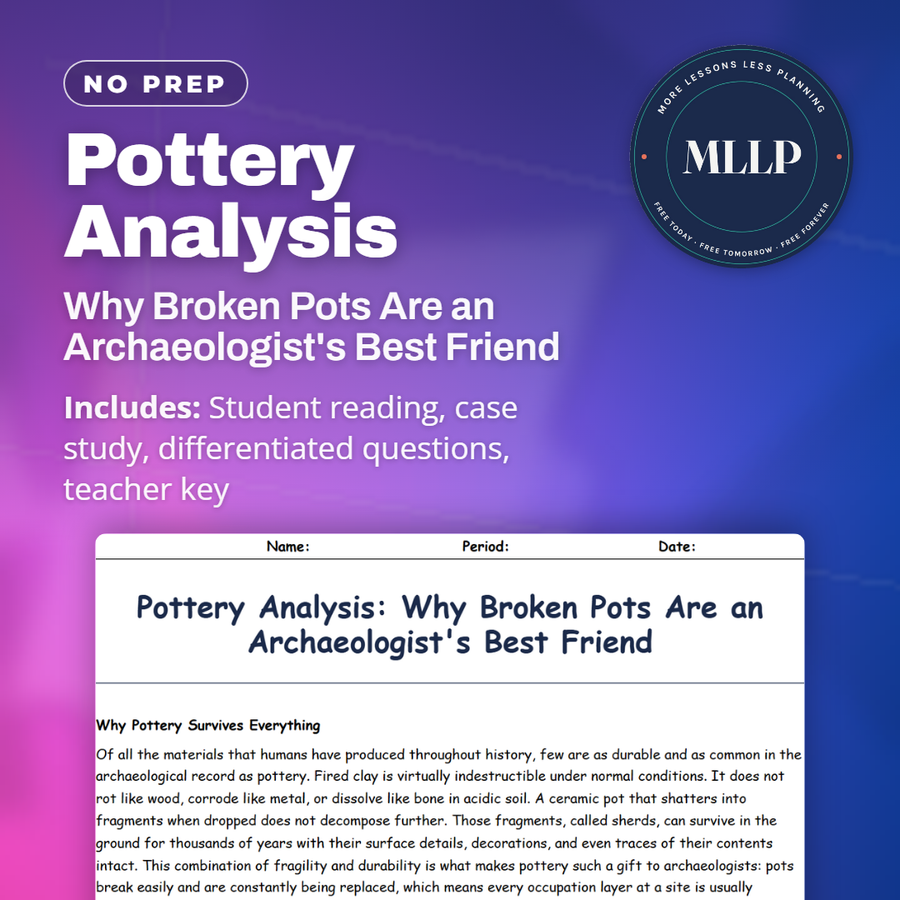
Pottery Analysis: Why Broken Pots Are an Archaeologist's Best Friend
Quality reviewed September 2026
Facts verified September 21, 2026
- Subject
- Social Studies
- Grades
- Grades 9-12
- Length
- 9-page student worksheet
- Time
- About one 50-minute class period
- Great for
- Sub plans and independent work
- Includes
- Reading passage, comprehension questions + full answer key
- Format
- Print-and-go PDF
What students do
- Typology and thin-section analysis get compared, one dates a sherd by eye, the other traces its clay to a source
- Match five terms, including sherd and temper, to their definitions
- Three fill-in-the-blank items name Monte Testaccio's amphorae, polarized light, and East Asia's earliest pottery
- Trace how a single sherd in Dr. Okafor's Ghana dig points to a trade route 500 miles inland
What it covers
- Pottery typology and dating sherds by style
- Thin-section analysis tracing clay back to its source
- Roman amphorae and Monte Testaccio as evidence of ancient trade
Start reading this worksheet
Why Pottery Survives Everything
Of all the materials that humans have produced throughout history, few are as durable and as common in the archaeological record as pottery. Fired clay is virtually indestructible under normal conditions. It does not rot like wood, corrode like metal, or dissolve like bone in acidic soil. A ceramic pot that shatters into fragments when dropped does not decompose further. Those fragments, called sherds, can survive in the ground for thousands of years with their surface details, decorations, and even traces of their contents intact. This combination of fragility and durability is what makes pottery such a gift to archaeologists: pots break easily and are constantly being replaced, which means every occupation layer at a site is usually littered with broken pottery. And once broken, the pieces last essentially forever. Pottery first appeared independently in multiple regions around the world. The earliest known pottery comes from East Asia, with fragments dated to around 20,000 years ago found in China and slightly younger examples found in Japan. In the Middle East, pottery production began around 7000 BCE, and in the Americas, the earliest ceramics date to roughly 5000 BCE. In every culture that developed pottery, it became central to daily life: for cooking, storage, serving food, carrying water, and performing religious rituals. Because pottery was used for so many purposes and was produced in enormous quantities, it is by far the most common type of artifact found at most archaeological sites. The sheer abundance of pottery at most sites is one reason archaeologists love it. While you might find one or two metal objects or a handful of stone tools at a site, you might find thousands of pottery fragments. This abundance provides a statistically meaningful sample that allows archaeologists to identify patterns, track changes over time, and make comparisons between sites. When archaeologists joke that pottery is their best friend, they are only half joking. For many periods and regions of the past, pottery is the single most informative category of evidence available.
Typology: Sorting the Sherds
The first step in analyzing pottery is sorting it into types based on observable characteristics. This process, called typology, involves classifying sherds according to features like the shape of the vessel, the type of clay used, the method of construction (handmade vs. wheel-thrown), the kind of decoration (painted, stamped, incised), and the surface finish (polished, glazed, rough). Each combination of features defines a type, and types are given names that archaeologists across a region can use to communicate precisely about what they have found. Typology is not just a filing system. It is a chronological tool. Because pottery styles change over time, identifying the type of pottery in a given layer helps date that layer. Certain types are associated with specific time periods, and when an archaeologist finds a well-known type in an excavation, it immediately provides an approximate date for the deposit. This is one of the most practical applications of seriation, the dating method discussed in Reading 2.4, where changes in pottery style over time create a chronological framework. The speed and reliability of typological dating is one of its greatest strengths. An experienced ceramic specialist can often pick up a sherd, examine it for a few seconds, and immediately identify its type and approximate date, something that laboratory dating methods cannot match for speed. This rapid dating ability is especially valuable during excavation, when archaeologists need to make real-time decisions about which layers to prioritize and how to interpret what they are finding.
What a Pot Can Tell You About Trade
Pottery provides some of the most compelling evidence for ancient trade networks. When archaeologists find pottery that was clearly made somewhere else, using clay and techniques not available locally, it proves that goods were being moved between regions. The distribution of a particular pottery type across a map can reveal the routes and extent of ancient trade networks with remarkable precision. For example, Roman amphorae, the large two-handled jars used to transport wine, olive oil, and fish sauce across the empire, have been found at sites from Britain to India. By analyzing the clay composition of these amphorae and matching it to known clay sources, researchers can determine exactly where each jar was made. Monte Testaccio in Rome, a hill made entirely of discarded amphora fragments, contains the remains of an estimated 53 million amphorae, each one representing a shipment of goods from across the Mediterranean. The stamps and inscriptions on many of these containers identify the producer, the contents, the shipper, and sometimes even the date, making them one of the richest sources of information about Roman commerce. Ancient trade is not always as obvious as a Roman amphora found in Britain. Sometimes pottery trade shows up in more subtle ways: a local potter imitating a foreign style, a vessel made from local clay but decorated in a foreign technique, or a type of cooking pot that appears at sites along a suspected trade route. These patterns help archaeologists reconstruct not just the movement of goods but the movement of ideas, technologies, and cultural influences between communities.
Like what you read? The full reading, the case study, and every question set are in the free download below, along with the answer key.
Why this matters
The reading's West Africa case study matters because it shows how a single broken pot can prove a trade connection that no written record ever mentioned, which is often the only kind of evidence available for regions and periods that did not leave written history behind. Chemical fingerprinting like thin-section analysis is also the same basic method used today to verify where food, wine, or other goods actually came from, so the skill described here shows up again anywhere origin or authenticity is in question. Pottery residue analysis, which found a fermented rice, honey, and fruit drink in China dating to about 7000 BCE, is a reminder that even the smallest surviving trace of daily life, a stain inside a broken jar, can answer questions that written sources from the same period never thought to record.
From one teacher to another
Pottery breaks constantly and then refuses to disappear, which is exactly why archaeologists call it their best friend: fired clay does not rot or rust, so sherds survive in the ground for thousands of years while giving up almost none of their detail. The reading walks through typology first, the classification system that lets a trained specialist glance at a sherd's shape and decoration and name its approximate date on the spot. Then it moves to trade: Roman amphorae stamped with the name of their maker have turned up from Britain to India, and Monte Testaccio in Rome is an entire hill built from an estimated 53 million discarded jars. Thin-section analysis goes further still, grinding a sliver of pottery thin enough to see its mineral fingerprint under a microscope and match it to the exact clay source it came from. In the case study, Dr. Amara Okafor finds one sherd at a Ghanaian fishing village that does not match anything local, and traces its decoration style to a region 500 miles inland.
What you get
Download
Where should I send the next one?
Everything here is free and it stays that way. Leave your email and I'll send you the new lessons as they go up. You can unsubscribe from any one of them.
Related resources
3D Scanning and Virtual Archaeology

Beyond Carbon: Other Ways to Date the Past
Dating and Detection: The Science Behind Archaeology
GIS and Digital Mapping: Archaeology Meets Big Data
Ground-Penetrating Radar: X-Ray Vision for Dirt

LiDAR: Seeing Through the Jungle from the Sky
Every lesson on this site is free to download and use. If one of them saved you a prep period, you can chip in a few bucks toward my three kids' daycare fund. That's genuinely where tips go.