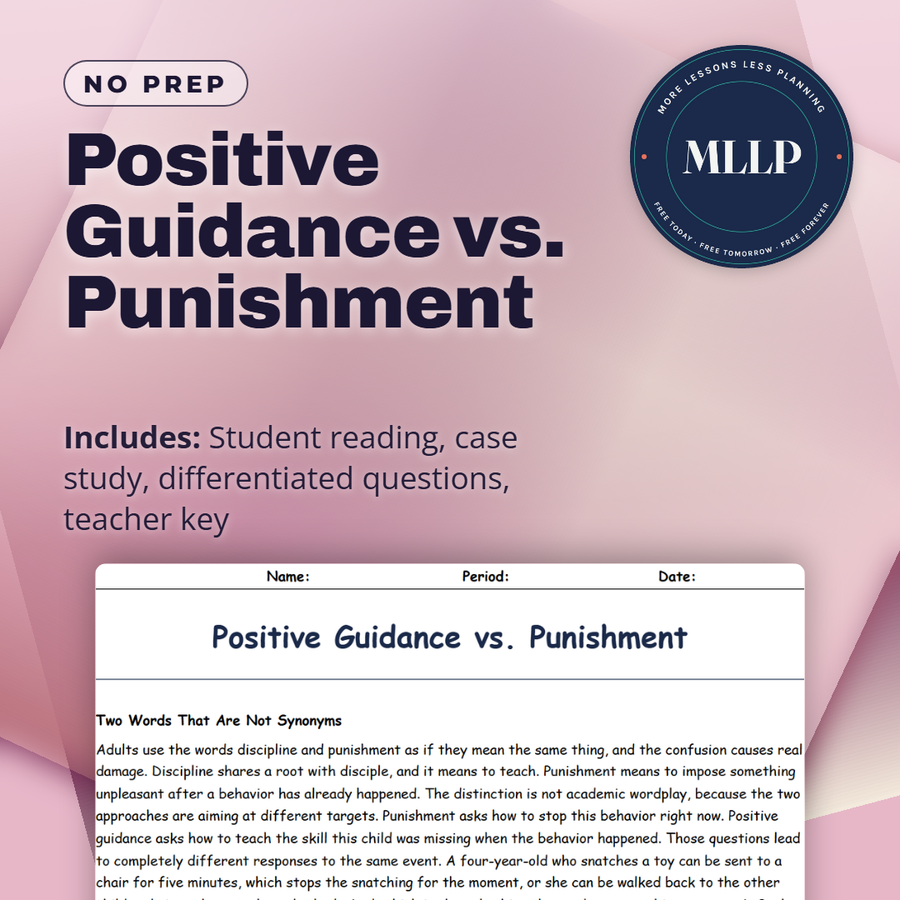
Positive Guidance vs. Punishment
Quality reviewed September 2026
Facts verified September 23, 2026
- Subject
- Career & Life Skills
- Grades
- Grades 9-12
- Length
- 8-page student worksheet
- Time
- About one 50-minute class period
- Great for
- Sub plans and independent work
- Includes
- Reading passage, comprehension questions + full answer key
- Format
- Print-and-go PDF
What students do
- Talia's switch from a time-out chair to a basket of foam balls gets traced back to the guidance technique she finally used
- Match redirection, logical consequences, and descriptive praise to what each one actually teaches a child
- Guidance techniques get sorted by age, from an infant who needs the environment changed to a teenager who needs negotiation
- Answer why an extinction burst fools a tired adult into giving up right before a limit would have worked
What it covers
- The difference between discipline, which means to teach, and punishment, which only stops behavior in the moment
- Why the American Academy of Pediatrics' 2018 statement advises against corporal punishment
- Talia's toddler classroom case study, where the real question is what Marcus was trying to do
Start reading this worksheet
Two Words That Are Not Synonyms
Adults use the words discipline and punishment as if they mean the same thing, and the confusion causes real damage. Discipline shares a root with disciple, and it means to teach. Punishment means to impose something unpleasant after a behavior has already happened. The distinction is not academic wordplay, because the two approaches are aiming at different targets. Punishment asks how to stop this behavior right now. Positive guidance asks how to teach the skill this child was missing when the behavior happened. Those questions lead to completely different responses to the same event. A four-year-old who snatches a toy can be sent to a chair for five minutes, which stops the snatching for the moment, or she can be walked back to the other child and given the actual words she lacked, which is the only thing that reduces snatching next week. Both adults responded. Only one taught anything. The short-term appeal of punishment is real and worth admitting: it usually works faster in the moment, which is exactly why exhausted caregivers reach for it. Guidance is slower at first and pays later. Understanding that trade-off is the single most useful thing a person can carry into a childcare classroom or a family. It reframes a difficult moment from a contest the adult has to win into a lesson the child has not learned yet, and adults who make that shift report that the moments themselves get less personal and far less exhausting. It also lowers the stakes of a bad afternoon, because a lesson that did not land today can simply be taught again tomorrow, while a contest lost today feels like authority permanently surrendered.
What Guidance Actually Looks Like
Positive guidance is not permissiveness, and this is the most common misreading of it. Guidance involves firm limits; what changes is how those limits get taught. Several techniques do most of the work. Redirection moves a young child's attention to an acceptable version of what they were already doing, so a toddler throwing blocks is handed a soft ball and shown where throwing is allowed. Natural consequences let reality do the teaching when it is safe to do so, as when a child who refuses a coat gets cold and asks for it. Logical consequences are arranged by the adult but connect directly to the behavior, so a child who draws on the table helps clean the table rather than losing screen time, which has nothing to do with drawing. Descriptive praise names the specific behavior instead of the child, so an adult says you waited for your turn instead of good job or good girl, giving the child information about what to repeat. Offering limited choices returns some control to a child who is fighting for it, so the question becomes red cup or blue cup rather than are you ready for milk. Modeling matters more than any of these, because children copy what adults actually do with anger and disappointment far more reliably than they follow what adults say. Each technique is small. Used consistently, they add up. Notice that none of them require the adult to be calm, clever, or well rested in the moment. They are scripts, and the reason experienced providers rehearse them is that a script is what remains available when patience is gone.
Why Harsh Punishment Backfires
The research on harsh physical punishment is unusually consistent, which is rare in social science. Decades of studies link spanking to increased aggression, more defiance over time, weaker parent-child relationships, and higher rates of anxiety and depression, and the association holds across income levels and cultures. In 2018 the American Academy of Pediatrics issued a policy statement advising against corporal punishment and against harsh verbal discipline such as shaming or humiliation, citing that body of evidence. The mechanism is not mysterious. Punishment teaches a child what not to do while providing no information about what to do instead, so the child stops the behavior in front of that adult and often continues it elsewhere. It also demonstrates that the way to handle frustration is to make someone smaller than you comply, which is precisely the lesson nobody intends to teach. There is a second problem that surprises people. Behavior often gets worse right before it gets better, a pattern called an extinction burst. A child whose whining has always eventually worked will whine harder the first few times it stops working, and an adult who reads that spike as proof that guidance failed will give in, teaching the child that louder eventually wins. Knowing to expect the burst is what allows an adult to hold a limit through it, which is the moment the actual learning happens. The same logic explains why inconsistent enforcement is worse than no rule at all, since a behavior that is rewarded unpredictably is the hardest kind to extinguish, a pattern casinos have understood for a very long time.
Like what you read? The full reading, the case study, and every question set are in the free download below, along with the answer key.
Why this matters
A cousin's meltdown or a little brother's tantrum is already familiar territory for a lot of students in this room, usually handled with whatever their own parents used because nothing else was on hand. The reframe this reading offers, that a difficult moment is a lesson a child has not learned yet rather than a fight the adult has to win, changes what the next five minutes look like without requiring the adult to be calm or well rested first. Talia's log entry, that Marcus was not being bad, he was being two, is a specific example of that shift happening in real time in a real classroom.
From one teacher to another
Talia is a childcare aide whose toddler room has a four o'clock block-throwing problem, and the fix she lands on only shows up once she stops asking how to stop Marcus and starts asking what he is actually trying to do. The reading builds toward that moment through a set of specific techniques, redirection, natural and logical consequences, descriptive praise, and offering limited choices, each explained with an example rather than left abstract. A full passage covers the research on harsh punishment, including the American Academy of Pediatrics' 2018 position and the extinction burst that makes a behavior look worse right before a limit starts working. Another passage matches guidance tools to what a child's brain can actually do at each age, from an infant who cannot be disciplined at all to a teenager who responds to negotiation. Talia's basket of foam balls is the reading's clearest proof that redirection can outperform a time-out chair in a single afternoon.
What you get
Download
Where should I send the next one?
Everything here is free and it stays that way. Leave your email and I'll send you the new lessons as they go up. You can unsubscribe from any one of them.
Related resources
Are You Ready? The Realities of Parenthood
Caring for Children with Special Needs

Childcare Options and What They Cost

Childproofing and Child Safety
Feeding Infants and Young Children
Parenting Styles and How They Shape Kids
Every lesson on this site is free to download and use. If one of them saved you a prep period, you can chip in a few bucks toward my three kids' daycare fund. That's genuinely where tips go.