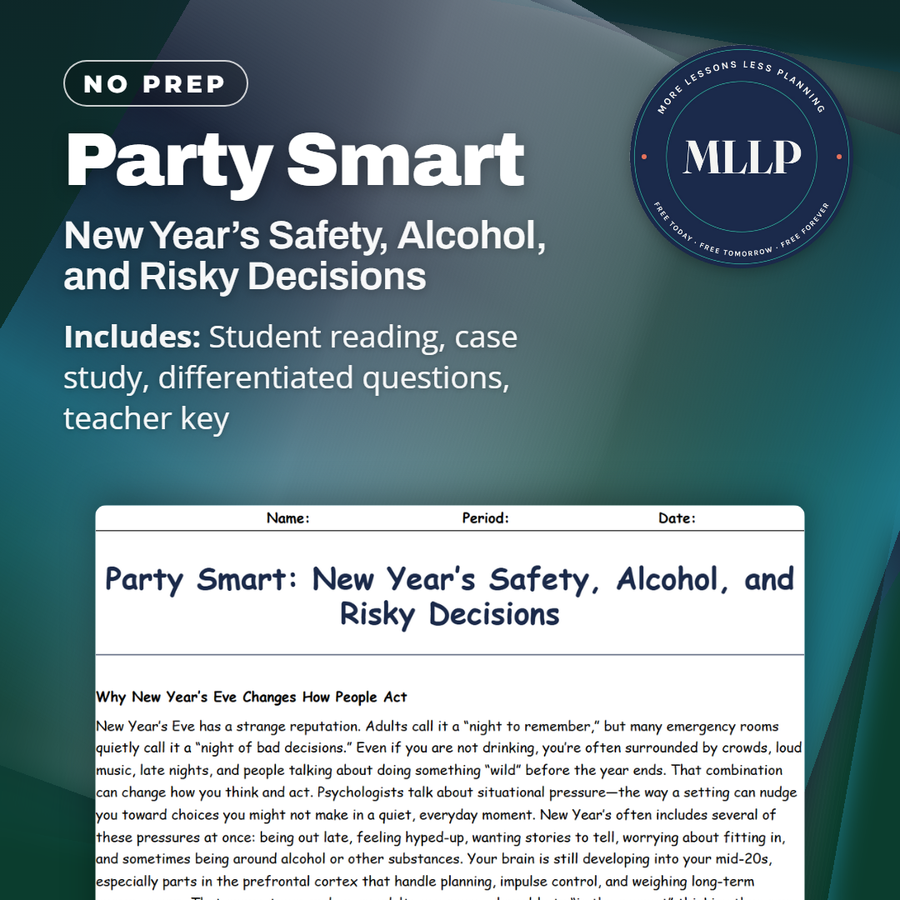
Party Smart: New Year’s Safety, Alcohol, and Risky Decisions
Quality reviewed September 2026
Facts verified September 9, 2026
- Subject
- Health & PE
- Grades
- Grades 9-12
- Length
- 8-page student worksheet
- Time
- About one 50-minute class period
- Great for
- Sub plans and independent work
- Includes
- Reading passage, comprehension questions + full answer key
- Format
- Print-and-go PDF
What students do
- Explain how alcohol lowers inhibitions and slows the teen brain's judgment at a time when it is still developing critical functions
- Apply knowledge of situational pressure and perceived norms to analyze peer influence and risky decisions in realistic scenarios
- Build a personal safety plan using clear boundaries, prepared scripts, and multiple backup transportation options
- Identify warning signs in Marcus's case study and evaluate the exact moment when he could have made a different choice
What it covers
- Alcohol's effects on the brain and teen development
- Peer pressure, perceived norms, and situational influence
- Consent, boundaries, and harm reduction strategies
Start reading this worksheet
Why New Year’s Eve Changes How People Act
New Year’s Eve has a strange reputation. Adults call it a “night to remember,” but many emergency rooms quietly call it a “night of bad decisions.” Even if you are not drinking, you’re often surrounded by crowds, loud music, late nights, and people talking about doing something “wild” before the year ends. That combination can change how you think and act. Psychologists talk about situational pressure: the way a setting can nudge you toward choices you might not make in a quiet, everyday moment. New Year’s often includes several of these pressures at once: being out late, feeling hyped-up, wanting stories to tell, worrying about fitting in, and sometimes being around alcohol or other substances. Your brain is still developing into your mid-20s, especially parts in the prefrontal cortex that handle planning, impulse control, and weighing long-term consequences. That means teens and young adults are more vulnerable to “in the moment” thinking than many adults realize. There’s also the myth that “everyone” is drinking or taking risks on New Year’s Eve. In reality, many teens choose not to drink at all, and a lot of parties are alcohol-free. But perceived norms (what you think others are doing) can shape your choices even more than the truth. If you believe you’re the only one who cares about safety, you may feel pressure to go along with risky plans. Learning how alcohol actually affects the body and how to set boundaries isn’t about ruining anyone’s fun; it’s about giving yourself the tools to stay in control of your own night and your own health.
Alcohol, the Brain, and Risky Situations
Alcohol is a depressant, which means it slows down the nervous system. At first, that can feel like the opposite: people may become louder, more talkative, or more confident. That “buzz” happens because alcohol lowers inhibitions, the brakes your brain normally uses to keep behavior in check. As blood alcohol concentration (BAC) rises, reaction time slows, coordination gets worse, and judgment becomes less accurate. You may underestimate how impaired you are, which is one reason drunk driving and other dangerous behaviors are such a problem on New Year’s Eve. For teenagers, alcohol carries extra risks. The teen brain is still wiring itself, especially areas that control planning, decision-making, and emotional regulation. Research suggests that heavy drinking at a young age can interfere with memory, learning, and mood, and can increase the likelihood of developing a substance use disorder later in life. Mix alcohol with other factors (like riding with a distracted driver, walking near busy roads at night, or being in unfamiliar places), and risk multiplies quickly. New Year’s also adds social pressure. Someone might hand you a drink you didn’t ask for, make fun of you if you say no, or push for risky stunts “for the story” or “for the snap.” In those moments, it helps to remember that consent and safety apply to more than just relationships. They apply to any situation where your body and choices are involved. You have the right to know what you’re drinking, to refuse any substance, and to leave a situation that feels unsafe. Having that mindset before the night starts makes it easier to stick to your decision when the music is loud and everyone is yelling “Happy New Year.” This table is not permission to drink; it’s a reminder that risks stack up. The safest choice for anyone underage is not drinking at all, and for everyone, it’s to avoid combining alcohol with driving or other dangerous activities.
Like what you read? The full reading, the case study, and every question set are in the free download below, along with the answer key.
Why this matters
Midnight on New Year's Eve is exactly when teenage judgment is least reliable, because a brain still learning to weigh consequences gets handed alcohol that slows it down further. Marcus did not plan to end up where the case study leaves him, he just kept ignoring small warning signs until there were no easy choices left.
What surprises students most is how ordinary Marcus's mistakes look. I don't treat him as reckless or foolish, he just ran out of a plan at the moment he needed one. Walking through where he could have said no turns vague advice about boundaries into a checklist: a script practiced ahead of time, a charged phone, a ride arranged before the night gets complicated.
From one teacher to another
I teach this matter-of-factly because the stakes are real on New Year's Eve. The reading doesn't shame anyone for drinking or partying; it explains what alcohol actually does (slows your brain, lowers brakes, makes you feel more confident than you actually are). Marcus's story is the key. He wasn't "bad" or "stupid". He just ignored warning signs and made one choice he regretted. By walking through where he could have said no, students see they have actual tools: boundaries set in advance, scripts they've practiced, a charged phone, a backup ride. That's not paranoid; that's normal safety planning that adults use too.
What you get
Download
Where should I send the next one?
Everything here is free and it stays that way. Leave your email and I'll send you the new lessons as they go up. You can unsubscribe from any one of them.
Related resources
Biology of Evergreen Plants: The Science Behind Christmas Trees
Body Clocks and Midnight Countdowns: Circadian Rhythms at New Year’s
Calendars, Orbits, and the Science of New Year’s Day
Christmas on the Home Front: WWII Rationing and Resilience
Colorful Chemistry: Holiday Lights, Fireworks, and the Science of Glow
Crowded Skies: Holiday Air Travel and the Environment
Every lesson on this site is free to download and use. If one of them saved you a prep period, you can chip in a few bucks toward my three kids' daycare fund. That's genuinely where tips go.