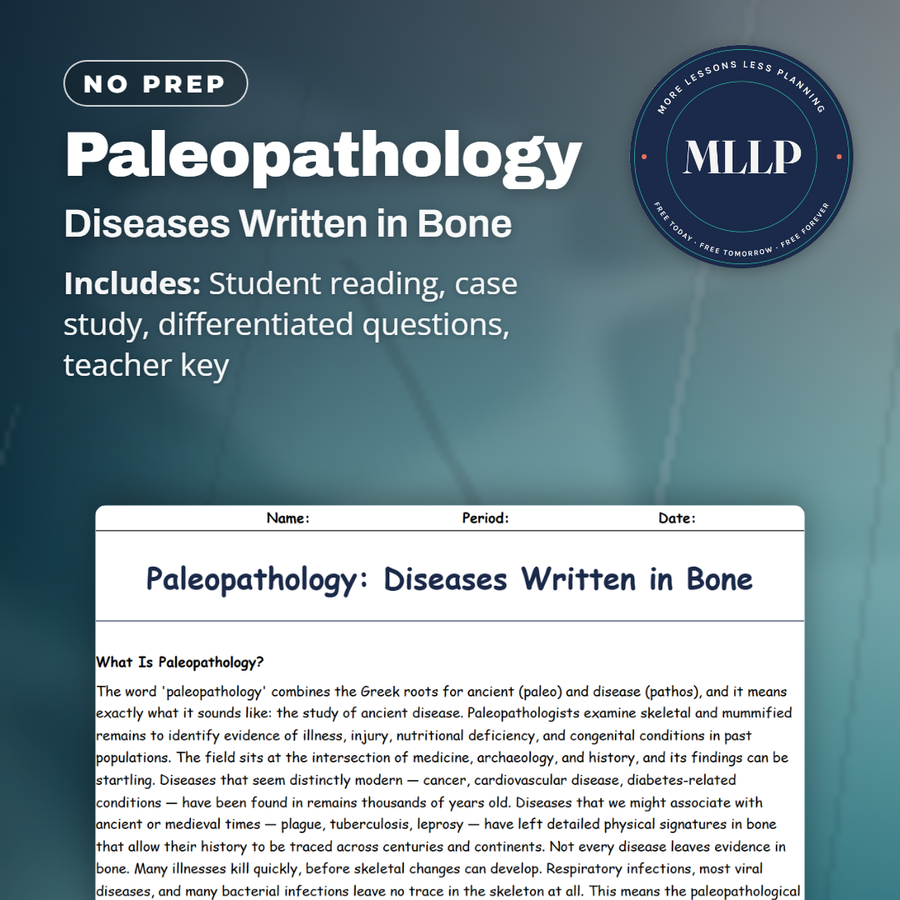
Paleopathology: Diseases Written in Bone
Quality reviewed September 2026
Facts verified September 21, 2026
- Subject
- Social Studies
- Grades
- Grades 9-12
- Length
- 9-page student worksheet
- Time
- About one 50-minute class period
- Great for
- Sub plans and independent work
- Includes
- Reading passage, comprehension questions + full answer key
- Format
- Print-and-go PDF
What students do
- Five matching pairs connect paleopathology, lesion, and epidemic to their working definitions
- Pott's disease leaves such a distinctive angular collapse in the spine that tuberculosis can be diagnosed without a single lab test
- Explain what the Krakow mass grave's lack of order and grave goods reveals about the community that buried it
- Answer short-answer questions on how paleopathologists tell disease apart from injury and normal aging
What it covers
- How tuberculosis and leprosy leave distinctive, diagnosable signatures in bone
- Why the debate over syphilis's origin in the Americas versus Europe remains unresolved
- What a disordered mass grave with no grave goods reveals about a community overwhelmed by the Black Death
Start reading this worksheet
What Is Paleopathology?
The word 'paleopathology' combines the Greek roots for ancient (paleo) and disease (pathos), and it means exactly what it sounds like: the study of ancient disease. Paleopathologists examine skeletal and mummified remains to identify evidence of illness, injury, nutritional deficiency, and congenital conditions in past populations. The field sits at the intersection of medicine, archaeology, and history, and its findings can be startling. Diseases that seem distinctly modern, including cancer, cardiovascular disease, and diabetes-related conditions, have been found in remains thousands of years old. Diseases that we might associate with ancient or medieval times, including plague, tuberculosis, and leprosy, have left detailed physical signatures in bone that allow their history to be traced across centuries and continents. Not every disease leaves evidence in bone. Many illnesses kill quickly, before skeletal changes can develop. Respiratory infections, most viral diseases, and many bacterial infections leave no trace in the skeleton at all. This means the paleopathological record is systematically biased toward chronic conditions, diseases that progressed slowly enough to reshape bone over years or decades. A population that died suddenly in an epidemic might leave little skeletal evidence of what killed them, while a population that suffered from chronic malnutrition would leave extensive evidence. Understanding what paleopathology can and cannot detect is as important as knowing what it finds.
Tuberculosis and Leprosy: The Ancient Killers
Tuberculosis (TB) is one of the most important and well-documented ancient diseases in the paleopathological record. Caused by Mycobacterium tuberculosis, TB most commonly affects the lungs, but in a significant percentage of cases, it spreads to the skeleton, particularly the spine. Spinal TB causes the vertebrae to collapse and fuse in a distinctive angular deformity called Pott's disease, or gibbus deformity. This pattern is so characteristic that paleopathologists can diagnose TB in a skeleton with considerable confidence even without any laboratory confirmation. Evidence of TB has been found in Egyptian mummies, in Neolithic European skeletons, and in pre-Columbian American remains, proving that this disease has been with humanity for at least 9,000 years. Leprosy, caused by Mycobacterium leprae, leaves equally recognizable skeletal signatures. The disease attacks peripheral nerves and the small bones of the extremities: the hands, feet, and face. In advanced cases, it causes the nasal bones to collapse, the small bones of the fingers and toes to be resorbed, and the facial bones to develop distinctive pitting. Medieval Europe had thousands of leprosaria (leper hospitals), and archaeological excavations of their associated cemeteries have provided extensive evidence of how the disease progressed and who it affected. DNA analysis of ancient M. leprae has even allowed researchers to trace the geographic origins and spread of different strains, revealing that medieval leprosy in Europe likely arrived via trade routes from Asia.
Syphilis: A Disease That Crossed Oceans
Few diseases in the paleopathological record are more controversial than syphilis. The Columbian hypothesis argues that syphilis was brought to Europe by sailors returning from the Americas with Columbus in 1493. The historical evidence is striking: a sudden epidemic of a virulent disease with syphilitic symptoms swept through Europe in the 1490s, killing tens of thousands within a few years. If syphilis was indeed introduced to Europe from the Americas, it would be one of the best-documented examples of a disease crossing an ocean and devastating a naive population with no prior immunity. Syphilis caused by Treponema pallidum leaves distinctive lesions on bone, a pattern of erosive pitting and new bone formation on the skull and long bones called caries sicca. Paleopathologists have identified these lesions in pre-Columbian American skeletons dating back thousands of years, consistent with the disease originating in the Americas. However, some researchers claim to have identified possible syphilitic lesions in pre-Columbian European remains as well, which would challenge the Columbian hypothesis. The debate continues, and each new ancient DNA study of Treponema organisms from different locations adds data to an ongoing scientific argument. What is not in dispute is that syphilis, wherever it originated, caused devastating epidemics and has left abundant skeletal evidence of its global spread.
Like what you read? The full reading, the case study, and every question set are in the free download below, along with the answer key.
Why this matters
Plague, tuberculosis, and syphilis are still active global health topics, and this reading traces how deep their history in the human body actually goes. The Krakow case study gives students a way to see a mass grave as data rather than horror, since the absence of ritual care tells Dr. Kowalski as much about the community's collapse as any single skeleton would. Understanding that TB has coexisted with humans for at least 9,000 years also gives students context for why modern public health researchers still study ancient plague DNA, since the same bacteria's evolutionary history matters for treating outbreaks today.
From one teacher to another
Some diseases write themselves directly into bone, and this reading shows students how to read that record. Tuberculosis causes a distinctive angular collapse of the spine called Pott's disease, found in remains as old as 9,000 years, while leprosy attacks the small bones of the hands, feet, and face closely enough that paleopathologists can diagnose it without any lab test. Syphilis leaves its own signature, called caries sicca, and the reading lays out the ongoing debate over whether it originated in the Americas before spreading to Europe after 1493. The final passage covers the Black Death, where mass graves with bodies stacked without order or grave goods reveal a society that had lost the capacity to bury its dead with normal care. The case study follows Dr. Anna Kowalski as she excavates a disordered mass grave in Krakow and predicts, before the lab results come back, what the tooth samples will show.
What you get
Download
Where should I send the next one?
Everything here is free and it stays that way. Leave your email and I'll send you the new lessons as they go up. You can unsubscribe from any one of them.
Related resources
Battlefield Archaeology: Uncovering the Cost of War
Bones, DNA & Forensic Archaeology: An Overview
Facial Reconstruction: Putting a Face on the Past
Forensic Archaeology: Solving Modern Crimes with Ancient Methods
_COVER.png)
Isotope Analysis: You Are What You Eat (and Where You Lived)
Mummies: Preserved Bodies and What They Teach Us
Every lesson on this site is free to download and use. If one of them saved you a prep period, you can chip in a few bucks toward my three kids' daycare fund. That's genuinely where tips go.