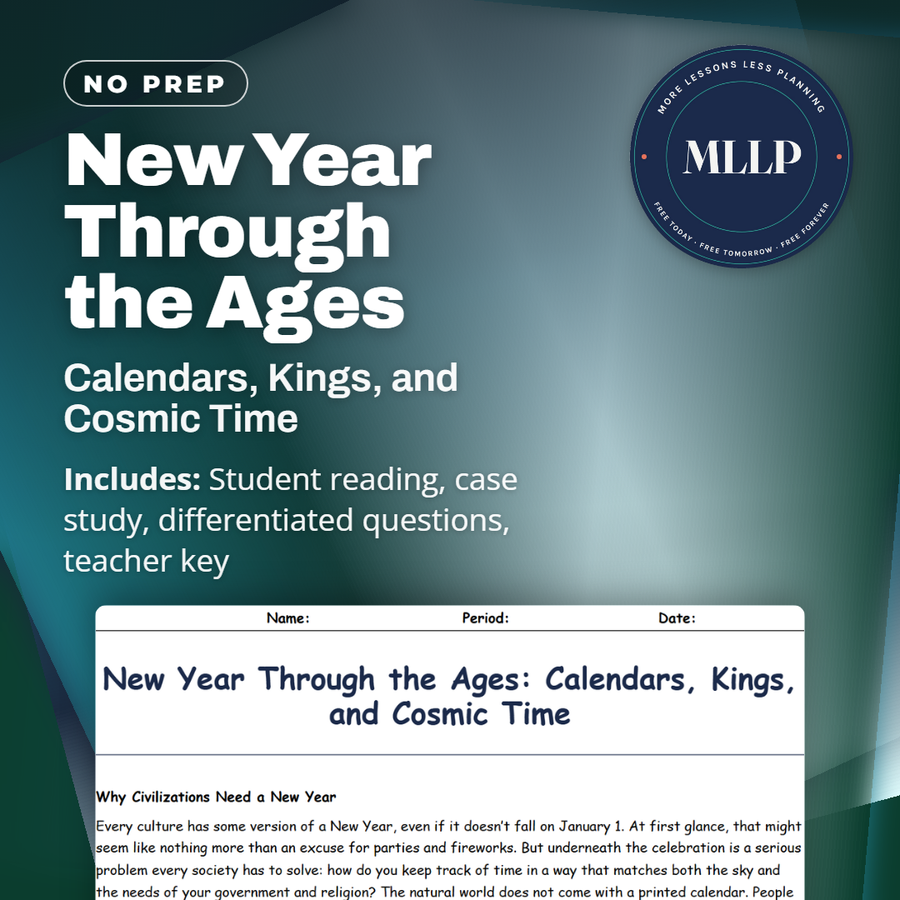
New Year Through the Ages: Calendars, Kings, and Cosmic Time
Quality reviewed September 2026
Facts verified September 9, 2026
- Subject
- Social Studies
- Grades
- Grades 9-12
- Length
- 8-page student worksheet
- Time
- About one 50-minute class period
- Great for
- Sub plans and independent work
- Includes
- Reading passage, comprehension questions + full answer key
- Format
- Print-and-go PDF
What students do
- Trace how ancient civilizations (Mesopotamian, Egyptian, Roman) used New Year to reinforce royal authority and religious meaning
- Explain why Julius Caesar and Pope Gregory XIII had to reform the calendar and the astronomical reasons behind each change
- Analyze a firsthand account of the Gregorian calendar reform to understand how authority controls time itself for everyone
- Compare lunar, solar, and lunisolar calendars across cultures and identify what each society prioritized
What it covers
- Ancient calendars and power (Akitu, Nile flood, Chinese systems)
- Calendar reform and the science of timekeeping
- Time as a tool of political control and identity
Start reading this worksheet
Why Civilizations Need a New Year
Every culture has some version of a New Year, even if it doesn’t fall on January 1. At first glance, that might seem like nothing more than an excuse for parties and fireworks. But underneath the celebration is a serious problem every society has to solve: how do you keep track of time in a way that matches both the sky and the needs of your government and religion? The natural world does not come with a printed calendar. People notice repeating patterns: the sun rises and sets, the moon waxes and wanes, seasons cycle from planting to harvest. But those cycles don’t line up perfectly. A solar year (one orbit of Earth around the sun) is about 365¼ days, while a lunar month is about 29½ days. If you simply follow the moon, your holidays drift through the seasons. If you follow only the sun, you miss the obvious phases in the night sky. Ancient societies experimented with different ways of combining these cycles, and the choice of a “New Year’s Day” became a way of announcing what mattered most: farming, religion, royal power, or all three. A New Year is also psychological. It creates a shared pause where people look backward and forward at the same time: reviewing debts, renewing promises, forgiving offenses, or re-setting political and religious duties. In many early civilizations, the New Year was when kings renewed their legitimacy, taxes were recorded, and religious rituals “re-started” the cosmic clock. When you tell people, “This is the first day of the year,” you’re not just pointing at the calendar. You’re telling them when their story, and their responsibilities, begin again.
Kings, Priests, and the Power of the Calendar
In ancient Mesopotamia, the New Year festival known as Akitu was far more than a party. It was a carefully staged ritual in cities like Babylon, lasting multiple days. Priests processed statues of the gods through the streets, recited sacred stories, and performed ceremonies that symbolically re-created the victory of order over chaos. The king took part in these rituals, sometimes even being briefly humbled before the statue of the god to show that his power depended on divine approval. When the festival ended, his authority (and the stability of the universe) were symbolically renewed for another year. Other civilizations tied the start of the year to their own priorities. Ancient Egyptians often linked the year’s beginning to the annual flooding of the Nile, which renewed farmland. Some early Chinese dynasties timed the New Year to both agricultural cycles and cosmic signs, such as the position of certain constellations. In each case, the calendar was not neutral. It told people when to plant crops, when to pay taxes, and when to perform rituals. It also reminded them who had the power to decide these things: usually kings and priests. Choosing a New Year was political. If a new dynasty came to power, it might rename years, reset the count to “Year One,” or adjust the calendar to highlight a favorite deity or heavenly sign. Even today, when you see a government adopt or reform a calendar, you’re also seeing a claim about identity and authority: “We are this kind of people, and we measure time this way.” This variety reminds us there is nothing “automatic” about starting the year in January. What counts as “New Year’s Day” depends on who is in charge and what they care about.
Reforming Time: From Julius Caesar to the Gregorian Calendar
By the first century BCE, the Roman calendar had become a mess. It was a lunisolar system, trying to juggle moon cycles with the solar year, and politicians could manipulate month lengths for their own purposes. Festivals drifted away from their proper seasons. To fix this, Julius Caesar introduced the Julian calendar in 46 BCE, with the help of Egyptian astronomers. This new system set the year at 365¼ days, adding a leap day every four years to catch up with the extra quarter day. For its time, the Julian calendar was a major improvement. It stabilized the schedule of Roman festivals and made record-keeping more consistent across the empire. But it wasn’t perfect. The actual solar year is slightly shorter than 365¼ days: about 365.2422. That tiny difference (about 11 minutes per year) added up over centuries. By the Middle Ages, the date labeled as the spring equinox on the calendar no longer matched the equinox in the sky. This created a particular problem for the Christian church, which calculated the date of Easter using the equinox as a reference point. In 1582, Pope Gregory XIII ordered another reform, now known as the Gregorian calendar. To realign dates with the seasons, ten days were dropped from the calendar (like in the case study), and a new rule was added: century years (like 1600, 1700, 1800) would only be leap years if divisible by 400. This small tweak made the calendar more accurate in the long run. Not everyone accepted the change right away. Catholic countries adopted it first; some Protestant regions resisted, seeing it as a “foreign” or “papal” invention. As a result, for a while, people in different parts of Europe wrote different dates for the same day. Over the next few centuries, most governments switched over, especially as global trade and science demanded a shared system. The story of these reforms shows that even something as basic as the date is the result of negotiation, power struggles, and scientific reasoning.
Like what you read? The full reading, the case study, and every question set are in the free download below, along with the answer key.
Why this matters
Pope Gregory XIII once deleted ten days from the calendar in a single stroke to fix centuries of drift, and people went to sleep on one date and woke on another with no days in between. A narrator in the case study describes it as time itself being stolen, a strange thing to feel about a chart on a wall.
Ancient civilizations used New Year for a similar reason: Mesopotamian, Egyptian, and Roman rulers tied the new year to their own authority, through a flooding river or a religious festival. Once students count how many calendars they live with, school, work, a religious one, the civil calendar, the idea that time is neutral stops holding up.
From one teacher to another
This worksheet works because it shows students that the calendar is not neutral. When you tell people the year has started, you're also telling them that someone, a king, a pope, a government, has the power to decide what year it is. The case study excerpt about losing ten days hits that point perfectly; a narrator feels as if time itself has been stolen. I love asking students to think about how many calendars they live with at once: school calendar, work calendar, maybe a religious calendar, the global civil calendar. It opens up questions about identity and belonging that usually feel abstract until they realize they're living proof of the concept.
What you get
Download
Where should I send the next one?
Everything here is free and it stays that way. Leave your email and I'll send you the new lessons as they go up. You can unsubscribe from any one of them.
Related resources

Biology of Evergreen Plants: The Science Behind Christmas Trees
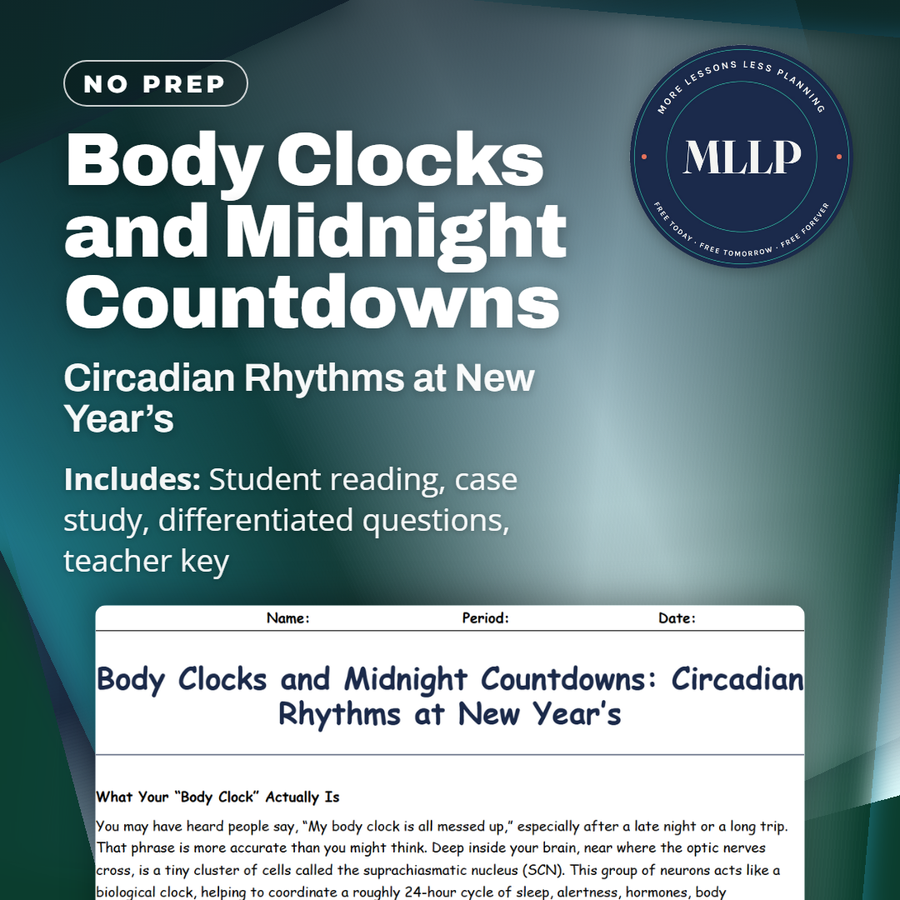
Body Clocks and Midnight Countdowns: Circadian Rhythms at New Year’s
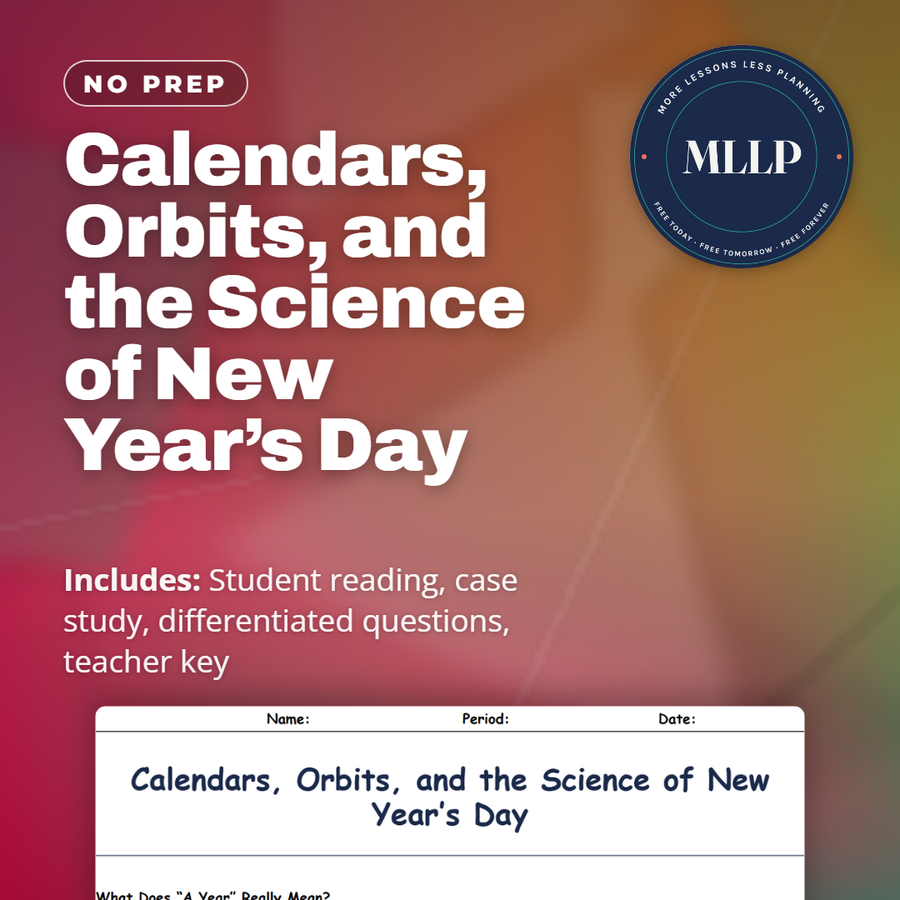
Calendars, Orbits, and the Science of New Year’s Day
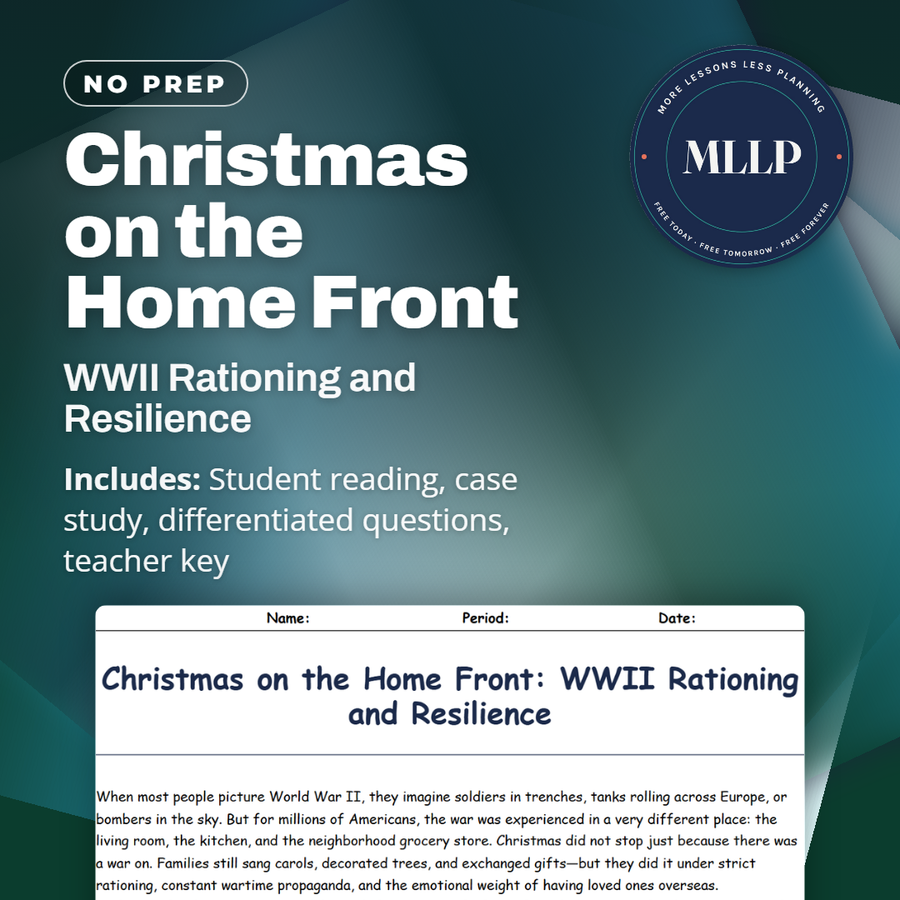
Christmas on the Home Front: WWII Rationing and Resilience
Colorful Chemistry: Holiday Lights, Fireworks, and the Science of Glow
Crowded Skies: Holiday Air Travel and the Environment
Every lesson on this site is free to download and use. If one of them saved you a prep period, you can chip in a few bucks toward my three kids' daycare fund. That's genuinely where tips go.