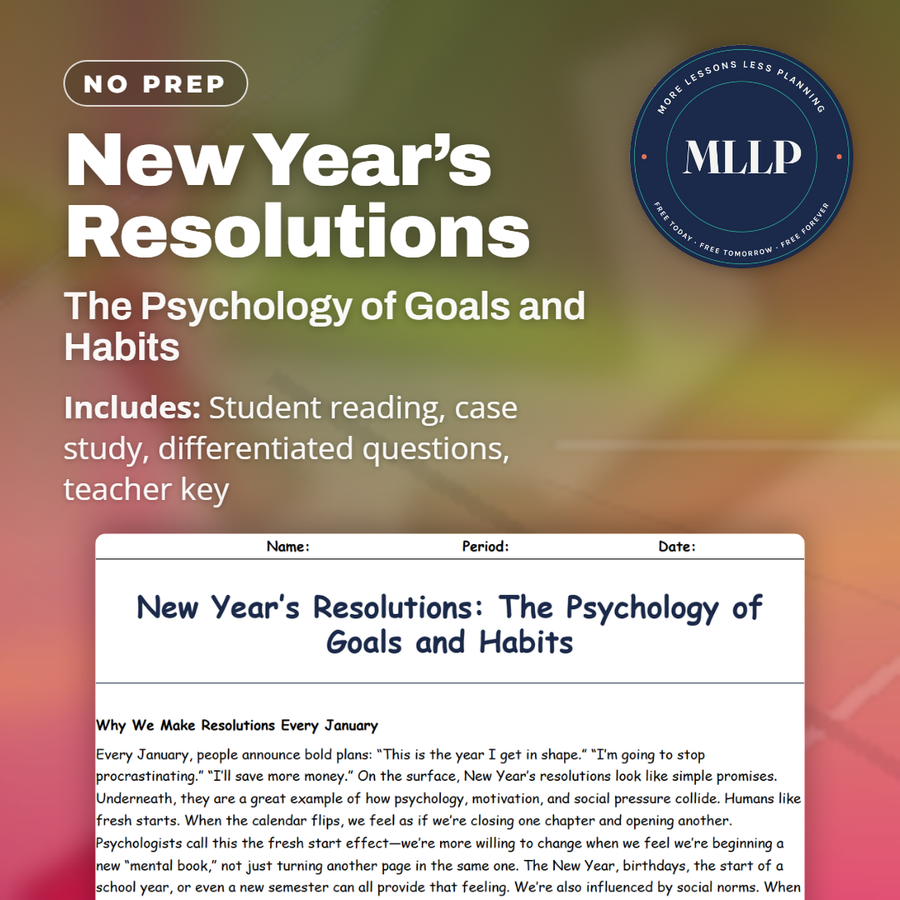
New Year’s Resolutions: The Psychology of Goals and Habits
Quality reviewed September 2026
Facts verified September 9, 2026
- Subject
- Social Studies
- Grades
- Grades 9-12
- Length
- 7-page student worksheet
- Time
- About one 50-minute class period
- Great for
- Sub plans and independent work
- Includes
- Reading passage, comprehension questions + full answer key
- Format
- Print-and-go PDF
What students do
- Contrast outcome goals (the end result) with process goals (daily actions) and explain why process goals give you more control
- Explore identity-based goals like "I'm the kind of person who" and analyze how they create stickier habits than behavior-alone goals
- Design a personal choice architecture plan that removes friction from a desired habit and adds friction to an unwanted one
- Examine the fresh start effect and explain how New Year's taps into psychological readiness for real change
What it covers
- Goal types, identity, and self-concept
- Habit science, dopamine, and reward systems
- Choice architecture and willpower management
Start reading this worksheet
Why We Make Resolutions Every January
Every January, people announce bold plans: “This is the year I get in shape.” “I’m going to stop procrastinating.” “I’ll save more money.” On the surface, New Year’s resolutions look like simple promises. Underneath, they are a great example of how psychology, motivation, and social pressure collide. Humans like fresh starts. When the calendar flips, we feel as if we’re closing one chapter and opening another. Psychologists call this the fresh start effect: we’re more willing to change when we feel we’re beginning a new “mental book,” not just turning another page in the same one. The New Year, birthdays, the start of a school year, or even a new semester can all provide that feeling. We’re also influenced by social norms. When everyone around you is talking about goals, tracking steps, or posting before-and-after photos, it sends a message: “People like us set goals in January.” That can be helpful, because seeing others work toward change can boost your own self-efficacy: your belief that you can succeed. But it can also backfire if you set huge, vague goals (“be perfect at everything”) just because you feel pressured to keep up. Understanding the psychology behind resolutions helps you design goals that are realistic instead of just Instagram-worthy.
How Goals Work in Your Brain
A goal is more than a wish. Psychologists define a goal as a mental target you commit to reaching. Good goals give your brain direction, focus, and a reason to ignore distractions. When you set a specific goal, such as “study biology for 30 minutes each school night,” you give your brain a clear signal about what matters. This activates executive functions in the prefrontal cortex, the part of your brain involved in planning, self-control, and decision-making. Not all goals are created equal. Vague goals (“get healthier”) are hard to measure, so your brain can’t easily tell if you’re succeeding. SMART goals (Specific, Measurable, Achievable, Relevant, and Time-bound) make progress visible. “Walk 20 minutes after dinner four nights a week” gives you something you can actually track. Psychologists also distinguish between outcome goals (the result you want) and process goals (the actions you’ll take). “Earn a B+ in chemistry” is an outcome goal; “review notes for 15 minutes after each class” is a process goal. You control process goals more directly, which often makes them more powerful. Here’s one way to compare them: Identity-based goals can be especially powerful. When you say, “I’m a reader,” it’s easier to pick up a book. When you say, “I’m bad at math,” your brain may stop trying. New Year’s is a chance to rewrite some of those identity stories in a healthier direction.
Like what you read? The full reading, the case study, and every question set are in the free download below, along with the answer key.
Why this matters
A resolution that tries to fix everything at once is set up to fail before January is over. Alex's case study makes the pattern obvious: he buys all the gear, color codes his whole system, and burns out in two weeks, because the goal describes an outcome instead of a single action he can repeat.
Rewriting that same goal as one 20-minute habit tied to a specific cue is what finally makes it stick. An outcome goal asks for a result you cannot control on any given day. An identity goal, the kind of person who follows through, asks your brain to act consistently with who you already believe you are.
From one teacher to another
This one goes deeper into the psychology than the SMART framework version. Alex's case study is painful and funny at once. He buys all the gear, color-codes everything, and burns out in two weeks because his resolution was too big and too vague. When he rewrites it as a single 20-minute daily habit tied to a specific cue, suddenly it works. The reading explains why: process goals feel achievable; outcome goals feel distant and discouraging. Identity-based goals work because if you see yourself as "the kind of person who follows through," your brain wants to act consistently. I like asking students which type of goal they naturally gravitate toward and whether that's serving them.
What you get
Download
Where should I send the next one?
Everything here is free and it stays that way. Leave your email and I'll send you the new lessons as they go up. You can unsubscribe from any one of them.
Related resources

Biology of Evergreen Plants: The Science Behind Christmas Trees
Body Clocks and Midnight Countdowns: Circadian Rhythms at New Year’s
Calendars, Orbits, and the Science of New Year’s Day
Christmas on the Home Front: WWII Rationing and Resilience
Colorful Chemistry: Holiday Lights, Fireworks, and the Science of Glow
Crowded Skies: Holiday Air Travel and the Environment
Every lesson on this site is free to download and use. If one of them saved you a prep period, you can chip in a few bucks toward my three kids' daycare fund. That's genuinely where tips go.