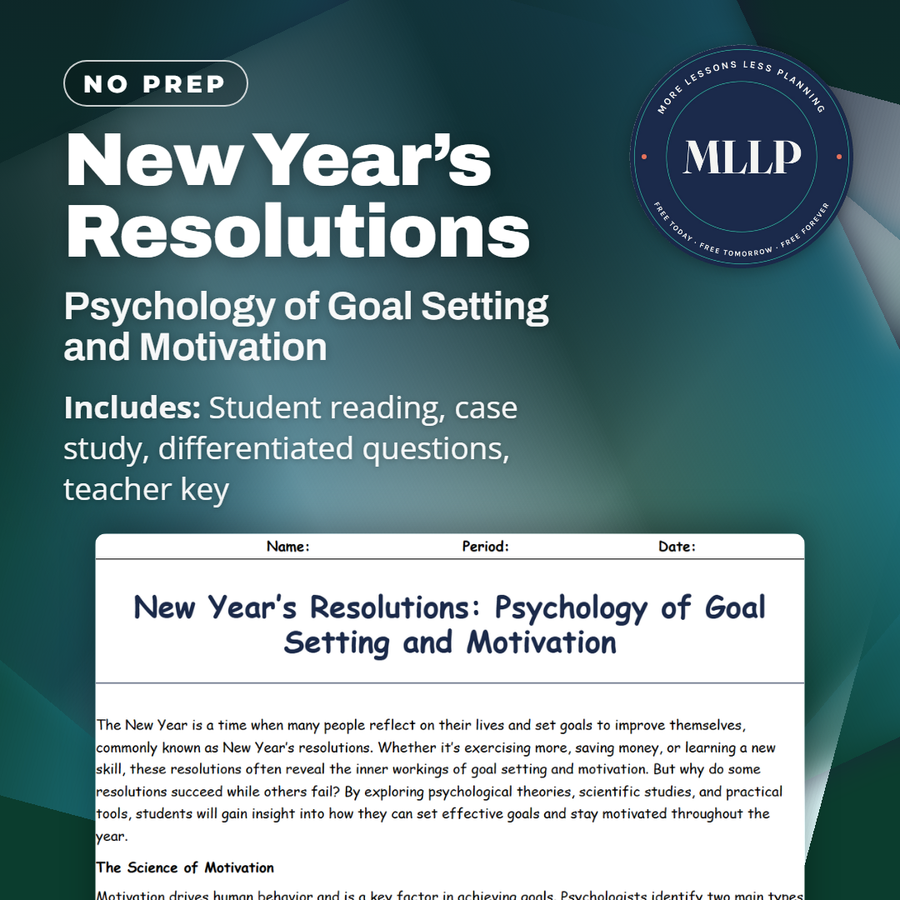
New Year’s Resolutions: Psychology of Goal Setting and Motivation
Quality reviewed September 2026
Facts verified September 9, 2026
- Subject
- Social Studies
- Grades
- Grades 9-12
- Length
- 7-page student worksheet
- Time
- About one 50-minute class period
- Great for
- Sub plans and independent work
- Includes
- Reading passage, comprehension questions + full answer key
- Format
- Print-and-go PDF
What students do
- Distinguish between intrinsic motivation (personal enjoyment) and extrinsic motivation (external rewards) and analyze which sustains goals longer
- Transform a vague resolution into a SMART goal that is Specific, Measurable, Achievable, Relevant, and Time-bound
- Trace the habit loop (cue, routine, reward) through a case study to explain why Maria's workout actually stuck
- Identify psychological barriers like procrastination and decision fatigue, then propose evidence-based strategies to overcome them
What it covers
- Intrinsic and extrinsic motivation science
- The SMART goal framework and habit formation
- Why 80% of resolutions fail and how self-compassion helps
Start reading this worksheet
The New Year is a time when many people reflect on their lives and set goals to improve themselves, commonly known as New Year’s resolutions. Whether it’s exercising more, saving money, or learning a new skill, these resolutions often reveal the inner workings of goal setting and motivation. But why do some resolutions succeed while others fail? By exploring psychological theories, scientific studies, and practical tools, students will gain insight into how they can set effective goals and stay motivated throughout the year.
The Science of Motivation
Motivation drives human behavior and is a key factor in achieving goals. Psychologists identify two main types of motivation: intrinsic motivation and extrinsic motivation. Intrinsic motivation comes from personal satisfaction or enjoyment. For example, a student might practice guitar because they genuinely love music. In contrast, extrinsic motivation comes from external rewards or pressures, such as studying to earn a good grade or working hard to win a competition. Research suggests that while both types of motivation can lead to success, intrinsic motivation is often more sustainable over time. Goals tied to personal values or passions tend to be more fulfilling and lead to greater persistence. However, extrinsic motivators, like deadlines or rewards, can provide a helpful push, especially when intrinsic motivation is lacking. Understanding motivation also involves recognizing the barriers to success. Common obstacles include procrastination, fear of failure, and lack of clarity about what needs to be done. Psychologists suggest that breaking goals into smaller, manageable steps can make them feel more achievable and reduce the likelihood of giving up.
SMART Goals: A Framework for Success
One of the most effective tools for setting and achieving goals is the SMART goal framework. This method encourages people to create goals that are: Specific: Clearly define what you want to achieve. Measurable: Include a way to track your progress. Achievable: Ensure the goal is realistic and within your capabilities. Relevant: Align the goal with your values or long-term objectives. Time-bound: Set a deadline to create urgency. For instance, instead of saying, “I want to exercise more,” a SMART goal might be, “I will go to the gym three times a week for 30 minutes each session for the next three months.” By making the goal specific and measurable, it becomes easier to track progress and stay accountable.
Like what you read? The full reading, the case study, and every question set are in the free download below, along with the answer key.
Why this matters
About 80 percent of resolutions fail, and most people blame willpower when the real problem is usually the goal itself. A vague wish like get healthier gives your brain nothing to act on, while a SMART goal gives it an actual target, something specific enough to act on this week instead of someday.
Maria's case study is the one that sticks because she does not succeed on the first try; she adjusts and keeps going, which is more honest than most resolution stories students have heard. The habit loop is where motivation stops feeling mystical: a cue, a routine, and a reward are mechanics students can build into their own week.
From one teacher to another
I pull this out every January because it speaks to something students are actually thinking about. The framework is practical: instead of vague wishes, SMART goals give you something measurable. Maria's case study resonates because she tries, fails, adjusts, and succeeds. It's honest about the struggle. The habit loop section is where it clicks for many students; they realize that motivation is not some mystical force but the result of a cue, an action, and a reward their brain learns to expect. By the end, they've usually redesigned at least one of their own resolutions and know why it's more likely to stick.
What you get
Download
Where should I send the next one?
Everything here is free and it stays that way. Leave your email and I'll send you the new lessons as they go up. You can unsubscribe from any one of them.
Related resources

Biology of Evergreen Plants: The Science Behind Christmas Trees
Body Clocks and Midnight Countdowns: Circadian Rhythms at New Year’s
Calendars, Orbits, and the Science of New Year’s Day

Christmas on the Home Front: WWII Rationing and Resilience
Colorful Chemistry: Holiday Lights, Fireworks, and the Science of Glow
Crowded Skies: Holiday Air Travel and the Environment
Every lesson on this site is free to download and use. If one of them saved you a prep period, you can chip in a few bucks toward my three kids' daycare fund. That's genuinely where tips go.