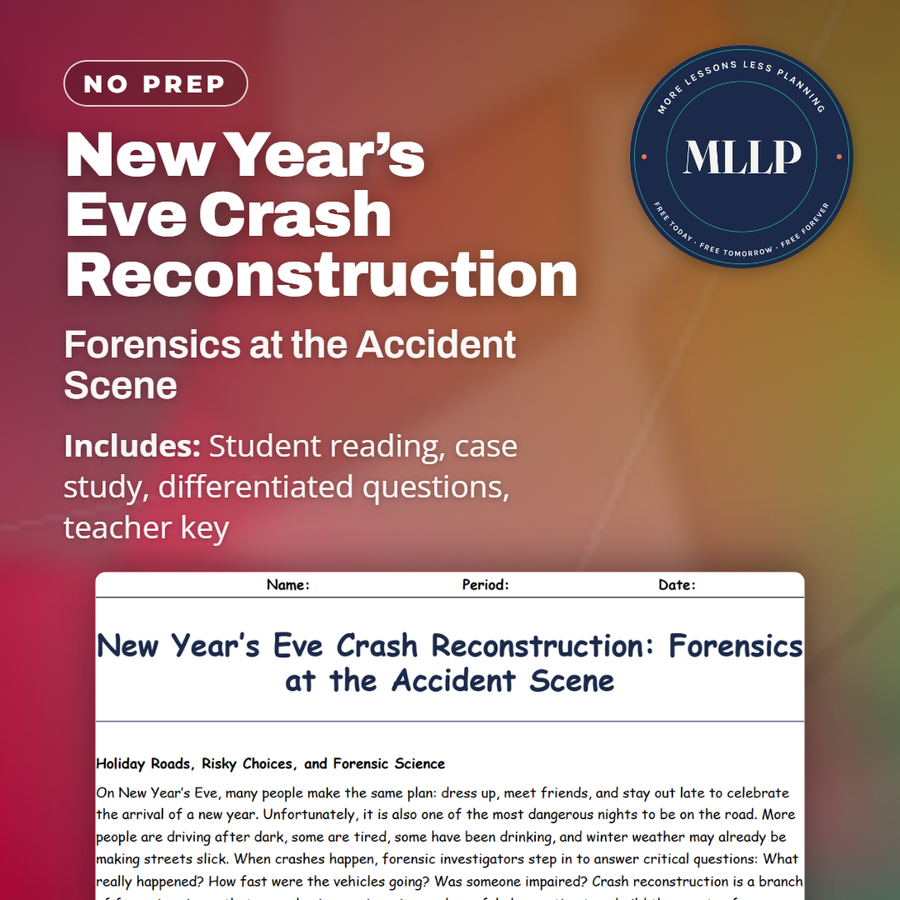
New Year’s Eve Crash Reconstruction: Forensics at the Accident Scene
Quality reviewed September 2026
Facts verified September 9, 2026
- Subject
- Science
- Grades
- Grades 9-12
- Length
- 8-page student worksheet
- Time
- About one 50-minute class period
- Great for
- Sub plans and independent work
- Includes
- Reading passage, comprehension questions + full answer key
- Format
- Print-and-go PDF
What students do
- Use skid mark measurements and drag factor calculations to estimate vehicle speed before impact
- Interpret event data recorder information to establish a timeline and sequence of events before a crash
- Evaluate multiple pieces of evidence (debris, damage patterns, BAC results) to determine which driver caused the collision
- Apply conservation of momentum and energy to explain how vehicles move and come to rest after impact
What it covers
- Forensic evidence collection at accident scenes
- Physics of skid marks, velocity, and impact dynamics
- Role of impairment and human factors in high-risk driving
Start reading this worksheet
Holiday Roads, Risky Choices, and Forensic Science
On New Year’s Eve, many people make the same plan: dress up, meet friends, and stay out late to celebrate the arrival of a new year. Unfortunately, it is also one of the most dangerous nights to be on the road. More people are driving after dark, some are tired, some have been drinking, and winter weather may already be making streets slick. When crashes happen, forensic investigators step in to answer critical questions: What really happened? How fast were the vehicles going? Was someone impaired? Crash reconstruction is a branch of forensic science that uses physics, engineering, and careful observation to rebuild the events of a collision. Investigators are not there to guess or rely on rumors. Instead, they collect physical evidence from the scene and the vehicles, then apply formulas and tested procedures to draw conclusions. Their findings may decide whether a crash is treated as an accident, a criminal offense, or even a homicide. New Year’s Eve adds extra complexity. A driver may blame a crash on “bad luck,” fireworks smoke, the weather, or sudden traffic. Another driver might quietly hope investigators cannot prove they were speeding or that they had too much alcohol in their system. The reconstruction team has to cut through those stories and focus on measurable facts—length of skid marks, damage patterns, airbag data, and blood alcohol concentration (BAC) results. Their work helps courts, families, and communities understand what actually happened instead of accepting easy excuses.
At the Scene: What Crash Investigators Look For
When a serious crash occurs, first responders focus on saving lives: securing the area, providing medical care, and preventing fires. Once the scene is safe, crash investigators begin treating the roadway like a crime scene. They photograph positions of vehicles, note weather and lighting, and mark any tire marks, debris fields, and fluid spills. Time is important—rain, snowplows, or tow trucks can quickly erase crucial evidence. Investigators pay special attention to the final resting positions of vehicles and any transfer evidence. Transfer evidence includes paint that has scraped from one car onto another, broken glass, or pieces of plastic that can show exactly where and how two objects struck each other. They measure the distance from each vehicle to fixed reference points (like a curb or utility pole) so the scene can be re-created later on paper or in computer software. They also look for signs of evasive action, such as swerving marks or intermittent braking. Inside the vehicles, they examine airbag modules, seat belt marks, and interior damage. Many modern cars record short bursts of data in event data recorders (sometimes called “black boxes”), including speed, brake use, and seat belt status seconds before impact. Meanwhile, other forensic specialists may collect blood or breath samples from drivers to test for alcohol or drugs, following strict legal procedures. All of this evidence becomes part of a larger puzzle that reconstruction experts will use to tell the story of the crash as accurately as possible. Here is a quick overview of common evidence types:
From Skid Marks to Speed: The Physics of Reconstruction
One of the classic tools of crash reconstruction is the skid mark. When a driver brakes hard enough to lock the wheels (or trigger anti-lock systems), the tires can leave dark lines on the pavement. By measuring these marks carefully and knowing the drag factor (a number that describes how slippery the road surface is), investigators can estimate the vehicle’s pre-braking speed using basic physics. The core idea is that the vehicle’s kinetic energy—energy of motion—was converted into heat and friction as it slid. The details matter. A long skid on dry asphalt usually means a higher initial speed than a short skid on the same surface; a short skid on ice may still represent a high speed because the drag factor is much lower. Investigators also have to distinguish between yaw marks (curved tire marks created during a sideways slide) and straight-line braking marks. Each type tells a different story about how the driver lost control. Crash reconstructionists also look at momentum and conservation of energy when more than one vehicle is involved. The direction in which cars move after impact, combined with their masses and final resting positions, can support or contradict driver statements. For example, if a driver claims they were “barely moving,” but the other car was spun completely around and pushed far off the road, the damage and motion may suggest a much higher speed. By combining math with physical evidence, investigators move beyond “he said, she said” and ground their conclusions in scientific reasoning.
Like what you read? The full reading, the case study, and every question set are in the free download below, along with the answer key.
Why this matters
Two drivers can walk away from the same New Year's Eve wreck telling opposite stories, and without physical evidence there is no way to know which one is lying. A longer skid mark paired with a lower drag factor means a higher starting speed, full stop, and that calculation can undo a driver's version of events before they finish telling it.
Most of the real work here is arithmetic, not a lab test: debris, damage patterns, and a data recorder's timeline all get measured and compared before anyone rules on fault. Running the numbers themselves changes how students read a crash scene, from something chaotic into a sequence they can reconstruct one measurement at a time.
From one teacher to another
New Year's Eve crashes are real enough that I use this worksheet to make forensic science feel urgent. The reading doesn't lecture about drunk driving; instead, it walks through what a reconstruction team actually finds at a scene. Measured skid marks, debris patterns, airbag deployment data, and how all of it adds up to a story. The case study shows two drivers blaming each other, and the evidence proves one wrong. Students love the physics because they can feel the math working: longer skid mark plus lower drag factor means higher starting speed. By the time they finish, they've learned that forensic evidence cuts through "he said, she said" and grounds guilt or innocence in measurable fact.
What you get
Download
Where should I send the next one?
Everything here is free and it stays that way. Leave your email and I'll send you the new lessons as they go up. You can unsubscribe from any one of them.
Related resources

Biology of Evergreen Plants: The Science Behind Christmas Trees
Body Clocks and Midnight Countdowns: Circadian Rhythms at New Year’s

Calendars, Orbits, and the Science of New Year’s Day
Christmas on the Home Front: WWII Rationing and Resilience

Colorful Chemistry: Holiday Lights, Fireworks, and the Science of Glow
Crowded Skies: Holiday Air Travel and the Environment
Every lesson on this site is free to download and use. If one of them saved you a prep period, you can chip in a few bucks toward my three kids' daycare fund. That's genuinely where tips go.