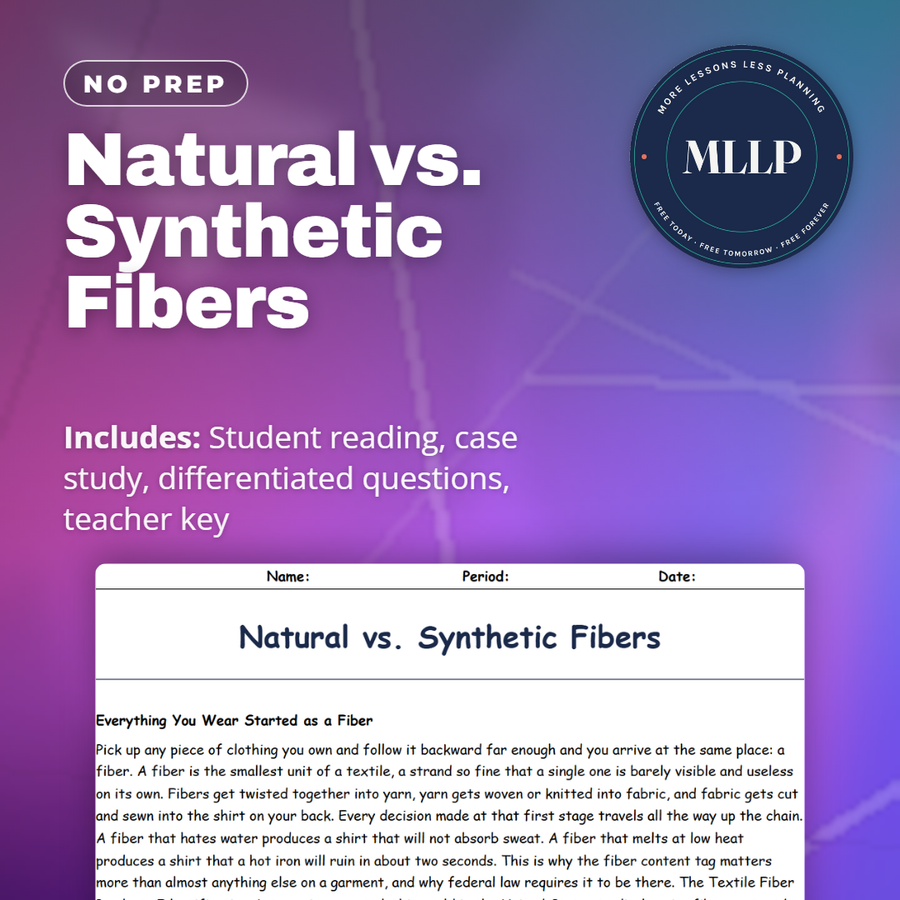
Natural vs. Synthetic Fibers
Quality reviewed September 2026
Facts verified September 23, 2026
- Subject
- Career & Life Skills
- Grades
- Grades 9-12
- Length
- 8-page student worksheet
- Time
- About one 50-minute class period
- Great for
- Sub plans and independent work
- Includes
- Reading passage, comprehension questions + full answer key
- Format
- Print-and-go PDF
What students do
- The fiber content tag predicts how a garment behaves every time it is washed, worn and ironed
- Match terms like spinneret, thermoplastic and blend to their working definitions
- Jordan cannot explain either practice jersey problem until he pulls up his own notes
- Compare why cotton feels heavy after a run while polyester stays light but starts to smell
What it covers
- The three fiber families, plant, animal and synthetic, plus the cellulosic fibers in between
- Why a hot iron scorches cotton but melts a hole through polyester
- The rule for caring for a blend, based on its most delicate fiber
Start reading this worksheet
Everything You Wear Started as a Fiber
Pick up any piece of clothing you own and follow it backward far enough and you arrive at the same place: a fiber. A fiber is the smallest unit of a textile, a strand so fine that a single one is barely visible and useless on its own. Fibers get twisted together into yarn, yarn gets woven or knitted into fabric, and fabric gets cut and sewn into the shirt on your back. Every decision made at that first stage travels all the way up the chain. A fiber that hates water produces a shirt that will not absorb sweat. A fiber that melts at low heat produces a shirt that a hot iron will ruin in about two seconds. This is why the fiber content tag matters more than almost anything else on a garment, and why federal law requires it to be there. The Textile Fiber Products Identification Act requires most clothing sold in the United States to disclose its fiber content by percentage, the country where it was processed, and an identification for the manufacturer. Shoppers routinely check the price tag and skip the fiber tag, which is exactly backward. The price tells you what the garment costs once. The fiber content tells you how it will behave every single time you wear it, wash it, and try to get a stain out of it. Textile professionals sort every fiber in existence into two families based on one question: did a plant or animal make it, or did a factory?
The Fibers That Grow
Natural fibers come from living sources, and they divide neatly into plant fibers and animal fibers. Plant fibers are built from cellulose. Cotton, harvested from the seed pod of the cotton plant, is the most used natural fiber on the planet because it is soft, absorbent, breathable, and cheap. It also wrinkles enthusiastically and shrinks if you wash it hot, and unlike most fibers it is actually stronger wet than dry, which is why cotton tolerates aggressive laundering. Linen comes from the stalk of the flax plant and is the strongest common plant fiber, cool to wear, and famous for wrinkling the moment you sit down. Hemp, jute, and ramie fill out the plant family in ropes, bags, and blends. Animal fibers are built from protein instead of cellulose, and that single chemical difference changes everything about how they are cared for. Wool comes from sheep and has a natural crimp that traps air, which is why it insulates even when damp, and microscopic surface scales, which is why heat plus moisture plus agitation locks those scales together and shrinks a sweater into doll clothing permanently. Silk, unwound from the cocoon of the silkworm, is the only natural filament fiber, meaning it comes in a continuous strand rather than short pieces. It is remarkably strong for its weight, takes dye brilliantly, and degrades in direct sunlight. Specialty animal fibers like cashmere, mohair, and alpaca are prized for softness and priced accordingly.
The Fibers That Get Invented
Synthetic fibers are manufactured rather than harvested, and most of them begin as petroleum-based chemicals. The raw material is turned into a thick liquid polymer, then pushed through a spinneret, a device that works on the same principle as a shower head, extruding continuous filaments that harden as they cool. Because the process is engineered rather than grown, manufacturers can dial in the properties they want. Polyester is the workhorse and grew to become the single most produced fiber in the world. It is strong, resists wrinkles and shrinking, dries fast, and holds a pleat. Its weakness is that it repels water rather than absorbing it, so sweat sits on the skin and body oils cling to the fiber, which is why polyester athletic shirts develop a permanent smell that cotton shirts do not. Nylon was the first fully synthetic fiber to reach the market and remains the champion of abrasion resistance, which is why it shows up in hosiery, backpacks, and outerwear. Acrylic was engineered to imitate wool at a fraction of the cost and does a decent job of it, though it pills badly with wear. Spandex, also sold as elastane or Lycra, can stretch five to seven times its own length and snap back, and it is almost never used alone. A pair of jeans with two percent spandex behaves completely differently from the same jeans without it. All of these share one critical vulnerability: they are thermoplastic, meaning heat softens and melts them rather than scorching them, so a hot iron does not leave a brown mark on polyester, it leaves a permanent hole.
Like what you read? The full reading, the case study, and every question set are in the free download below, along with the answer key.
Why this matters
The fiber content tag is the one label on a garment most people skip in favor of the price tag, and this reading argues that is backwards, since the fiber predicts how the shirt performs on the next run, the next hot wash and the next humid afternoon rather than what it cost once. Jordan's practice jersey confusion is the kind of everyday problem, sweat, smell, temperature, that gets easier to solve once a student can name what a fiber actually does instead of guessing at the checkout.
From one teacher to another
Every garment starts as a fiber, and this reading sorts the fibers a person actually wears into three families, plant and animal fibers that grow, synthetic fibers that are manufactured from petroleum, and cellulosic fibers like rayon that start natural and then get chemically reformed. It explains why cotton is stronger wet than dry, why wool felts permanently in a hot wash, and why every synthetic is thermoplastic, meaning a hot iron melts a hole instead of leaving a scorch mark. The case study follows Jordan, a cross country runner who cannot explain why his team's cotton practice shirts get heavy and cold on the ride home while the polyester ones stay dry but start to smell so badly his mother bans them from the laundry room. His own FACS notes turn out to have the answer already highlighted.
What you get
Download
Where should I send the next one?
Everything here is free and it stays that way. Leave your email and I'll send you the new lessons as they go up. You can unsubscribe from any one of them.
Related resources

Fashion Design and the Design Process
Fast Fashion and the Cost of Cheap Clothing
Hand Stitches and Basic Clothing Repairs
How Fabric Is Made: Woven, Knit, and Nonwoven
How to Read a Pattern
Laundry Basics: Sorting, Washing, and Stains
Every lesson on this site is free to download and use. If one of them saved you a prep period, you can chip in a few bucks toward my three kids' daycare fund. That's genuinely where tips go.