Moving Out: The First Apartment Checklist
Quality reviewed September 2026
Facts verified September 23, 2026
- Subject
- Career & Life Skills
- Grades
- Grades 9-12
- Length
- 9-page student worksheet
- Time
- About one 50-minute class period
- Great for
- Sub plans and independent work
- Includes
- Reading passage, comprehension questions + full answer key
- Format
- Print-and-go PDF
What students do
- Kayla's missing deposit, lost to a roommate's early move and an undocumented move in, drives both case study questions
- Match five terms, from total housing cost to warranty of habitability, to their definitions
- Explain in three short answers why lease promises, liability coverage, and move out photos each matter
- Replacement cost gets tested against the definition the reading actually gives it, not actual cash value
What it covers
- The real cost of a first apartment, from move in cash to monthly utilities and fees
- Lease clauses, the move in walkthrough, and the paper trail that protects a deposit
- Renters insurance, joint and several liability, and the tenant rights a lease cannot waive
Start reading this worksheet
The Number That Decides Everything
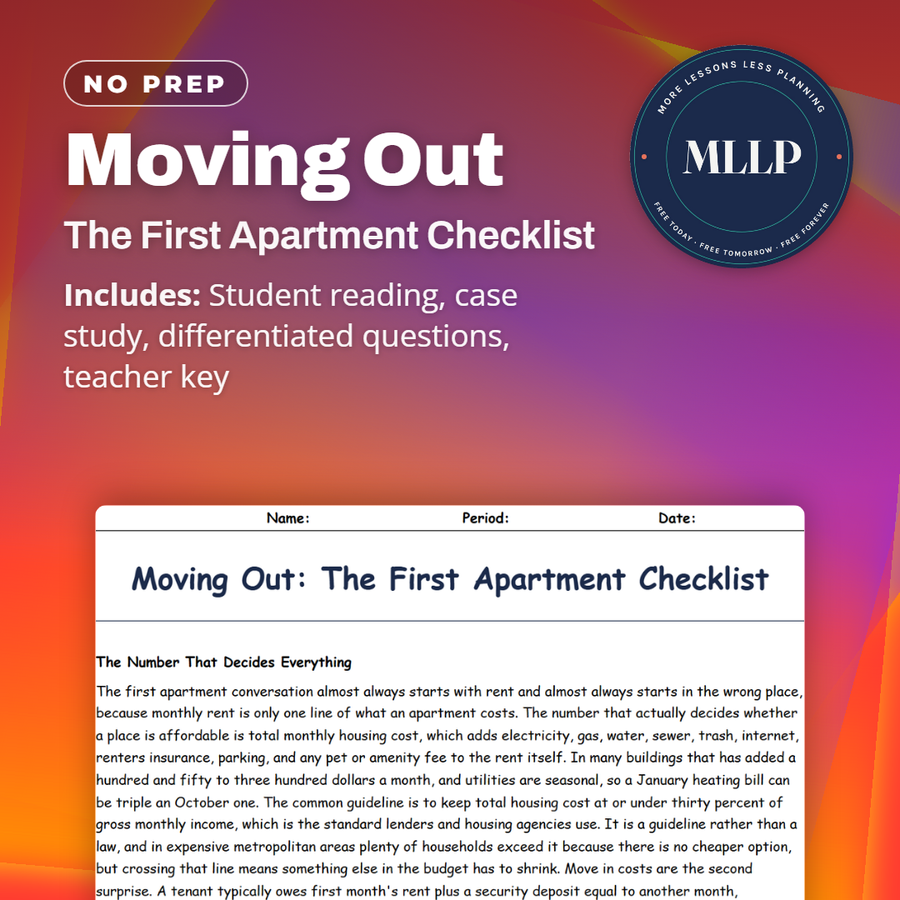
The first apartment conversation almost always starts with rent and almost always starts in the wrong place, because monthly rent is only one line of what an apartment costs. The number that actually decides whether a place is affordable is total monthly housing cost, which adds electricity, gas, water, sewer, trash, internet, renters insurance, parking, and any pet or amenity fee to the rent itself. In many buildings that has added a hundred and fifty to three hundred dollars a month, and utilities are seasonal, so a January heating bill can be triple an October one. The common guideline is to keep total housing cost at or under thirty percent of gross monthly income, which is the standard lenders and housing agencies use. It is a guideline rather than a law, and in expensive metropolitan areas plenty of households exceed it because there is no cheaper option, but crossing that line means something else in the budget has to shrink. Move in costs are the second surprise. A tenant typically owes first month's rent plus a security deposit equal to another month, sometimes last month's rent as well, plus application fees, utility deposits for accounts without credit history, and the cost of moving. That means a nine hundred dollar apartment can require two thousand dollars or more before a key changes hands. Anyone planning a move should be saving that lump sum months in advance rather than discovering it at signing.
Reading a Lease Before You Sign It
A lease is a binding legal contract, and the single most expensive mistake a first time renter makes is signing one without reading it. Certain clauses deserve attention every time. The term states how long you are obligated, and breaking a lease early usually triggers a penalty that may run to several months of rent. The rent due date and the late fee structure matter, including exactly how many days of grace exist. The security deposit section should state the conditions for return and the deadline by which a landlord must return it or provide an itemized list of deductions, since state law sets that deadline. Maintenance and repair language should say who is responsible for what and how requests are submitted, because a verbal promise from a landlord is nearly impossible to enforce later. Look for rules on guests, subletting, pets, smoking, and alterations such as painting or mounting a television. Understand whether utilities are included and which ones. Find out whether the lease automatically renews and how much notice you must give to leave, which is commonly thirty or sixty days. Never sign a lease with blank spaces in it. Ask for every promise in writing and added to the document itself. If something in the lease is unclear, ask before signing, because after signing the document controls and what either party remembers saying does not. It is also reasonable to ask for a copy of the lease to read overnight before signing, and a landlord who refuses that request has told you something useful about how the rest of the tenancy will go.
The Walkthrough That Protects Your Deposit
Security deposit disputes are one of the most common conflicts between tenants and landlords, and most of them are decided by evidence created on day one. Before moving anything in, walk the entire unit with a written condition checklist and document every existing problem, including stained carpet, scuffed walls, cracked tile, burned out fixtures, torn screens, and anything that does not work. Photograph and video everything with a timestamp, including inside cabinets, appliances, and closets. Test the things people forget until it is too late: water pressure and how long hot water takes, whether every outlet works, whether windows lock, whether the heat and air conditioning actually run, and whether there is cell reception. Note the condition in writing, have the landlord sign it if possible, and keep your own copy rather than relying on the landlord's file. The same discipline applies on the way out. Clean thoroughly, repair what you damaged, take a second set of photographs after the unit is empty, and provide a forwarding address in writing so the deposit and the itemized statement can reach you. Understand the difference the law recognizes between normal wear and tear, which a landlord may not charge for, and damage, which they may. Faded paint and worn carpet from ordinary use are wear. A hole in the drywall is damage, and the paperwork you created in the first hour is what proves which is which.
Like what you read? The full reading, the case study, and every question set are in the free download below, along with the answer key.
Why this matters
A first apartment is one of the first legal contracts most students will sign, and this reading treats it that way instead of skipping to the fun part, paint colors and furniture. Kayla's deposit disappeared over something a phone photo and a signed checklist would have prevented entirely, which is a cheaper lesson to learn from a worksheet than from a landlord's itemized deduction list. The reading also corrects a specific, expensive misunderstanding, that a landlord's insurance protects a tenant's belongings, which it never does, before a student finds that out the hard way after a fire or a burst pipe.
From one teacher to another
Kayla moved out of her first apartment with no photographs, no signed condition checklist, and a landlord who kept her entire eighteen hundred dollar deposit for damage that was there before she moved in. This worksheet uses her case to walk through the real cost of a first apartment, the total housing cost beyond rent, the cash needed at signing, and the lease clauses worth reading twice before anyone signs. Students read about the move in walkthrough that protects a deposit, then work through joint and several liability, the rule that made one roommate's early departure everyone's problem. A short answer question asks why a verbal promise from a landlord is nearly worthless once a lease is signed.
What you get
Download
Where should I send the next one?
Everything here is free and it stays that way. Leave your email and I'll send you the new lessons as they go up. You can unsubscribe from any one of them.
Related resources
Balancing Work, Family, and Personal Life

Careers in Culinary Arts and Hospitality

Careers in Early Childhood Education

Careers in Family and Consumer Sciences

Careers in Fashion and Interior Design

Careers in Human Services
Every lesson on this site is free to download and use. If one of them saved you a prep period, you can chip in a few bucks toward my three kids' daycare fund. That's genuinely where tips go.