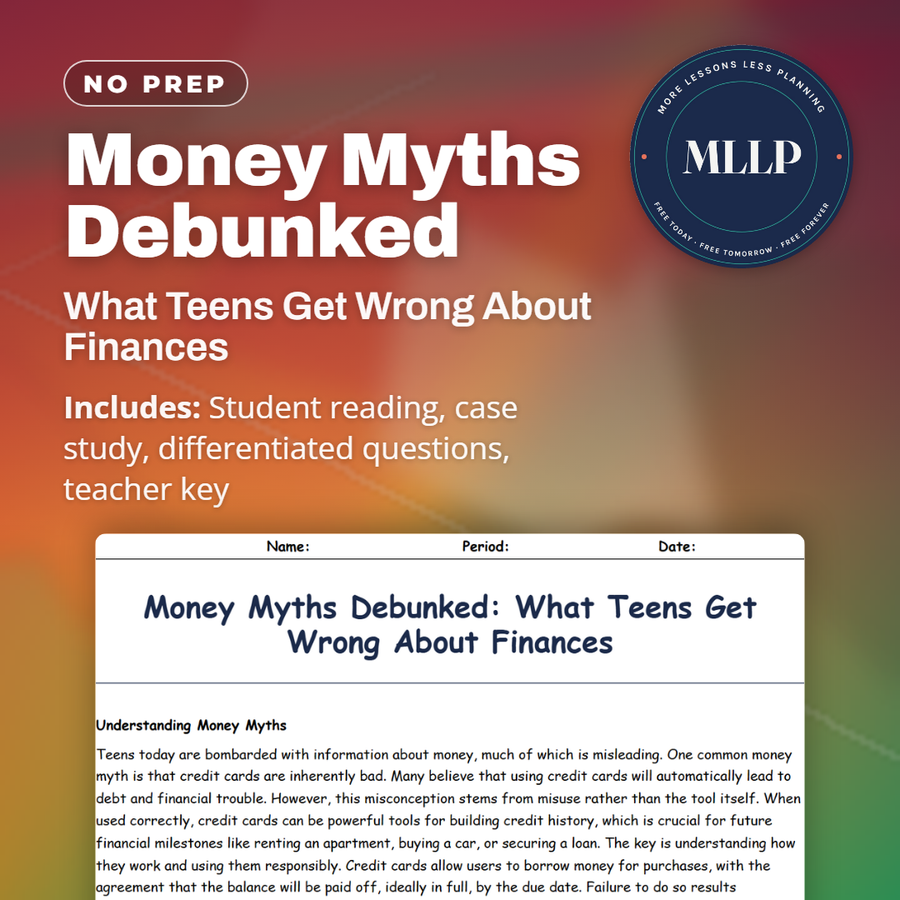
Money Myths Debunked: What Teens Get Wrong About Finances
Quality reviewed September 2026
Facts verified September 24, 2026
- Subject
- Career & Life Skills
- Grades
- Grades 9-12
- Length
- 7-page student worksheet
- Time
- About one 50-minute class period
- Great for
- Sub plans and independent work
- Includes
- Reading passage, comprehension questions + full answer key
- Format
- Print-and-go PDF
What students do
- Match budgeting and good debt to definitions like tracking expenses and low-interest loans, plus compound interest, investing, and an emergency fund to long-term wealth growth, high returns with risk, and savings for unexpected needs
- Fill in the blanks on what lets savings grow faster by earning interest on interest, what a detailed plan for managing income and expenses is called, and which accounts suit short-term savings and emergencies
- Answer multiple choice questions on the myth about credit cards, the 50/30/20 budgeting rule, and the real difference between saving and investing
- Write short answers on why saving early matters, how to use credit cards responsibly, and how Jordan's 10/10/20 budget split turned babysitting money into a concert ticket
What it covers
- Common money myths teens believe, like credit cards always leading to debt and saving being something to worry about later
- The 50/30/20 budgeting rule and the difference between good debt, like student loans, and bad debt, like carried credit card balances
- A case study on Jordan, who built a budget after realizing babysitting money was gone before the month ended
Start reading this worksheet
Understanding Money Myths
Teens today are bombarded with information about money, much of which is misleading. One common money myth is that credit cards are inherently bad. Many believe that using credit cards will automatically lead to debt and financial trouble. However, this misconception stems from misuse rather than the tool itself. When used correctly, credit cards can be powerful tools for building credit history, which is crucial for future financial milestones like renting an apartment, buying a car, or securing a loan. The key is understanding how they work and using them responsibly. Credit cards allow users to borrow money for purchases, with the agreement that the balance will be paid off, ideally in full, by the due date. Failure to do so results in interest charges, which can quickly grow if not managed. But by paying off the balance in full each month, individuals avoid interest and can even earn rewards points or cashback on their spending. For teens, learning this principle early can prevent common pitfalls later in life. Another myth is the belief that saving money isn’t urgent for young people. Many teens think saving can wait until they have a full-time job or significant income. This mindset overlooks the power of compound interest, which allows savings to grow exponentially over time. Starting early, even with small amounts, can result in a substantial financial cushion in the future.
Why Budgeting Matters
Another widely held misconception is that budgeting is restrictive or unnecessary for teens. Some think that since they don’t have significant expenses, there’s no need to track their spending. In reality, learning to budget early sets the foundation for smart financial habits. A budget isn’t about limiting fun; it’s about prioritizing spending and understanding where money goes. Consider this: A teen earning $100 a week from a part-time job may think it’s fine to spend $50 on entertainment. Without a budget, they might not realize they’re also spending $30 on snacks and $20 on subscriptions, leaving nothing for savings. A budget can highlight spending patterns, showing areas where they can cut back and save for goals like a new phone, car, or even college expenses. Budgeting apps or even a simple spreadsheet can make this process easy and accessible. Teens should aim for the 50/30/20 rule: 50% for needs, 30% for wants, and 20% for savings. While needs may be minimal during adolescence, putting 20% into savings or an emergency fund can provide long-term benefits.
Debunking the “Debt Is Always Bad” Myth
Many teens fear debt, associating it solely with financial failure. While excessive or poorly managed debt can indeed be harmful, certain types of debt are considered “good debt.” For example, student loans enable access to higher education, which often leads to better-paying careers. Similarly, a mortgage allows individuals to invest in property, often increasing their net worth over time. The key to managing debt is understanding its terms. Borrowers should focus on low-interest loans and ensure they can make monthly payments without jeopardizing other financial obligations. Credit card debt, however, is a type of “bad debt” if balances are carried over month to month with high interest rates. By distinguishing between good and bad debt, teens can make informed decisions that align with their long-term goals.
Like what you read? The full reading, the case study, and every question set are in the free download below, along with the answer key.
Why this matters
Much of the money advice teens pick up secondhand, like avoiding credit cards altogether or assuming retirement savings can wait, actually works against them once they start earning their own money. Jordan's situation, running out of money before the month is over, is familiar to almost anyone with a part-time job, and the fix wasn't earning more but giving the money already coming in a plan. Sorting out which beliefs are myths now means fewer financial habits to unlearn later, when the amounts of money involved get bigger.
From one teacher to another
Two beliefs get corrected right away in this reading: that credit cards automatically lead to debt, and that saving can wait until later in life. It lays out the 50/30/20 budgeting rule, the difference between good debt like student loans and bad debt like a carried credit card balance, and how saving and investing serve different purposes, one for short-term goals and one for long-term growth. A case study puts a babysitter, Jordan, through the same problem: earnings gone on fast food and video games, then a budget splitting money into entertainment, snacks, and savings that paid for a concert ticket within three months.
What you get
Download
Where should I send the next one?
Everything here is free and it stays that way. Leave your email and I'll send you the new lessons as they go up. You can unsubscribe from any one of them.
Related resources
Debit vs. Credit Cards: How to Choose the Right Payment Method
Financial Scams Teens Should Know: Spotting and Avoiding Fraud
How to Build a Strong Credit Score from Day One
How to Read a Paycheck: Understanding Deductions and Net Pay
How to Start Saving for Retirement as a Teen
Insurance for Beginners: What Teens Need to Know About Coverage
Every lesson on this site is free to download and use. If one of them saved you a prep period, you can chip in a few bucks toward my three kids' daycare fund. That's genuinely where tips go.