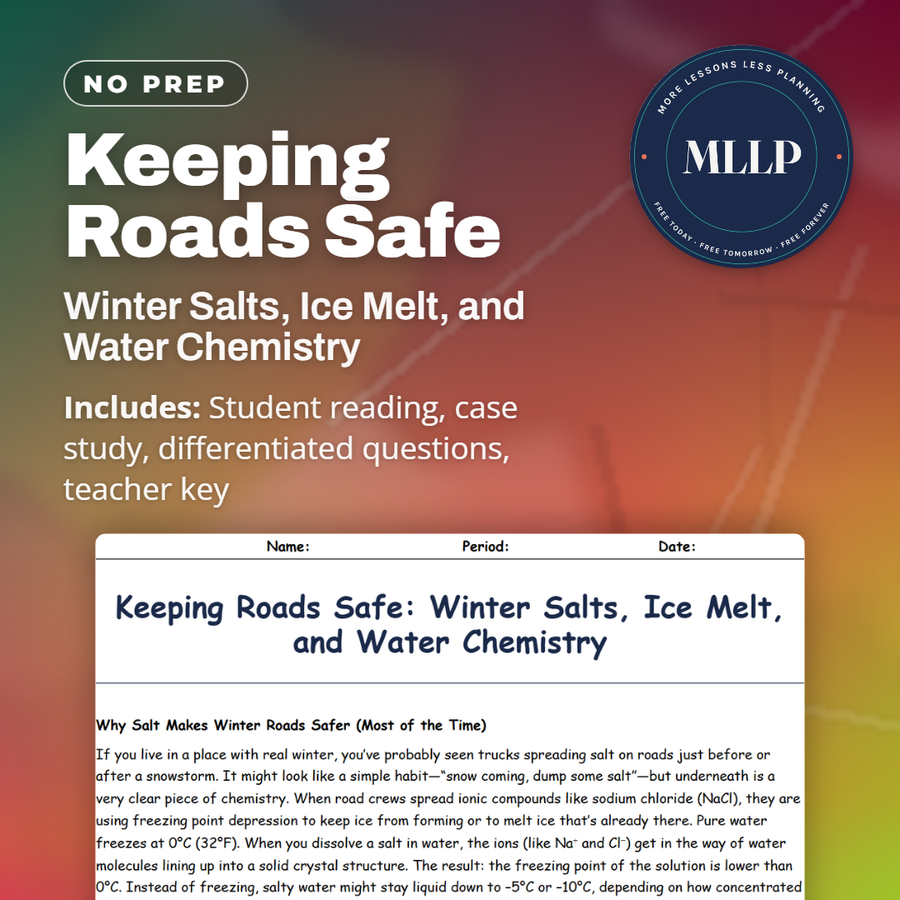
Keeping Roads Safe: Winter Salts, Ice Melt, and Water Chemistry
Quality reviewed September 2026
Facts verified September 9, 2026
- Subject
- Science
- Grades
- Grades 9-12
- Length
- 7-page student worksheet
- Time
- About one 50-minute class period
- Great for
- Sub plans and independent work
- Includes
- Reading passage, comprehension questions + full answer key
- Format
- Print-and-go PDF
What students do
- Explain how dissolved ions lower the freezing point of water and keep roads safer
- Compare the effectiveness of three different deicers using chemical formulas and particle counts
- Analyze conductivity measurements from a stream ecosystem affected by road salt runoff
- Evaluate strategies to reduce salt use while maintaining winter safety on icy roads
What it covers
- Ionic compounds and colligative properties
- Road chemistry and phase changes
- Environmental impact of deicing practices
Start reading this worksheet
Why Salt Makes Winter Roads Safer (Most of the Time)
If you live in a place with real winter, you’ve probably seen trucks spreading salt on roads just before or after a snowstorm. It might look like a simple habit—“snow coming, dump some salt”—but underneath is a very clear piece of chemistry. When road crews spread ionic compounds like sodium chloride (NaCl), they are using freezing point depression to keep ice from forming or to melt ice that’s already there. Pure water freezes at 0°C (32°F). When you dissolve a salt in water, the ions (like Na⁺ and Cl⁻) get in the way of water molecules lining up into a solid crystal structure. The result: the freezing point of the solution is lower than 0°C. Instead of freezing, salty water might stay liquid down to –5°C or –10°C, depending on how concentrated it is and what salt is used. This is an example of a colligative property—a property that depends on the number of dissolved particles, not their specific identity. That’s why road salt is spread before a storm when possible. If the salt dissolves into a thin film of brine on the pavement, falling snow has a harder time bonding and freezing solid. If ice has already formed, salt can help create a salty meltwater layer at the surface. This weakens the bond between the ice and the road, making it easier for plows and tires to break it up. The basic idea: by changing the chemistry of the water on the road, you change how it behaves at winter temperatures.
Different Deicers, Different Chemistry
Road crews don’t always use the same chemical. While sodium chloride (NaCl) is the most common, other salts like calcium chloride (CaCl₂) and magnesium chloride (MgCl₂) are also used, especially at lower temperatures. Each of these compounds behaves a little differently in water because of their charge and the number of ions they produce when they dissolve. When NaCl dissolves, each formula unit splits into two ions: one Na⁺ and one Cl⁻. Calcium chloride splits into three ions: one Ca²⁺ and two Cl⁻. Magnesium chloride does the same with Mg²⁺ and two Cl⁻. Having more ions per formula unit means more particles in solution, which can cause a larger freezing point depression at the same molar concentration. That’s why CaCl₂ and MgCl₂ can keep working at lower temperatures than regular rock salt. Here is a simplified comparison: Of course, these numbers are approximate and depend on how concentrated the solution is and how it’s applied. But the pattern is important for chemistry students: more dissolved ions generally mean a stronger effect on the freezing point. That’s useful for road safety, but it raises another big question: what happens to all those ions after winter is over?
Like what you read? The full reading, the case study, and every question set are in the free download below, along with the answer key.
Why this matters
Road salt seems to disappear once the snow melts, but the stream conductivity readings students take say otherwise. Those dissolved ions get in the way of water molecules trying to line up into ice, which is exactly why the salt works on the road, and exactly why it doesn't just vanish once it washes off the pavement.
Students walk in assuming safety and environmental harm are separate issues, one about driving and one about nature, but I want them to see the same chemistry explains both. Measuring conductivity in a real stream and connecting the number back to tons of salt spread on local roads turns an abstract colligative property into a tradeoff they can actually argue about.
From one teacher to another
I use this one when students need to connect chemistry to something they see outside their classroom window every winter. The reading walks through why salt actually works. Dissolved ions get in the way of water molecules lining up into ice, without making it abstract. The case study hits hard: students measure conductivity in a stream and realize that all those tons of salt we dump on roads don't just vanish when snow melts. They move through soil and water, harming aquatic life. The worksheet balances the genuine benefit (safer driving) against a real environmental cost, so students can think critically about what "safe" actually means.
What you get
Download
Where should I send the next one?
Everything here is free and it stays that way. Leave your email and I'll send you the new lessons as they go up. You can unsubscribe from any one of them.
Related resources

Biology of Evergreen Plants: The Science Behind Christmas Trees
Body Clocks and Midnight Countdowns: Circadian Rhythms at New Year’s

Calendars, Orbits, and the Science of New Year’s Day
Christmas on the Home Front: WWII Rationing and Resilience
Colorful Chemistry: Holiday Lights, Fireworks, and the Science of Glow
Crowded Skies: Holiday Air Travel and the Environment
Every lesson on this site is free to download and use. If one of them saved you a prep period, you can chip in a few bucks toward my three kids' daycare fund. That's genuinely where tips go.