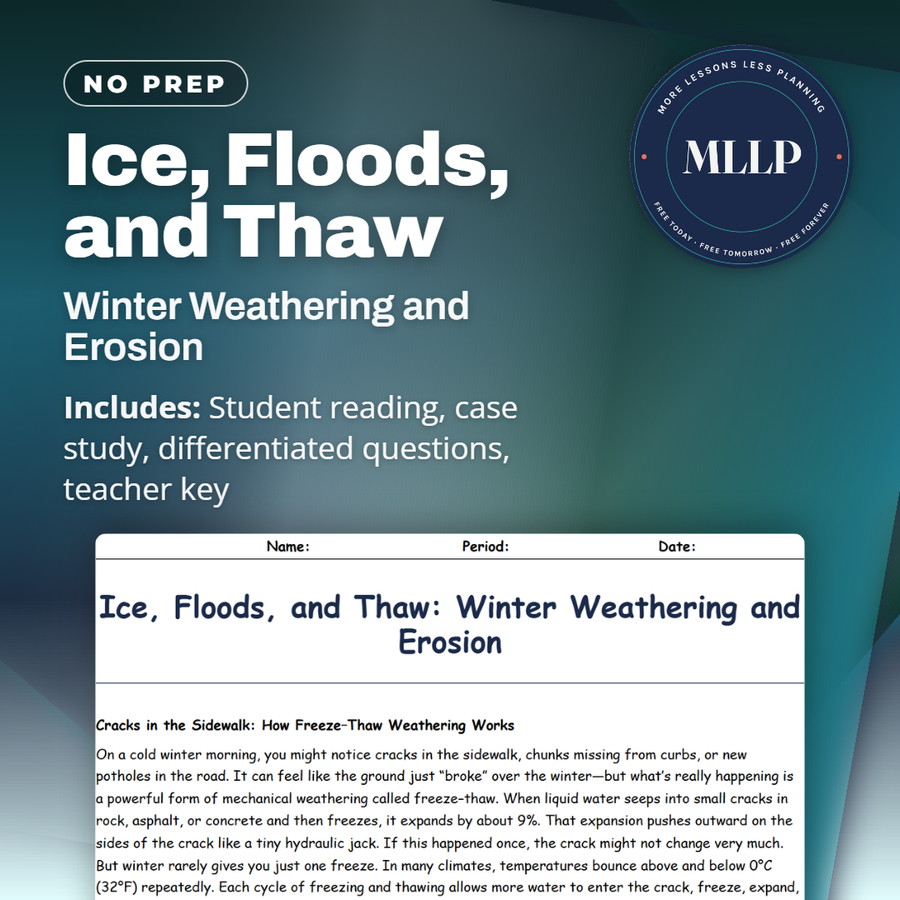
Ice, Floods, and Thaw: Winter Weathering and Erosion
Quality reviewed September 2026
Facts verified September 9, 2026
- Subject
- Science
- Grades
- Grades 9-12
- Length
- 7-page student worksheet
- Time
- About one 50-minute class period
- Great for
- Sub plans and independent work
- Includes
- Reading passage, comprehension questions + full answer key
- Format
- Print-and-go PDF
What students do
- Explain how freeze-thaw cycles turn tiny cracks into potholes over weeks and months
- Analyze how frozen ground and blocked drains increase flood risk during spring thaw
- Trace the path of meltwater from parking lots into streams and waterways
- Evaluate how ice jams form and why they can cause sudden flooding upstream
What it covers
- Freeze-thaw weathering and mechanical breakdown
- Winter runoff, infiltration, and flood risk
- Erosion and landscape change through seasons
Start reading this worksheet
Cracks in the Sidewalk: How Freeze–Thaw Weathering Works
On a cold winter morning, you might notice cracks in the sidewalk, chunks missing from curbs, or new potholes in the road. It can feel like the ground just “broke” over the winter—but what’s really happening is a powerful form of mechanical weathering called freeze–thaw. When liquid water seeps into small cracks in rock, asphalt, or concrete and then freezes, it expands by about 9%. That expansion pushes outward on the sides of the crack like a tiny hydraulic jack. If this happened once, the crack might not change very much. But winter rarely gives you just one freeze. In many climates, temperatures bounce above and below 0°C (32°F) repeatedly. Each cycle of freezing and thawing allows more water to enter the crack, freeze, expand, and then melt, pulling in even more water next time. Over weeks and months, these repeated stresses slowly pry apart the material. What starts as a hairline fracture can turn into a visible gap, a loose chunk, or a full-blown pothole that can damage car tires and suspensions. This process doesn’t just affect human-built structures. In rocky climates, freeze–thaw weathering breaks off pieces of bedrock, forms talus slopes at the base of cliffs, and helps shape landscapes over time. Even though each freeze–thaw cycle is small, the cumulative effect is enormous. You are literally watching geology in slow motion on your walk to school. Understanding freeze–thaw weathering helps explain why road crews are constantly patching pavement after winter and why engineers care so much about drainage and materials when they design structures in cold regions.
From Melting Snow to Muddy Streets: Runoff, Infiltration, and Flood Risk
When winter storms hit, snow and ice accumulate on roofs, sidewalks, and frozen ground. As temperatures warm, this stored water must go somewhere. It can infiltrate into the soil, evaporate back into the air, or run off across the surface into storm drains, streams, and rivers. In late winter and early spring, the balance between infiltration and runoff can shift rapidly, sometimes causing flooding even when there’s no heavy rain. One key factor is the condition of the soil. If the ground is frozen, water has a hard time soaking in. Instead, meltwater flows over the surface like water on a paved parking lot. Ice-covered storm drains can back up, forming large puddles at street corners. In rural areas, meltwater races across fields and down hillsides, picking up sediment and carrying it into ditches and creeks. If warming is slow and gradual, rivers may handle the extra water without much trouble. But when a sudden warm spell or rain-on-snow event hits—rain falling on top of snowpack—melt can be rapid, and streams can rise dangerously fast. Here is a simplified look at how different conditions change the risk of flooding and erosion: For Earth science, it’s important to see winter not as a “quiet” time, but as a setup for powerful erosion when melting begins. The same meltwater that cleans salt off the roads can carve small channels in soil, undercut stream banks, and carry pollutants (like road salt, oil, and litter) into waterways.
Like what you read? The full reading, the case study, and every question set are in the free download below, along with the answer key.
Why this matters
The student parking lot at Ridgeview High started January smooth and was pocked with potholes by March, and every one of those craters traces back to meltwater that seeped into a crack and refroze, over and over, until the pavement gave way.
Geology sounds like something that happens over centuries, so a season of watching a parking lot fall apart between first period and study hall surprises students every time. Once they trace where that same meltwater goes after it leaves the asphalt, into storm drains, into the creek behind school, they stop separating winter weather from the water quality question that shows up later in the unit.
From one teacher to another
At Ridgeview High, the student parking lot started smooth in January but was pocked with potholes by March. Snowplows pushed snow into piles; meltwater seeped into cracks and froze repeatedly, expanding and widening them. Blocked drains meant water pooled in low spots, deepening the freeze-thaw damage. The same salty, gritty runoff washed into the nearby creek, turning it cloudy. This worksheet teaches students that winter geology is not a slow process. It's visible between lunch and study hall. They see freeze-thaw weathering up close, track where meltwater goes, and understand how drainage and snow management affect both pavement and water quality downstream.
What you get
Download
Where should I send the next one?
Everything here is free and it stays that way. Leave your email and I'll send you the new lessons as they go up. You can unsubscribe from any one of them.
Related resources

Biology of Evergreen Plants: The Science Behind Christmas Trees
Body Clocks and Midnight Countdowns: Circadian Rhythms at New Year’s

Calendars, Orbits, and the Science of New Year’s Day
Christmas on the Home Front: WWII Rationing and Resilience
Colorful Chemistry: Holiday Lights, Fireworks, and the Science of Glow
Crowded Skies: Holiday Air Travel and the Environment
Every lesson on this site is free to download and use. If one of them saved you a prep period, you can chip in a few bucks toward my three kids' daycare fund. That's genuinely where tips go.