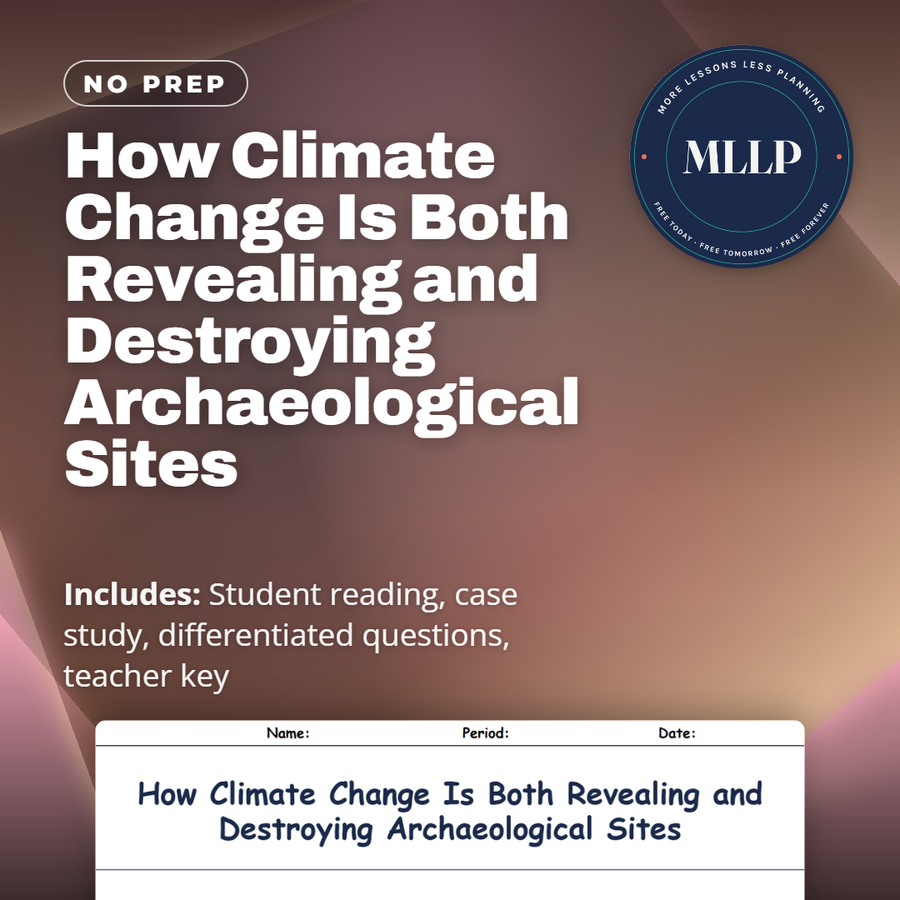
How Climate Change Is Both Revealing and Destroying Archaeological Sites
Quality reviewed September 2026
Facts verified September 21, 2026
- Subject
- Social Studies
- Grades
- Grades 9-12
- Length
- 10-page student worksheet
- Time
- About one 50-minute class period
- Great for
- Sub plans and independent work
- Includes
- Reading passage, comprehension questions + full answer key
- Format
- Print-and-go PDF
What students do
- Explain the cruel paradox at the center of the reading, that warming both reveals and destroys sites
- Follow Dr. Natsiq Amaruq's race to document a thawing 800-year-old village before it erodes into the sea
- Compare glacial melt, permafrost thaw, and sea level rise as three different threats to archaeological sites
- Five terms, including permafrost and salvage archaeology, get matched to their correct definitions
What it covers
- How melting ice and thawing permafrost are revealing artifacts like Otzi the Iceman
- Why rising seas and coastal erosion threaten sites like Skara Brae in Scotland
- Dr. Natsiq Amaruq's case study racing to save a thawing Inuit village site
Start reading this worksheet
What the Ice Gives Back
For thousands of years, glaciers and ice patches across the world have served as accidental time capsules, preserving organic materials that would have decayed long ago in warmer conditions. Leather shoes, wooden arrows, woven textiles, animal remains, and even human bodies have been locked in ice for millennia, perfectly preserved in the freezing conditions. As global temperatures rise and ice retreats, these artifacts are being exposed for the first time, emerging from glaciers and ice patches like messages from the past. The most famous example is Otzi the Iceman, a 5,300-year-old naturally mummified man discovered in 1991 in the Alps on the border between Austria and Italy. Otzi was found by hikers as his body emerged from a melting glacier. He was carrying a copper axe, a bow and arrows, a flint knife, and a leather backpack, an astonishing assemblage of personal belongings that provided unprecedented insight into life during the Copper Age. Analysis of his stomach contents revealed his last two meals. DNA analysis identified genetic conditions and dietary patterns. Even the sequence of wounds on his body told a story: Otzi had been shot in the back with an arrow and likely murdered. Since Otzi, glacial archaeology has become an increasingly urgent field. In Norway, the Secrets of the Ice program has recovered over 3,000 artifacts from melting ice patches, including 1,500-year-old arrows, Iron Age textiles, and Viking-era horse equipment. In the Canadian Yukon, melting ice has exposed wooden hunting tools and the remains of animals that were driven into ice patches by ancient hunters. In the Swiss and Austrian Alps, researchers monitor retreating glaciers with GPS and satellite imagery, racing to reach exposed artifacts before wind, rain, and biological decomposition destroy them.
What the Sea Takes Away
While melting ice reveals artifacts, rising sea levels are destroying coastal archaeological sites at an accelerating pace. Thousands of sites around the world (shell middens, fishing villages, port cities, coastal fortifications, and burial grounds) sit at or near sea level and face inundation or erosion as oceans expand and storms intensify. The sites most at risk are often the oldest, because ancient coastlines were different from modern ones, and many of the world's earliest coastal settlements are now at or below current sea level. In Scotland, some of the most important Neolithic and Bronze Age sites sit on eroding coastlines. The famous Skara Brae settlement in Orkney, a 5,000-year-old village preserved beneath sand dunes, is increasingly threatened by storm surges and coastal erosion. In the Pacific Islands, rising seas are submerging cultural sites that are central to Indigenous identity and oral history. In the southeastern United States, shell mound sites built by Native American communities over thousands of years are being washed away by hurricane storm surges and chronic tidal flooding. The challenge is scale. There are far more threatened sites than there are archaeologists and funding to document them. Organizations like CyArk and the Scottish Coastal Archaeology and the Problem of Erosion project use digital documentation, such as 3D scanning, photogrammetry, and drone surveys, to record threatened sites before they are lost. But digital records are not a substitute for the sites themselves. A 3D scan of Skara Brae captures its appearance, but it cannot preserve the unexcavated layers of soil and artifacts that still lie beneath the surface.
The Permafrost Problem
Permafrost, ground that remains frozen year-round, covers about 25 percent of the Northern Hemisphere's land surface. For centuries, it has served as a natural deep freeze, preserving organic materials in extraordinary condition. Frozen archaeological sites in Siberia, Alaska, and northern Canada contain preserved wood, leather, animal tissue, and even intact human bodies that would have decomposed within years in warmer climates. As global temperatures rise, permafrost is thawing at unprecedented rates. This has exposed remarkable finds. In Siberia, melting permafrost has revealed the frozen remains of woolly mammoths so well preserved that their muscles, blood, and stomach contents can be studied. While mammoths are not archaeological finds (they predate humans in most cases), the same thawing process is exposing ancient human campsites, burial grounds, and village sites that have been frozen since they were occupied thousands of years ago. The problem is that once thawed, organic materials begin to decompose rapidly. A wooden tool that survived intact for 3,000 years in frozen ground can disintegrate within a single summer once exposed to air, sunlight, and microorganisms. Researchers in the Arctic face a cruel paradox: climate change is revealing some of the best-preserved archaeological material in the world, but the same warming that reveals it also destroys it. Teams have days or weeks, not months or years, to reach, document, and recover artifacts before they are gone.
Like what you read? The full reading, the case study, and every question set are in the free download below, along with the answer key.
Why this matters
Climate change is not an abstract future problem in this reading, it is a stopwatch running on real history right now, and that immediacy is worth sitting with. Dr. Amaruq's line to the journalist, that what took 800 years to freeze is going to rot in 800 days, puts a number on something students usually only hear discussed in vague terms like rising temperatures or melting ice. The reading also complicates a simple story about climate change: the same warming erasing coastal villages and permafrost sites is simultaneously handing archaeologists artifacts like Otzi that would otherwise still be locked away. For a student who has heard climate change discussed mostly in terms of weather and emissions, this reading offers a different angle, one where a grandmother's homeland, a funding grant, and a field season all collide against a melting deadline nobody chose.
From one teacher to another
Otzi the Iceman emerged from a melting Alpine glacier in 1991 after 5,300 years frozen in place, carrying a copper axe and a bow that told archaeologists more about Copper Age life than decades of excavation had managed. This worksheet covers that cruel paradox running through the whole unit: the same warming that reveals artifacts frozen in ice and permafrost is also destroying coastal sites like Skara Brae to rising seas and storm erosion. Students read about Norway's Secrets of the Ice program recovering thousands of artifacts from melting ice patches, and about permafrost that can preserve a wooden tool for 3,000 years and then let it rot within a single summer once exposed. The case study follows Dr. Natsiq Amaruq, an Inuvialuit archaeologist racing to document an 800-year-old village falling into the Beaufort Sea before a one-year emergency grant runs out. Students connect her limited time and funding to the reading's larger argument about salvage archaeology in a warming world.
What you get
Download
Where should I send the next one?
Everything here is free and it stays that way. Leave your email and I'll send you the new lessons as they go up. You can unsubscribe from any one of them.
Related resources
Archaeology in Pop Culture: What Movies Get Wrong
Archaeology's Biggest Mistakes and Hoaxes
Careers in Archaeology: What Can You Actually Do?
Context Is Everything: Why Location Matters More Than the Object
Experimental Archaeology: Rebuilding the Past to Understand It
Famous Archaeologists Who Changed the Game
Every lesson on this site is free to download and use. If one of them saved you a prep period, you can chip in a few bucks toward my three kids' daycare fund. That's genuinely where tips go.