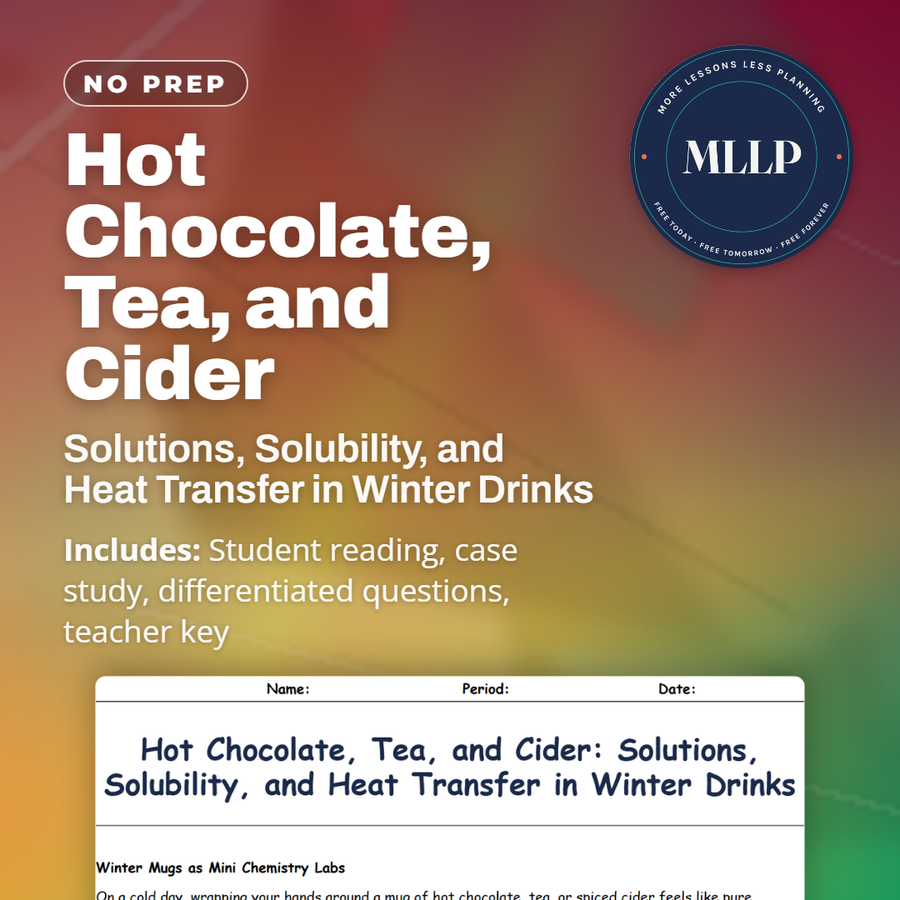
Hot Chocolate, Tea, and Cider: Solutions, Solubility, and Heat Transfer in Winter Drinks
Quality reviewed September 2026
Facts verified September 9, 2026
- Subject
- Science
- Grades
- Grades 9-12
- Length
- 8-page student worksheet
- Time
- About one 50-minute class period
- Great for
- Sub plans and independent work
- Includes
- Reading passage, comprehension questions + full answer key
- Format
- Print-and-go PDF
What students do
- Explain why hot water and stirring help cocoa powder and sugar dissolve more completely
- Analyze how temperature affects solubility and causes crystals to form as drinks cool
- Compare conduction, convection, and radiation as heat moves through mugs and drinks
- Evaluate how solvent, solute, and emulsifiers behave differently in tea, cocoa, and cider
What it covers
- Solutions and solubility at different temperatures
- Heat transfer and thermal equilibrium
- Suspensions and colloids in everyday mixtures
Start reading this worksheet
Winter Mugs as Mini Chemistry Labs
On a cold day, wrapping your hands around a mug of hot chocolate, tea, or spiced cider feels like pure comfort. But in science terms, that mug is also a small, everyday chemistry and physics lab. Each drink is a mix of substances: water, sugars, acids, flavor molecules, and sometimes fats and proteins. How these substances behave depends on concepts you’ve already seen in class: solutions, suspensions, and heat transfer. A solution is a homogeneous mixture where one substance (the solute) is dissolved in another (the solvent). In most winter drinks, liquid water is the main solvent. When sugar disappears evenly throughout your cocoa, you’ve created a solution. A suspension or colloid has small particles that don’t fully dissolve and may stay floating or eventually settle out. Unfiltered apple cider with tiny fruit particles is closer to a suspension; hot chocolate made from real melted chocolate can behave like a colloid, with microscopic fat droplets suspended in water rather than perfectly dissolved. Different drinks highlight different science ideas. Hot tea shows how diffusion and temperature affect how fast flavors move from tea leaves into water. Hot chocolate and cider reveal how solubility depends on temperature and how stirring and time affect how much solid will dissolve. Even the mug itself demonstrates conduction of heat to your hands, while swirling patterns inside your drink demonstrate convection. In other words, the same concepts that show up in chemistry and physical science problems are literally sitting on your kitchen table. To get a clearer picture, look at these three drinks side by side:
Solubility, Temperature, and Why Stirring Matters
If you’ve ever poured cocoa mix into lukewarm water and ended up with clumps, you’ve seen solubility limits in action. Solubility is the maximum amount of a solute that can dissolve in a certain amount of solvent at a given temperature. In general, many solids, like sugar, become more soluble in hot water than in cold. Heating water gives its molecules more kinetic energy, so they move faster and collide more often with the particles of sugar or cocoa. Those collisions help pull solute particles away from the solid and spread them throughout the liquid. Stirring speeds up this process. When you stir, you move fresh solvent into contact with the undissolved solute and break up clumps. Without stirring, dissolved molecules can build up near the surface of the solid, slowing further dissolving. Stirring doesn’t change how much can dissolve in total (that’s determined by solubility), but it changes how quickly the system reaches that limit. That’s why recipes almost always tell you to “stir until dissolved.” Not everything in your drink behaves the same way. Some cocoa mixes contain emulsifiers: molecules that help oil-based ingredients and water-based ingredients stay mixed. Some spice molecules in cider are more soluble in hot liquids than in cold, which is why hot cider can have a strong cinnamon aroma while cold cider might taste milder. If a drink cools down, some dissolved solids can even recrystallize or settle out, leaving gritty sugar or cocoa at the bottom. These everyday annoyances are actually real-world examples of saturated solutions, temperature-dependent solubility, and particle size effects.
Like what you read? The full reading, the case study, and every question set are in the free download below, along with the answer key.
Why this matters
Jalen kept noticing a gritty layer at the bottom of the school cafe's hot chocolate, so he ran his own test: one mug with lukewarm water and barely any stirring, one with very hot water stirred well, and one left to sit for fifteen minutes before drinking.
Most students assume dissolving is just about mixing hard enough, not temperature, so Jalen's third mug growing visible crystals as it cooled is the detail that resets their thinking. Once they've watched heat change how much solute a liquid can actually hold, a drink they make every winter turns into evidence instead of just a snack, and that's exactly the kind of proof that sticks past the test.
From one teacher to another
Jalen noticed the school café's hot chocolate always left a gritty layer at the bottom. For a science project, he made three batches: one with lukewarm water and barely stirred, one with very hot water and thorough stirring, and one that sat for fifteen minutes before drinking. The second batch stayed smoothest. The third developed visible crystals as it cooled. His experiment showed exactly what the reading teaches: higher temperature dissolves more solute, stirring speeds up dissolving, and cooling causes solids to fall out of solution again. Perfect for chemistry students who want to see solutions and heat transfer actually working in something they drink every winter.
What you get
Download
Where should I send the next one?
Everything here is free and it stays that way. Leave your email and I'll send you the new lessons as they go up. You can unsubscribe from any one of them.
Related resources
Biology of Evergreen Plants: The Science Behind Christmas Trees
Body Clocks and Midnight Countdowns: Circadian Rhythms at New Year’s
Calendars, Orbits, and the Science of New Year’s Day
Christmas on the Home Front: WWII Rationing and Resilience
Colorful Chemistry: Holiday Lights, Fireworks, and the Science of Glow
Crowded Skies: Holiday Air Travel and the Environment
Every lesson on this site is free to download and use. If one of them saved you a prep period, you can chip in a few bucks toward my three kids' daycare fund. That's genuinely where tips go.