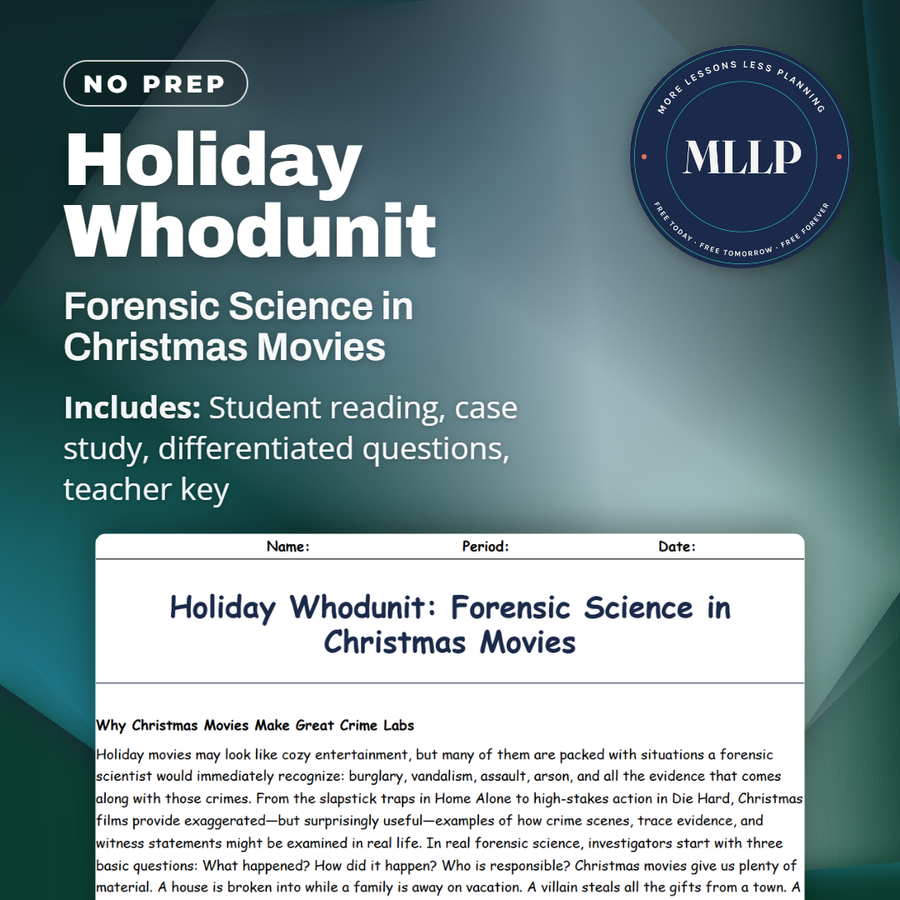
Holiday Whodunit: Forensic Science in Christmas Movies
Quality reviewed September 2026
Facts verified September 9, 2026
- Subject
- Science
- Grades
- Grades 9-12
- Length
- 8-page student worksheet
- Time
- About one 50-minute class period
- Great for
- Sub plans and independent work
- Includes
- Reading passage, comprehension questions + full answer key
- Format
- Print-and-go PDF
What students do
- Apply Locard's exchange principle to analyze how evidence links suspects to crime scenes
- Identify trace evidence, tool marks, and fingerprints in holiday movie scenarios
- Contrast movie forensics with real investigation timelines and lab testing
- Evaluate realistic versus exaggerated forensic techniques shown in film
What it covers
- Crime scene reconstruction and evidence analysis
- Forensic principles applied to real scenarios
- Trace evidence, DNA, and ballistics
Start reading this worksheet
Why Christmas Movies Make Great Crime Labs
Holiday movies may look like cozy entertainment, but many of them are packed with situations a forensic scientist would immediately recognize: burglary, vandalism, assault, arson, and all the evidence that comes along with those crimes. From the slapstick traps in Home Alone to high-stakes action in Die Hard, Christmas films provide exaggerated (but surprisingly useful) examples of how crime scenes, trace evidence, and witness statements might be examined in real life. In real forensic science, investigators start with three basic questions: What happened? How did it happen? Who is responsible? Christmas movies give us plenty of material. A house is broken into while a family is away on vacation. A villain steals all the gifts from a town. A skyscraper party is interrupted by armed intruders. Each situation would require careful scene documentation, evidence collection, and reconstruction: figuring out the sequence of events from the clues left behind. Of course, movie directors care more about drama than accuracy. Evidence appears and disappears, characters handle items without gloves, and detectives solve complex cases in minutes. But if you watch like a forensic scientist, you can separate movie magic from genuine forensic principles. Instead of just asking, “Was that a cool scene?” you can ask, “What evidence would I collect here? How would I preserve it? What would actually hold up in court?”
Booby Traps and Broken Doors: Home Alone as a Crime Scene
In Home Alone, Kevin McCallister is left behind when his family accidentally flies to Paris. Two burglars, Harry and Marv, target the house, only to find it loaded with Kevin’s improvised traps. From a forensic perspective, the McCallister home is a nightmare of overlapping events and evidence. There are broken ornaments, burned doorknobs, icy stairs, paint cans swinging on ropes, and multiple entry points. A real crime scene team would have to work methodically. First, they would secure the scene and photograph everything: shattered glass by the window, footprints in the snow, damaged locks, and blood drops from injuries. They might collect latent fingerprints from doorknobs and window frames, shoe impressions from the driveway, and fibers from clothing caught on nails or broken ornaments. Any dropped hats, crowbars, or tools would be bagged and labeled as physical evidence. The biggest challenge would be sorting Kevin’s actions from the burglars’ actions. Locard’s exchange principle (every contact leaves a trace) applies to everyone, not just the suspects. Kevin’s own fingerprints and footprints would be everywhere. Investigators would need comparison samples from all residents, plus clear statements about who lived in the home, who had permission to be there, and when the traps were set. The case reminds us that crime scenes in real life are often messy; forensic scientists must carefully separate overlapping sources of evidence to build a reliable timeline.
Grinches, Thieves, and Questioned Evidence
In How the Grinch Stole Christmas, the Grinch sneaks into Whoville and steals gifts, food, and decorations. If the Whos called in a forensic team instead of singing on the hill, how would investigators work? They would start by identifying points of entry: chimneys, windows, or doors that show signs of tampering. Soot smears, scraped paint, or fibers from the Grinch’s fuzzy green suit could all count as trace evidence. Investigators would also look for tool marks on locks or hinges. If a special wrench or crowbar was used to open doors, matching the tool’s unique scratch pattern to the marks could link a specific item to the crime. In the lab, questioned documents like the fake “Santa” notes left behind could be analyzed for handwriting patterns, pressure marks, and even printer or ink characteristics. Holiday movies often feature exaggerated facial recognition: characters instantly “know” who did it. Real forensic identification relies on more systematic methods: DNA profiles, fingerprint comparison, shoeprint analysis, and video enhancement. Imagine a security camera in Whoville that caught a blurry, green figure slinking away. Forensic video specialists would clarify the footage as much as possible, but they would still be cautious about overclaiming. A responsible expert might say, “The figure’s size and shape are consistent with the Grinch,” not “This is definitely the Grinch,” unless there were multiple, independent lines of evidence.
Like what you read? The full reading, the case study, and every question set are in the free download below, along with the answer key.
Why this matters
Broken ornaments, paint stained footprints, blood drops, a crowbar left behind: Home Alone is a crime scene once you stop laughing at it, and a real investigator would need to sort Kevin's evidence from the burglars' before any of it made sense.
I ask students who've watched these movies a dozen times to separate the plot from the physical evidence sitting in every frame, something none of them have done before. Once they apply Locard's exchange principle to a living room instead of a textbook diagram, they notice how much slower and messier a real investigation would be than the single hour the movie gives it.
From one teacher to another
Home Alone is a forensic nightmare once you stop laughing. Broken ornaments, paint-stained footprints, blood drops, a crowbar left behind. A real crime scene team would photograph every room, carefully separate Kevin's evidence from the burglars' evidence, and test everything for DNA and prints. This worksheet teaches students to watch movies like forensic scientists: not to just enjoy the plot but to ask what evidence would actually hold up in court and how long real investigations take. Scenes from Home Alone, How the Grinch Stole Christmas, and Die Hard show trace evidence, reconstruction, ballistics, and the messy reality of overlapping traces at crime scenes.
What you get
Download
Where should I send the next one?
Everything here is free and it stays that way. Leave your email and I'll send you the new lessons as they go up. You can unsubscribe from any one of them.
Related resources

Biology of Evergreen Plants: The Science Behind Christmas Trees
Body Clocks and Midnight Countdowns: Circadian Rhythms at New Year’s
Calendars, Orbits, and the Science of New Year’s Day
Christmas on the Home Front: WWII Rationing and Resilience
Colorful Chemistry: Holiday Lights, Fireworks, and the Science of Glow
Crowded Skies: Holiday Air Travel and the Environment
Every lesson on this site is free to download and use. If one of them saved you a prep period, you can chip in a few bucks toward my three kids' daycare fund. That's genuinely where tips go.