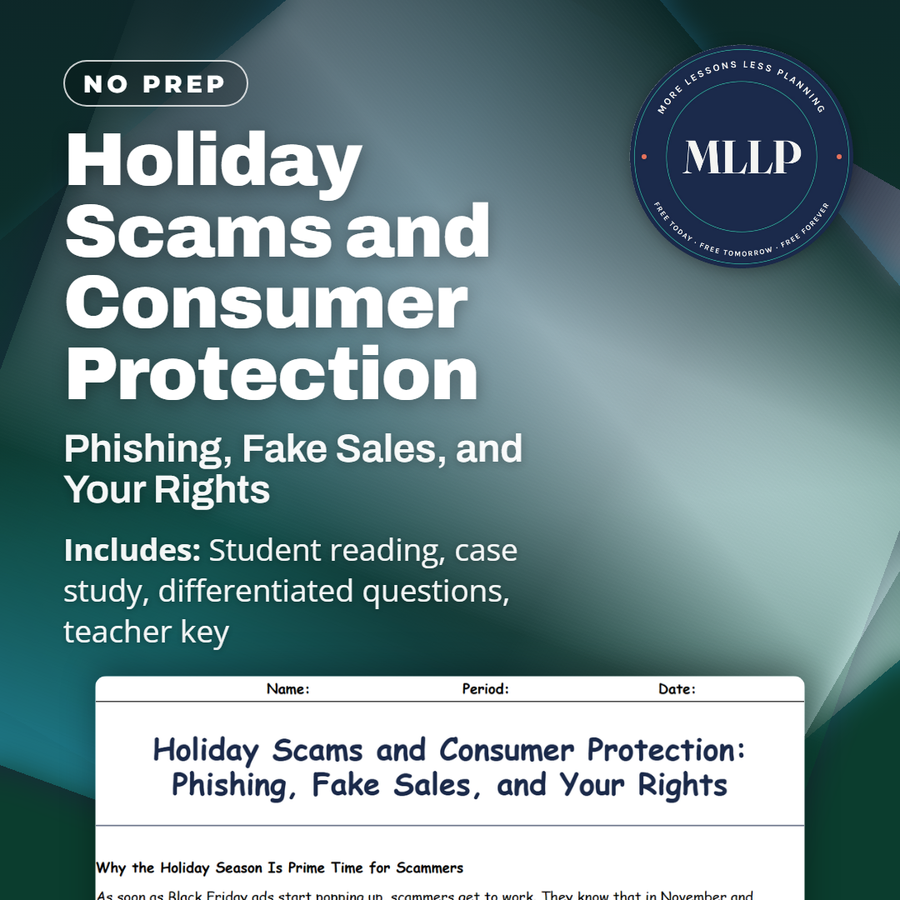
Holiday Scams and Consumer Protection: Phishing, Fake Sales, and Your Rights
Quality reviewed September 2026
Facts verified September 9, 2026
- Subject
- Career & Life Skills
- Grades
- Grades 9-12
- Length
- 8-page student worksheet
- Time
- About one 50-minute class period
- Great for
- Sub plans and independent work
- Includes
- Reading passage, comprehension questions + full answer key
- Format
- Print-and-go PDF
What students do
- Identify red flags in phishing emails and fake websites that scammers use during holidays
- Compare the protections offered by credit cards versus debit cards for online fraud
- Analyze how scammers exploit holiday urgency and emotions to trick shoppers
- Evaluate consumer rights and resources available after reporting fraud
What it covers
- Phishing scams and cybersecurity awareness
- Fake websites and online fraud
- Consumer protection and financial rights
Start reading this worksheet
Why the Holiday Season Is Prime Time for Scammers
As soon as Black Friday ads start popping up, scammers get to work. They know that in November and December, people are shopping more, clicking more, donating more, and rushing more. That combination makes the holidays the perfect time for fraud. When you’re juggling school, family plans, and gift lists, you’re more likely to skim an email or tap a link without thinking it through. Scammers take advantage of emotions as much as technology. They lean on excitement (“Flash sale!”), fear (“Your package is delayed!”), and guilt (“Don’t let a child go without a gift this year”). Their goal is to get you to act fast and think later. That might mean clicking a link in a fake phishing email, entering your card number on a fake website, or donating to a “charity” that doesn’t actually exist. The rise of online shopping means more of our purchasing happens through websites, apps, and digital wallets. That’s convenient. But it also creates more opportunities for criminals to pretend to be stores, delivery companies, or charities. The good news is that you don’t have to memorize every scam. Instead, you can learn the patterns: how scammers normally operate, what red flags to look for, and what rights you have if something goes wrong. Once you see those patterns, the holiday internet looks a lot less mysterious and a lot easier to navigate safely.
How Holiday Scams Try to Trick You
Most holiday scams fall into a few big categories. One is phishing, where scammers send fake emails or texts pretending to be from a trusted company, like a major retailer, a shipping company, or even your bank. A typical message might say, “There’s a problem with your order, click here to fix it,” or “We couldn’t deliver your package, click this link to reschedule.” The link often leads to a spoofed website (a site designed to look real but isn’t) that asks for your login, card number, or other personal information. Once you type it in, the scammer has what they need. Another category is fake sales and stores. These might show up as ads for unbelievably cheap electronics, sneakers, or beauty products. The website might look professional, but there are hints: strange web addresses, lots of spelling mistakes, no clear return policy, or only one way to pay (like a wire transfer or sketchy payment app). In the best case, you might get a low-quality counterfeit product. In the worst case, you get nothing at all, and the scammers still have your payment information. Holiday charity scams are a third danger. Real charities do important work, especially around the holidays. But scammers create fake donation sites or spoof the names of real organizations to collect money that will never reach anyone in need. They may pressure you to give immediately, refuse to send written information, or demand payment in gift cards or cryptocurrency. These are two major red flags.
Your Rights as a Consumer: Chargebacks, Agencies, and Complaints
Being careful helps, but no one is perfect. If you (or someone in your family) do get scammed, it’s important to know that you’re not helpless. In many situations, consumer protection laws give you rights and tools to limit the damage. First, how you pay matters. Using a credit card usually offers more protection than using a debit card, wiring money, or paying in gift cards. If you use a credit card and a charge turns out to be fraudulent or the goods never arrive, you can contact your card issuer and ask for a chargeback: a reversal of the charge. You’ll usually need to explain what happened and may have to provide screenshots or emails as evidence, but there is a formal process. With a debit card or wire transfer, the money comes straight out of your bank account and is much harder to recover. Second, there are agencies whose job is to help protect consumers. In the United States, the Federal Trade Commission (FTC) and state attorneys general (AGs) investigate patterns of fraud and can bring cases against companies that break consumer protection laws. While they may not get your individual money back, your report helps them spot large-scale scams and warn others. Local consumer protection offices and Better Business Bureau listings can also give clues about whether a company has a bad history. Finally, you have the right to ask questions before paying. Real charities should be able to tell you their official name, how donations are used, and how you can verify their status (for example, on a government or watchdog site). Real businesses should provide an address, contact information, and clear return policies. If someone pressures you to act immediately, refuses to provide details, or insists on unusual payment methods, you have the right to walk away. Saying, “I’ll check this and get back to you” is a powerful consumer protection tool all by itself.
Like what you read? The full reading, the case study, and every question set are in the free download below, along with the answer key.
Why this matters
Two days before break, Carlos got a text saying a package was on hold. He had orders coming from three different sites, so the message felt believable, and the fake site even matched the real company's logo and colors.
The lesson isn't that scams are obvious once you know what to look for. It's that they're built to feel exactly like something already happening in your life, which is why checking a web address matters more than trusting a familiar logo. Students leave knowing the difference between a scam that fails and one that works often comes down to one small habit: opening the real app instead of tapping the link.
From one teacher to another
Two days before winter break, Carlos got a text about a package on hold. He had several orders, so the message felt real. The fake website copied the company's logo and colors perfectly, but one detail stopped him. The web address didn't match. He opened his real app instead and found no problem. This worksheet walks through exactly how that scam worked and why it's so effective during holidays. Students learn the patterns behind phishing, charity scams, and fake sales, then practice spotting real red flags. Includes what to do if something goes wrong and how your rights as a consumer actually protect you.
What you get
Download
Where should I send the next one?
Everything here is free and it stays that way. Leave your email and I'll send you the new lessons as they go up. You can unsubscribe from any one of them.
Related resources
Biology of Evergreen Plants: The Science Behind Christmas Trees
Body Clocks and Midnight Countdowns: Circadian Rhythms at New Year’s
Calendars, Orbits, and the Science of New Year’s Day
Christmas on the Home Front: WWII Rationing and Resilience
Colorful Chemistry: Holiday Lights, Fireworks, and the Science of Glow
Crowded Skies: Holiday Air Travel and the Environment
Every lesson on this site is free to download and use. If one of them saved you a prep period, you can chip in a few bucks toward my three kids' daycare fund. That's genuinely where tips go.