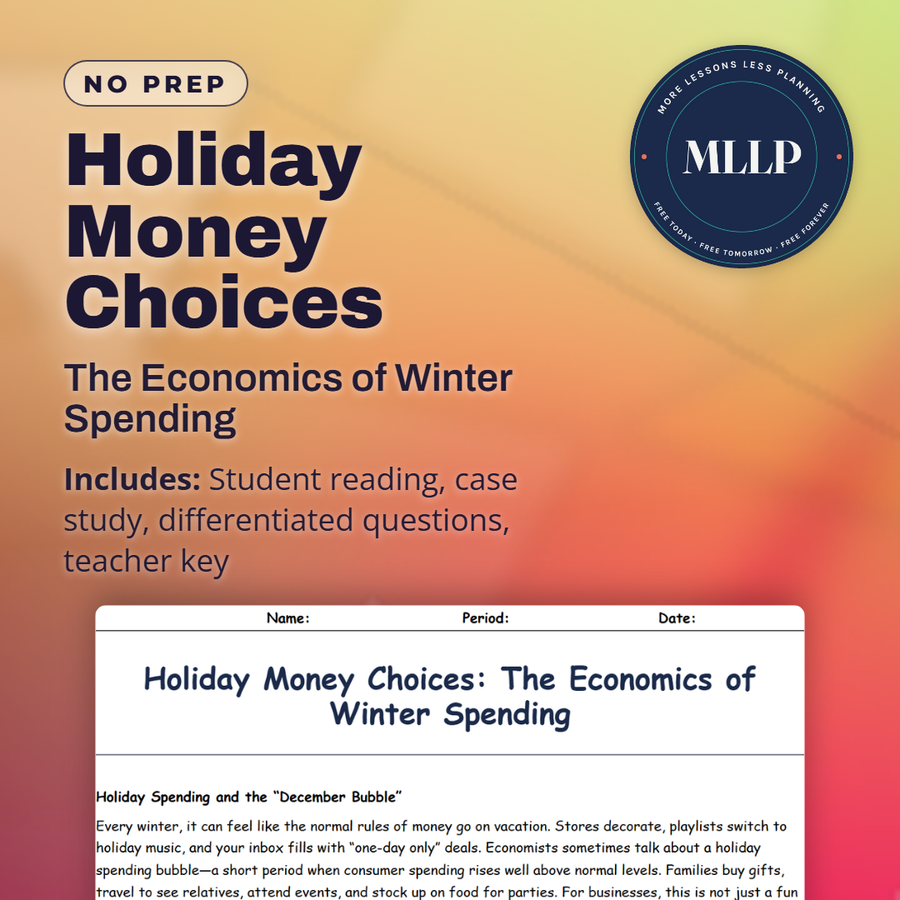
Holiday Money Choices: The Economics of Winter Spending
Quality reviewed September 2026
Facts verified September 9, 2026
- Subject
- Career & Life Skills
- Grades
- Grades 9-12
- Length
- 8-page student worksheet
- Time
- About one 50-minute class period
- Great for
- Sub plans and independent work
- Includes
- Reading passage, comprehension questions + full answer key
- Format
- Print-and-go PDF
What students do
- Analyze how retailers use doorbuster sales and free shipping thresholds to shape spending
- Explain the relationship between credit card interest, minimum payments, and total debt
- Trace Jordan's spending choices in December and their financial impact in January
- Evaluate the concept of opportunity cost through holiday purchasing decisions
What it covers
- Consumer spending and retail strategy
- Credit cards, interest, and personal finance
- Scarcity, opportunity cost, and economic decision-making
Start reading this worksheet
Holiday Spending and the “December Bubble”
Every winter, it can feel like the normal rules of money go on vacation. Stores decorate, playlists switch to holiday music, and your inbox fills with “one-day only” deals. Economists sometimes talk about a holiday spending bubble: a short period when consumer spending rises well above normal levels. Families buy gifts, travel to see relatives, attend events, and stock up on food for parties. For businesses, this is not just a fun time of year; it is a major piece of their annual revenue. From an economics point of view, every purchase still involves scarcity and opportunity cost. Scarcity means you have limited income, time, and attention. Opportunity cost is what you give up when you choose one option over another. If you spend $60 on holiday decorations, you can’t use that same $60 for gas, savings, or a concert ticket. In December, social pressure and tradition can make it feel like there is no choice. You “have to” buy certain things. In reality, you are still making trade-offs, even if you don’t stop to think about them. Marketers understand this. They use limited-time offers, “only three left” messages, and emotional advertising to increase demand. If many consumers respond, the quantity demanded of popular items (like game consoles, headphones, or limited sneakers) can spike. When supply is limited, prices may rise or items may sell out. Some shoppers treat holiday buying as an exception to their normal rules (“I’ll worry about it in January”), but the basic economic principles of choices, trade-offs, and incentives are still in play.
Credit Cards, Interest, and the January Bill Shock
A huge part of holiday economics happens on plastic. Many people use credit cards to buy gifts or pay for travel, telling themselves they’ll “catch up later.” A credit card is basically a short-term loan from the bank. If you pay the full balance on time, you avoid interest. If you only make the minimum payment, the remaining balance is carried forward and the bank charges interest, often at a high annual percentage rate (APR). Imagine someone charges $600 in December at a 20% APR and then only pays the minimum each month. Because of interest, the final cost of those purchases will be much higher than $600, and it may take years to pay off. Economists call this the time value of money: a dollar today is not the same as a dollar in the future, especially when interest and inflation are involved. Holiday purchases can quietly turn into long-term debt, reducing future consumption options. There is also a psychological angle. Shoppers often focus on the monthly payment rather than the total cost, which can lead to over-borrowing. Buy-now-pay-later plans and store cards are designed to make purchases feel smaller and more manageable. The January credit card statement brings everything back into focus. This is the moment when the “December bubble” collides with reality. For students, understanding how interest works is not just a math exercise; it is a survival skill that affects future financial well-being.
Retail Strategies: Sales, Gift Cards, and Returns
Retailers plan months ahead for the holiday season. They don’t just hope customers show up; they design pricing strategies to shape consumer behavior. Temporary discounts draw price-sensitive shoppers. Free shipping thresholds encourage people to add “just one more item” to reach the minimum. Doorbuster deals get people in the store (or on the website), where they may buy full-priced items once they’re already browsing. Another important tool is the gift card. When you buy a $50 gift card for a friend, the store receives cash immediately. Some recipients spend more than the card’s value, increasing sales. Others never use the full amount, creating what retailers call breakage: money the business keeps without providing goods or services. Return policies also matter. Stores with generous returns reduce the perceived risk of buying the wrong item, which can increase sales. But handling returns costs money, so firms adjust prices and policies to protect profits. Here is a simplified look at how some holiday retail strategies work: For students, learning to see these strategies as incentives rather than magic is key. When you recognize that a sale or free shipping offer is designed to change your behavior, you can decide whether the deal really matches your own budget and priorities, or whether it mostly benefits the store.
Like what you read? The full reading, the case study, and every question set are in the free download below, along with the answer key.
Why this matters
A fifteen percent discount looks like savings until the bill arrives. Jordan used a store credit card to grab that deal in December, and by January he owed four hundred eighty dollars, money he no longer had for gas or concert tickets.
Students want to treat the discount and the debt as two separate stories, but they're the same transaction. I have them trace Jordan's December decisions forward into his January statement so the connection between a good deal and a bad month stops being abstract. Retailers count on shoppers making exactly the choice Jordan made, and naming that incentive out loud changes how students shop the next time a doorbuster sale shows up in their inbox.
From one teacher to another
Jordan told himself he was doing fine in December. He picked up extra shifts, then switched to a store credit card when his paycheck ran out. That 15 percent discount felt like a win. By January, his credit card statement showed $480 due and the math hit different: interest, minimum payments, and money he wouldn't have for gas and concert tickets. The worksheet uses his story to teach how the December bubble collides with January reality. Students see scarcity, opportunity cost, and incentives playing out in real holiday choices, then build their own budget rules for next season.
What you get
Download
Where should I send the next one?
Everything here is free and it stays that way. Leave your email and I'll send you the new lessons as they go up. You can unsubscribe from any one of them.
Related resources
Biology of Evergreen Plants: The Science Behind Christmas Trees
Body Clocks and Midnight Countdowns: Circadian Rhythms at New Year’s
Calendars, Orbits, and the Science of New Year’s Day
Christmas on the Home Front: WWII Rationing and Resilience
Colorful Chemistry: Holiday Lights, Fireworks, and the Science of Glow
Crowded Skies: Holiday Air Travel and the Environment
Every lesson on this site is free to download and use. If one of them saved you a prep period, you can chip in a few bucks toward my three kids' daycare fund. That's genuinely where tips go.