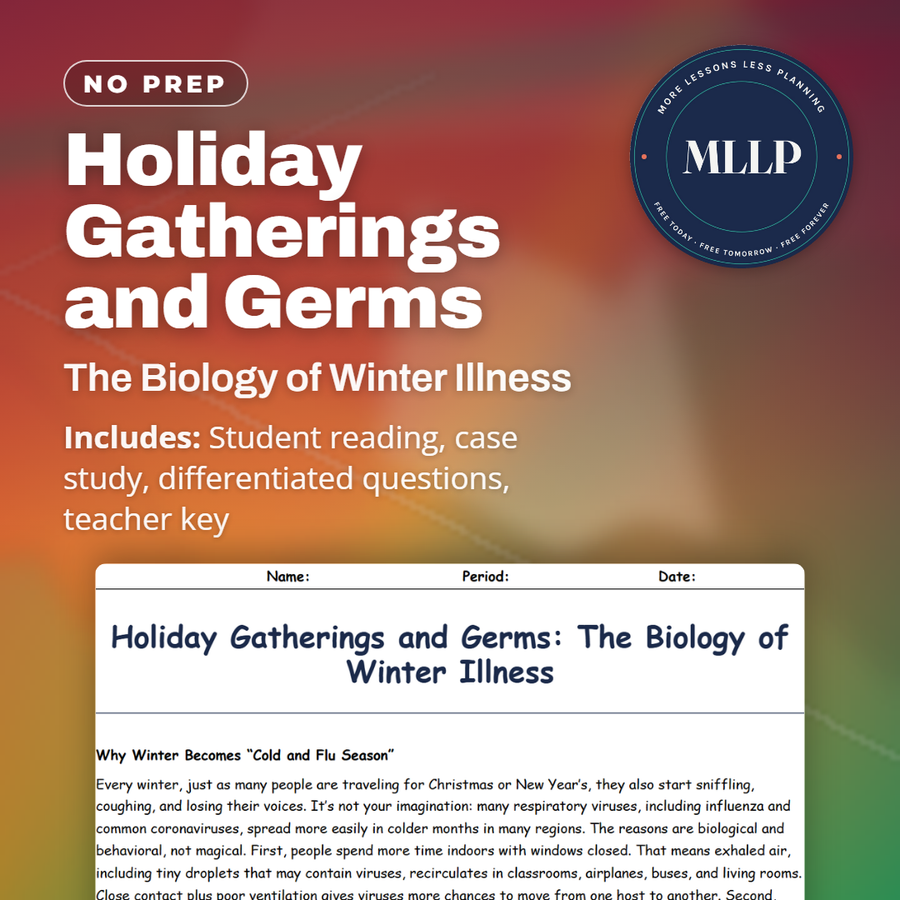
Holiday Gatherings and Germs: The Biology of Winter Illness
Quality reviewed September 2026
Facts verified September 9, 2026
- Subject
- Science
- Grades
- Grades 9-12
- Length
- 8-page student worksheet
- Time
- About one 50-minute class period
- Great for
- Sub plans and independent work
- Includes
- Reading passage, comprehension questions + full answer key
- Format
- Print-and-go PDF
What students do
- Analyze how crowded indoor spaces and poor ventilation increase respiratory virus transmission
- Explain the biological pathways by which viruses hijack host cells to replicate
- Compare how the adaptive and innate immune systems defend against winter illnesses
- Evaluate how sleep deprivation and stress during holidays weaken immune responses
What it covers
- Viral transmission and airborne pathogens
- Immune system function and infection
- Biology of winter illness and holiday gatherings
Start reading this worksheet
Why Winter Becomes “Cold and Flu Season”
Every winter, just as many people are traveling for Christmas or New Year’s, they also start sniffling, coughing, and losing their voices. It’s not your imagination: many respiratory viruses, including influenza and common coronaviruses, spread more easily in colder months in many regions. The reasons are biological and behavioral, not magical. First, people spend more time indoors with windows closed. That means exhaled air, including tiny droplets that may contain viruses, recirculates in classrooms, airplanes, buses, and living rooms. Close contact plus poor ventilation gives viruses more chances to move from one host to another. Second, some viruses survive longer in cooler, drier air. When the air is dry, mucus membranes in your nose and throat can also dry out slightly, making it harder for your body to trap and flush out invading microbes. On top of that, the holiday season can disrupt healthy routines. Travel, late-night events, and stress can all affect the immune system, the network of cells, tissues, and organs that defend the body against pathogens. None of this means winter illnesses are “inevitable,” but it does mean the biology of viruses and the ways people behave during the holidays combine to make infection more likely.
How Viruses Travel at Holiday Events
When someone with a respiratory infection coughs, sneezes, laughs, or even talks, they release tiny respiratory droplets and aerosols into the air. Larger droplets may fall quickly onto surfaces like tables, doorknobs, or serving utensils. Smaller aerosols can hang in the air, especially in crowded, poorly ventilated spaces. If another person inhales those particles or touches a contaminated surface and then touches their eyes, nose, or mouth, the virus can enter their body. Once inside, viruses do something that bacteria and human cells never do: they hijack the host cell’s machinery. A virus is mostly genetic material (DNA or RNA) wrapped in a protein coat, sometimes with an outer envelope. It cannot reproduce on its own. Instead, it attaches to specific receptors on the surface of a host cell, injects or releases its genetic material, and uses the cell’s ribosomes and enzymes to build more copies of itself. Eventually, new virions (virus particles) burst out or bud off, infecting neighboring cells and spreading through tissues like the respiratory tract. Holiday gatherings create many opportunities for this process to begin. Shared food tables, crowded living rooms, car rides with the windows up, and long flights all increase contact. That does not mean every gathering is unsafe, but it does mean simple choices—like improving ventilation, washing hands, and staying home when truly sick—have a clear biological impact. The more you understand these routes, the easier it is to see where a small habit change can interrupt a virus’s journey from one host to the next.
Like what you read? The full reading, the case study, and every question set are in the free download below, along with the answer key.
Why this matters
A cold after New Year's gets blamed on bad luck, when really the party created ideal conditions for a virus: closed windows, people packed close together, food passed hand to hand, and one guest who came even though he felt off.
Students usually assume they can't do anything about catching a cold besides luck and vitamin C, so tracing that actual chain changes how they think about the next crowded room they walk into. They start asking why a party feels stuffy instead of complaining about it, and once they see what sleep and stress do to the immune system underneath it all, the illness stops feeling random.
From one teacher to another
This worksheet uses a post-New Year's Eve mystery cold to teach viral biology. Half the party guests caught the same bug, and students map out exactly how it happened, closed windows, close contact, shared food, and an obviously sick guest who stayed anyway. The reading breaks down how viruses actually work inside cells, why cold air helps viruses survive, and how your immune system either bounces back or struggles depending on sleep and stress. Perfect for biology or health class before winter break.
What you get
Download
Where should I send the next one?
Everything here is free and it stays that way. Leave your email and I'll send you the new lessons as they go up. You can unsubscribe from any one of them.
Related resources
Biology of Evergreen Plants: The Science Behind Christmas Trees
Body Clocks and Midnight Countdowns: Circadian Rhythms at New Year’s
Calendars, Orbits, and the Science of New Year’s Day
Christmas on the Home Front: WWII Rationing and Resilience
Colorful Chemistry: Holiday Lights, Fireworks, and the Science of Glow
Crowded Skies: Holiday Air Travel and the Environment
Every lesson on this site is free to download and use. If one of them saved you a prep period, you can chip in a few bucks toward my three kids' daycare fund. That's genuinely where tips go.