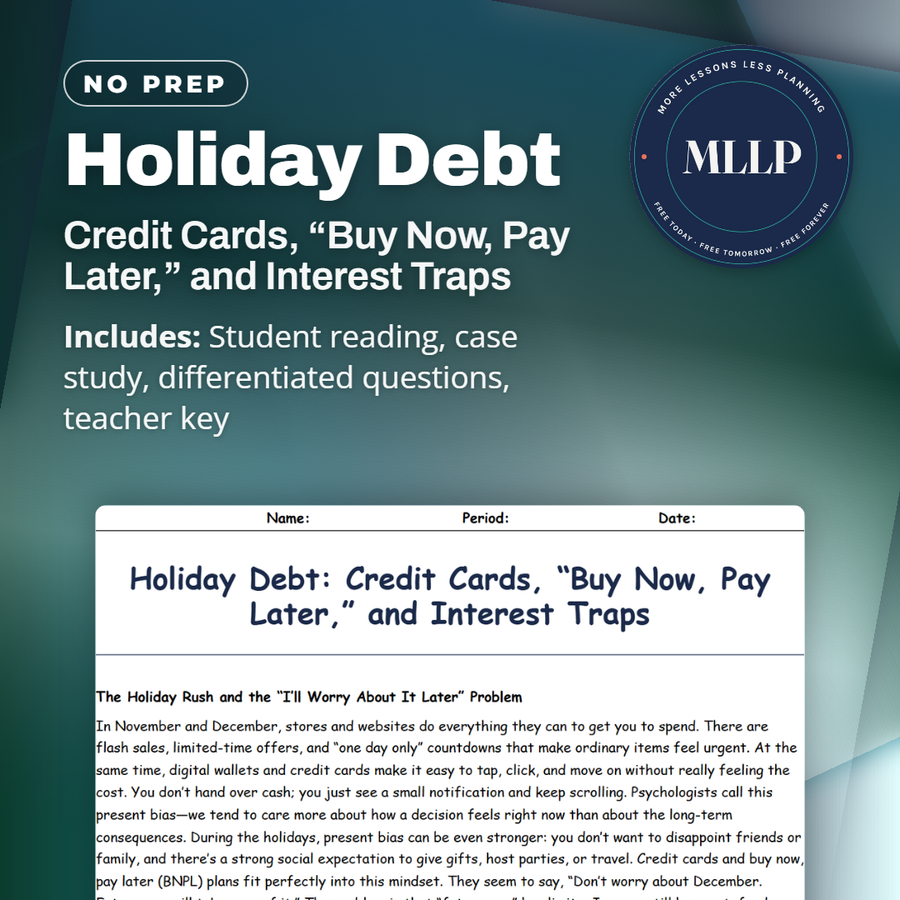
Holiday Debt: Credit Cards, “Buy Now, Pay Later,” and Interest Traps
Quality reviewed September 2026
Facts verified September 9, 2026
- Subject
- Career & Life Skills
- Grades
- Grades 9-12
- Length
- 8-page student worksheet
- Time
- About one 50-minute class period
- Great for
- Sub plans and independent work
- Includes
- Reading passage, comprehension questions + full answer key
- Format
- Print-and-go PDF
What students do
- Explain how a 23 percent APR turns a $900 holiday balance into months of payments
- Analyze why Maya's minimum payments barely moved her balance by March
- Compare one advantage and one risk of a buy now, pay later plan
- Match APR, minimum payment, compound interest, and late fee to their definitions
What it covers
- Present bias and the holiday spending rush
- Minimum payments, APR, and how interest grows
- Buy now, pay later plans and better holiday habits
Start reading this worksheet
The Holiday Rush and the “I’ll Worry About It Later” Problem
In November and December, stores and websites do everything they can to get you to spend. There are flash sales, limited-time offers, and “one day only” countdowns that make ordinary items feel urgent. At the same time, digital wallets and credit cards make it easy to tap, click, and move on without really feeling the cost. You don’t hand over cash; you just see a small notification and keep scrolling. Psychologists call this present bias. We tend to care more about how a decision feels right now than about the long-term consequences. During the holidays, present bias can be even stronger: you don’t want to disappoint friends or family, and there’s a strong social expectation to give gifts, host parties, or travel. Credit cards and buy now, pay later (BNPL) plans fit perfectly into this mindset. They seem to say, “Don’t worry about December. Future-you will take care of it.” The problem is that “future-you” has limits. January still has rent, food, gas, and school expenses. When December purchases follow you into the new year as debt, the true cost of that gift or plane ticket can be much higher than the price tag you saw. Understanding how minimum payments, interest rates, and BNPL plans actually work is one of the most important financial literacy skills you can have as a teenager, even if you don’t have your own card yet. The choices adults make today are the reality you’ll be living in when it’s your turn to manage money.
Minimum Payments, APR, and How Interest Grows in the Background
A credit card is not free money. It’s a short-term loan with rules. When you swipe or tap, the credit card company pays the store on your behalf. At the end of the month, you receive a statement listing everything you bought and the total balance you owe. If you pay that full balance by the due date, you usually pay no interest on those purchases because of a grace period: the time between the statement date and the due date. Trouble starts when you don’t pay in full. The statement also shows a minimum payment: the smallest amount you must pay to keep the account in good standing. Minimum payments are often set very low, sometimes around 1–3% of the balance plus fees. Paying only the minimum can make a large balance shrink very slowly, because the remaining balance is charged interest every month. Card interest is quoted as an APR (annual percentage rate), such as 22% APR. Behind the scenes, this is broken into a daily or monthly rate and applied to whatever balance you’re carrying. That’s compound interest: you may pay interest not just on what you originally borrowed, but also on interest added in previous months. A very simplified example helps show the idea: The exact numbers depend on the card’s formula, but the pattern is clear: the higher the balance and the lower the payment, the longer you’re stuck. A “holiday splurge” can quietly become a long-term financial drag, limiting what you can do later: renting an apartment, buying a car, or saving for emergencies.
Buy Now, Pay Later: Helpful Tool or Holiday Trap?
Recently, Buy Now, Pay Later (BNPL) options have appeared on many websites next to the regular checkout button. They might say “4 payments of $25, interest-free” or “No payment for 6 weeks.” These services spread the cost of a purchase into several smaller payments over time, often without traditional interest. For someone on a tight budget, that can feel like a lifesaver: you get the item now and pay in chunks that fit into your paycheck. However, BNPL has its own set of traps. First, splitting a price into smaller pieces can make the total feel less real. You might say, “It’s only $20 every two weeks,” and forget that you’ve done that three or four times on different sites. The payments start layering on top of each other, and suddenly your future paychecks are already spoken for. Second, many BNPL plans charge late fees if you miss a payment or if your bank account doesn’t have enough money when an automatic withdrawal hits. Those fees can add up quickly and may not be obvious in the fine print when you click “Agree.” Another issue is that BNPL is not always covered by the same consumer protections as credit cards. In some cases, disputes over damaged or missing items can be harder to resolve, and missing payments may eventually be reported to credit bureaus, hurting your credit score. BNPL is not automatically bad; used carefully, it can help you avoid running up a credit card balance. But it is still debt. The key is to treat each BNPL plan like a real bill, because that’s exactly what it is.
Like what you read? The full reading, the case study, and every question set are in the free download below, along with the answer key.
Why this matters
Nine hundred dollars charged in December sounds manageable until the interest rate does its work. At 23 percent APR, a balance that isn't paid off keeps growing even while the minimum payment gets made, because that payment is built to cover interest first and barely touch what's owed.
Most students think a minimum payment means the balance is shrinking, and that misunderstanding keeps people in debt for years. I want them to run Maya's numbers themselves and see that buy now pay later plans hide the same problem behind four smaller payments split across different stores. Once they've traced her balance to March, a low payment stops looking like proof a purchase was affordable.
From one teacher to another
Maya puts $900 on her first credit card in December and tells herself she will clear it in February. Then January brings textbooks and a phone repair, so she pays the $30 minimum, and by March most of each payment is going to interest. My students read that case study and recognize a plan they have already made in their heads. The reading explains present bias, the grace period, and why a minimum payment is designed to keep a balance alive, then takes on buy now, pay later plans that split one purchase into four payments that stack up across different sites. The final questions have students build a holiday budget that does not need a bailout in spring.
What you get
Download
Where should I send the next one?
Everything here is free and it stays that way. Leave your email and I'll send you the new lessons as they go up. You can unsubscribe from any one of them.
Related resources
Biology of Evergreen Plants: The Science Behind Christmas Trees
Body Clocks and Midnight Countdowns: Circadian Rhythms at New Year’s
Calendars, Orbits, and the Science of New Year’s Day
Christmas on the Home Front: WWII Rationing and Resilience
Colorful Chemistry: Holiday Lights, Fireworks, and the Science of Glow
Crowded Skies: Holiday Air Travel and the Environment
Every lesson on this site is free to download and use. If one of them saved you a prep period, you can chip in a few bucks toward my three kids' daycare fund. That's genuinely where tips go.