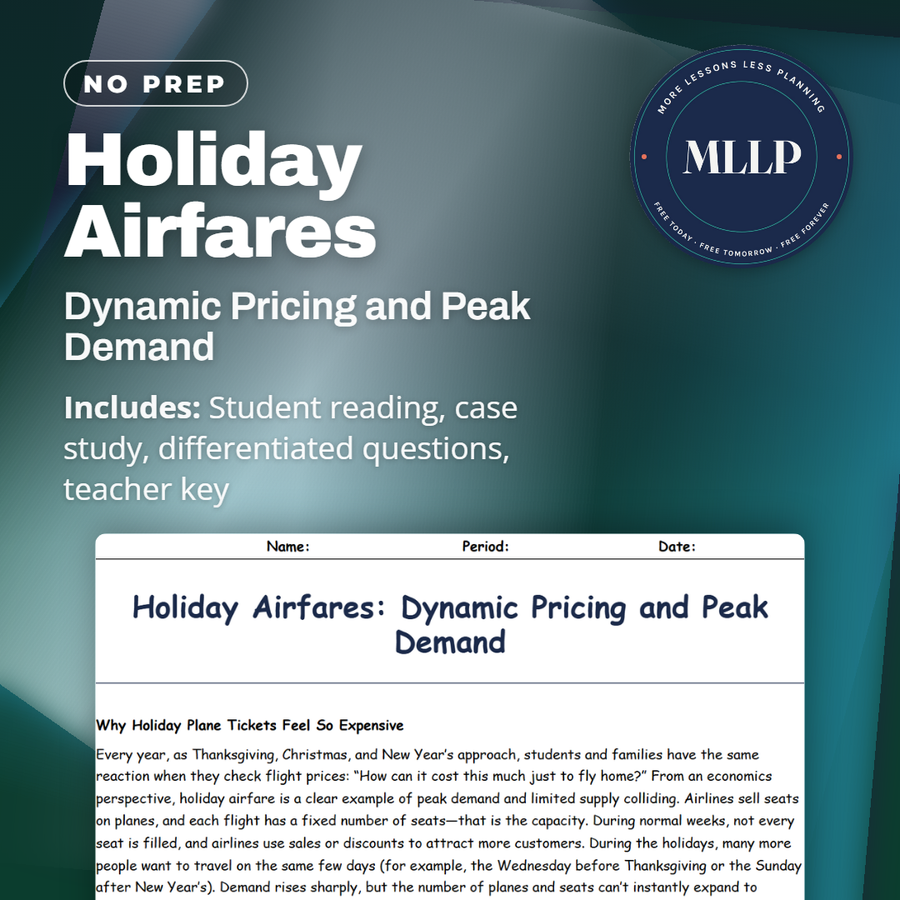
Holiday Airfares: Dynamic Pricing and Peak Demand
Quality reviewed September 2026
Facts verified September 9, 2026
- Subject
- Social Studies
- Grades
- Grades 9-12
- Length
- 7-page student worksheet
- Time
- About one 50-minute class period
- Great for
- Sub plans and independent work
- Includes
- Reading passage, comprehension questions + full answer key
- Format
- Print-and-go PDF
What students do
- Explain why flight prices rise sharply when demand for specific holiday dates increases while seat capacity stays fixed
- Map the Rodriguez family's ticket search onto a demand curve and trace how waiting affected their pricing options
- Analyze how airlines use dynamic pricing and price discrimination to maximize revenue from different customer types
- Evaluate the difference between elastic and inelastic demand using holiday travel as an example
What it covers
- Supply and demand curves, equilibrium pricing, and peak seasons
- Dynamic pricing and yield management in revenue optimization
- Price discrimination and customer segmentation strategies
Start reading this worksheet
Why Holiday Plane Tickets Feel So Expensive
Every year, as Thanksgiving, Christmas, and New Year’s approach, students and families have the same reaction when they check flight prices: “How can it cost this much just to fly home?” From an economics perspective, holiday airfare is a clear example of peak demand and limited supply colliding. Airlines sell seats on planes, and each flight has a fixed number of seats: that is the capacity. During normal weeks, not every seat is filled, and airlines use sales or discounts to attract more customers. During the holidays, many more people want to travel on the same few days (for example, the Wednesday before Thanksgiving or the Sunday after New Year’s). Demand rises sharply, but the number of planes and seats can’t instantly expand to match. In a basic supply and demand graph, demand curves shift to the right during peak times while supply stays almost vertical (fixed capacity). The result is higher equilibrium prices; in plain language, tickets cost more. Airlines can add a few extra flights or use bigger planes on popular routes, but those changes are limited by crew, maintenance, and airport slots. Because of this, airlines rely heavily on pricing strategies instead of huge changes in how many flights they operate.
Dynamic Pricing: Changing the Fare Without Changing the Seat
You may have noticed that flight prices change from one day to the next, or even within the same day, without anything obvious happening. This is dynamic pricing: adjusting prices in real time based on demand, remaining capacity, booking patterns, and sometimes even the time of day people are searching. Airlines use complex revenue management systems (also called yield management) to decide how many seats they will sell at each fare class. Imagine a single flight with 150 seats. The airline might set up several fare levels: a small number of very cheap seats, more at a mid-range price, and some at a high last-minute price. Early in the year, you may see lower fares because many cheap seats are still available. As the flight fills up, especially for holiday dates, the system automatically closes the cheapest fare classes and offers only higher-priced ones. The seat itself hasn’t changed, but its price has, based on how many people are trying to buy it. This is not random or personal; it’s based on patterns of consumer behavior. Airlines know that some travelers are price-sensitive (they will shop around and change dates to save money) while others are time-sensitive (they must travel on specific days, no matter the cost). Dynamic pricing is designed to capture more revenue from people who are less flexible, especially around holidays, while still filling the plane with a mix of passengers at different price points. Here is a simplified illustration of how prices can change as the departure date approaches for a popular holiday flight (these numbers are just for teaching, not a rule):
Like what you read? The full reading, the case study, and every question set are in the free download below, along with the answer key.
Why this matters
Three hundred twenty dollars in October becomes more than five hundred fifty dollars by December for the same route, and nothing about the plane changed except how many seats were left. Elena's family waited for the price to drop and watched it climb instead, exactly as dynamic pricing predicts.
A price jump like this reads as unfair until Elena's search gets mapped onto a demand curve and the airline turns out to behave exactly as the model predicts. The detail that lands hardest: flexibility, not luck, saved the family money, rewarding whoever can move their dates and squeezing whoever cannot.
From one teacher to another
Elena's family is hunting for Christmas flights in the case study. In October, they see a $320 round-trip and think they'll wait for it to drop. By early December, only high-priced seats remain and the fare has jumped above $550. The economics feels real because it is. By shifting travel by one day each direction, they move from peak demand into a slightly cheaper section of the curve. Students see the system working exactly as it should for the airline and exactly why families feel squeezed.
What you get
Download
Where should I send the next one?
Everything here is free and it stays that way. Leave your email and I'll send you the new lessons as they go up. You can unsubscribe from any one of them.
Related resources

Biology of Evergreen Plants: The Science Behind Christmas Trees
Body Clocks and Midnight Countdowns: Circadian Rhythms at New Year’s

Calendars, Orbits, and the Science of New Year’s Day

Christmas on the Home Front: WWII Rationing and Resilience

Colorful Chemistry: Holiday Lights, Fireworks, and the Science of Glow
Crowded Skies: Holiday Air Travel and the Environment
Every lesson on this site is free to download and use. If one of them saved you a prep period, you can chip in a few bucks toward my three kids' daycare fund. That's genuinely where tips go.